E-Paper



Char Dham Yatra hit after rains trigger landslides, block 155 roads in Uttarakhand
The India Meteorological Department (IMD) has issued an orange alert for four districts, warning of heavy to very heavy rainfall on Friday and Saturday

 Prefer HTon Google


Mussoorie: The Char Dham Yatra was disrupted on Thursday after overnight rains triggered multiple landslides across Uttarakhand, leaving 155 roads blocked, including key national highways. The India Meteorological Department (IMD) has issued an orange alert for four districts, warning of heavy to very heavy rainfall on Friday and Saturday.
The Badrinath National Highway was blocked at Kamera, Bhanerpani, and Pagal Nala in Chamoli district due to landslides around 6:30 am. National Highways Authority (NHA) teams took three hours to clear the blockage with heavy machinery, allowing stranded pilgrims to resume their journey under police supervision.
In Uttarkashi, road connectivity to the Gangotri and Yamunotri shrines remained fragile, with the Gangotri highway, already damaged at multiple spots since the August 5 calamity in Dharali village, again blocked near Dharasu and Songad. Similarly, the Yamunotri highway faced disruptions near Kuthnaur and Naradchatti. Restoration teams managed to reopen these stretches after several hours, though authorities advised commuters to proceed with caution.
“Authorities are working swiftly. A section of the Gangotri highway near Dharasu has reopened, while work on Yamunotri’s blocked stretches at Kuthnaur and Naradchatti was completed after two hours of effort,” district disaster management officer Shardul Gusain said.
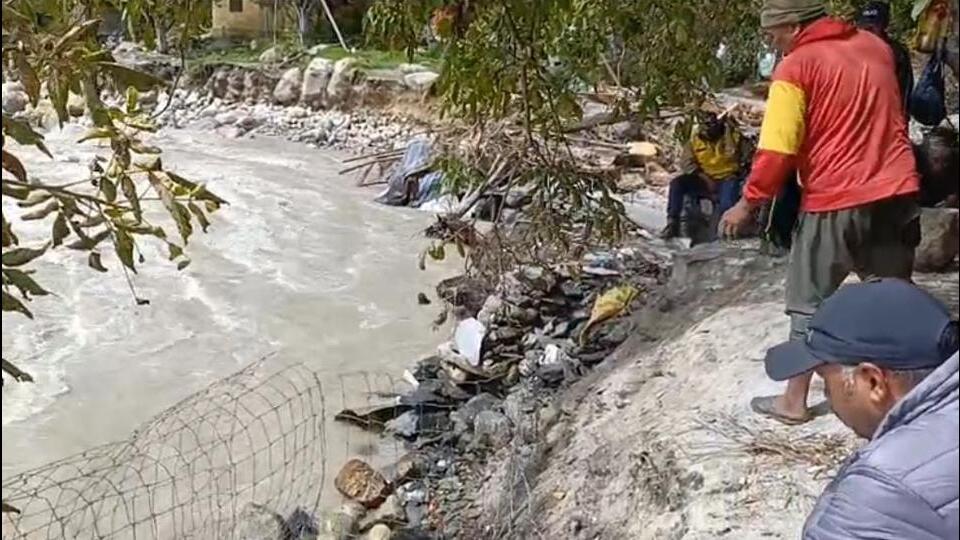
Water levels at a temporary lake formed in the upper reaches of Harsil following the Dharali flash flood receded by 1 to 1.5 metres on Thursday after manual channelisation carried out by irrigation department teams. “Embankments were being strengthened to protect nearby habitations and apple orchards, which are central to the local economy. Marshy conditions due to fine silt deposits are hampering the use of Army-provided machines. We are waiting for road access to improve so that more equipment can be deployed to drain the lake,” executive engineer of irrigation department Sachin Singhal said.
Also read: CM Dhami aerial surveys Uttarkashi as landslides kills 2, injures 2, disrupts yatra
Residents in Harsil, heavily dependent on apple farming, expressed concern about transporting their crop, which should be ready by month-end. “The Harsil apple is renowned nationwide. If roads are not restored quickly, our produce worth several crores will be at risk,” local apple farmer Himanshu Singh said.
The Border Roads Organisation (BRO) has mobilised four loaders, two JCBs, four Poclains, four tippers, and 100 workers to construct a temporary ramp over a 350 metre debris field at Dharali, restoring limited two-way traffic.
In Tehri district, 25 roads remained blocked by landslides. District magistrate Nitika Khandelwal inspected disaster-hit areas where residents reported widespread damage to homes, farmland, and water pipelines.
Chandra Prakash, a resident of Daukala Tok, said that several houses are at risk of collapse. Shivsharan, a resident from Muldhar, said, “Many homes have been damaged by mud debris, roads are blocked, and water supply is disrupted.”
Also read: Studies show frequency of cloudbursts increasing
Khandelwal directed Jal Sansthan officials to ensure tanker-based drinking water supply to affected villages. She also ordered immediate ration kit distribution to families hit by the disaster.
According to the state emergency control, Uttarakhand recorded 15.1 mm of rainfall in the 24 hours till 8:30 am Thursday—47% above normal. Champawat received the heaviest showers at 51.6 mm, 500% above normal, followed by Bageshwar at 42.2 mm, 486% above normal. Nainital (30.5 mm), Dehradun (21.4 mm), Haridwar (13.8 mm), and Chamoli (12.3 mm) also saw significant rain. Other districts reported moderate rainfall, with Pithoragarh recording the lowest at 2.1 mm.
The IMD has issued an orange alert for heavy to very heavy rainfall in Bageshwar and Champawat on Friday, warning of extremely intense spells at isolated spots. Heavy showers are also likely across hilly districts and Udham Singh Nagar. On Saturday, Dehradun, Bageshwar, and Pithoragarh face an orange alert, with thunderstorms and lightning predicted.
Officials have urged pilgrims and tourists to remain cautious, warning of possible landslides, flash floods, and travel delays. The state disaster response force (SDRF) and local police have been instructed to remain on high alert, with continuous monitoring of vulnerable zones along highways.