A nondescript stretch of road that disappears into a dirt track and a thick canopy of forests in the heart of Chhattisgarh’s red corridor is at the centre of a bruising years-long conflict between the government and Maoist rebels.
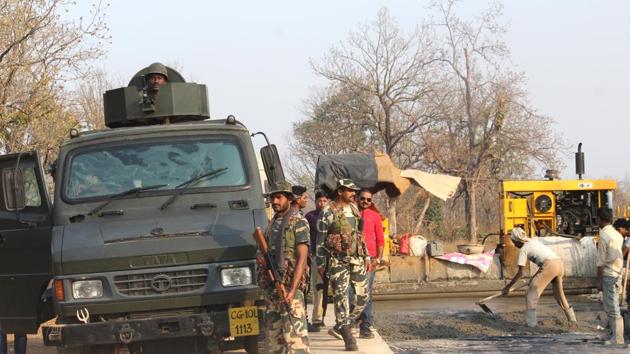
The insurgents control the desperately poor region that has seen little government intervention or development in decades, and have struck security forces twice in two months to stop construction.
In March, suspected Maoist rebels ambushed a road-opening party of the Central Reserve Police Force (CRPF) and killed 12.
On Monday, the militants struck again, killing 25 in one of the worst attack on the force in seven years.
The midday attack, which occurred between the Burkapal-Chintagufa area in the Maoist hotbed of Bastar, is the worst in seven years. In 2010, rebels killed 75 CRPF troopers in the same region.
Monday’s victims were part of a 99-strong team providing security to workers building the road.
The government says the increasing intensity of violence indicates one thing: That the rebels don’t want any road links to pierce their stronghold of Sukma. For the rebels, the roads mean quick access for government troops into their heartland, and cancelling their turf advantage of hostile terrain and guerrilla warfare.
{{/usCountry}}The government says the increasing intensity of violence indicates one thing: That the rebels don’t want any road links to pierce their stronghold of Sukma. For the rebels, the roads mean quick access for government troops into their heartland, and cancelling their turf advantage of hostile terrain and guerrilla warfare.
{{/usCountry}}The government knows this and, hence, has an ambitious plan for a pincer grip on the rebels.
The state is building two roads, Injiram-Bheji and Dornapal – Jagargonda, that will connect National Highway 30 and state capital Raipur with the remote, rebel-held areas. Construction of the roads began roughly a decade ago but has progressed at a snail’s pace with contractors unwilling to risk working in a region littered with land mines and booby traps.
Rebels targeted the Injiram-Bheji road in its March 11 attack. On Monday, it focused on stalling the Dornapal – Jagargonda stretch.
The roads are supposed to meet each other deep inside Maoist territory, a nightmare scenario for the rebels who are far outnumbered by government forces. Moreover, it would enable the state administration to bring in schools, hospitals and ancillary development to wean away local villagers from the rebels.
When HT spoke to senior officials after the March 11 attack, most of them appeared certain that the roads would break the back of insurgency in the region.
“Security forces will move with ease in the area after this road is built and this is troubling the Maoists. We are entering their core through this road,” said DM Awasthi, special director general of police (anti-Maoist operations).
The attacks hurt construction work. More than 20 kilometres of the Injiram road is left while just seven of the 56-odd kilometers of the Jagargonda road has been built. But CRPF is defiant.
“Road to poora banega aur hum hi banvayienge…chahe dus nahin, bees shaheed ho jayen (The road will be built and we will build it… even if 20 are martyred),” CRPF assistant sub-inspector Pawan Kumar had told HT in March.
“Maoists are attacking us in frustration. Inka jungle raaj khatam karna hai iss road ko banaake (we have to end their lawless reign by building this road),” said Kumar. Less than a week after the March 11 strike, work on the road resumed.