
 E-Paper



Courts often wary of removing arbitrators, need dedicated forum: Justice BV Nagarathna
The judge also advocated for a mature legal system that supports a diverse and complementary ADR framework to deliver efficient solutions

 Prefer HTon Google


Supreme Court judge Justice BV Nagarathna on Saturday stressed the need for dedicated forum to examine complaints of misconduct, and said that courts are often reluctant to remove arbitrators, since they are former judges, chief justices, or people in higher positions.
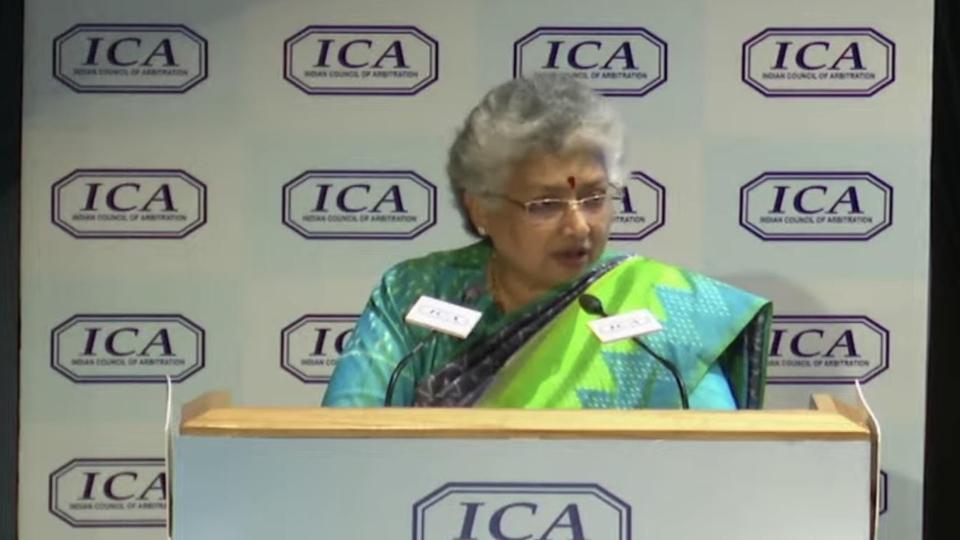
Speaking at the 5th edition of the Indian Council of Arbitration’s International Conference on “Arbitration in the Era of Globalisation”, during the technical session titled “Navigating the ADR Quagmire: Harmonising Arbitration and Mediation”, the judge emphasised that arbitrators and mediators must remain conscious that, as alternatives to the court system, they are required to maintain high standards of integrity and fairness throughout the process.
“We have many advantages of it, but one of the disadvantages is this conduct of the arbitrators or mediators, and sometimes to the extent of saying that there is a lack of trust, a bias, or a misconduct. And it’s very difficult to change the arbitrator on that score. Therefore, by submission is, that the arbitrators and mediators...have within them the sensitisation that they are an alternative to the court system. That means they are as equal to adjudication, but it is not an adjudication, it is an ADR (alternative dispute resolution) mechanism. The standards of the arbitrators and mediators must be very high, and they have to maintain that throughout the proceeding, and there can never be any reflection of a bias...,” the judge said.
Also Read:Mediation no longer confined to halls, elite clubs, but entered villages and streets: CJI Surya Kant
She added, “Of course, there is no forum as such where a misconduct of an arbitrator is complained against except before a court, and the courts are very wary of changing an arbitrator as such, because many of the arbitrators...are former judges, chief justices, and with the higher positions that they have already held...but the thing is, it all depends on the standard, the arbitrators and mediators would have to meet.”
In her speech, the judge also advocated for a mature legal system that supports a diverse and complementary ADR framework, in which arbitration, mediation, and negotiation function together to deliver efficient and context-sensitive solutions.
The judge added, “But even as ADR has transformed the landscape of dispute resolution, the practical challenges are also worth acknowledging. Questions of enforceability of awards, delays, and rising costs in arbitration, the need for well-trained arbitrators, mistrust in the arbitrators and mediators, and continuing adversarial mindset of parties, and sometimes their counsel, all remind us that ADR must constantly evolve to remain effective and credible.”
Also Read:Arbitration, mediation as integral to modern justice system as litigation: Justice Nagarathna
Justice Nagarathna pointed out that it is not a single ideal method, but a “spectrum of approaches” that could be applied to a case, each suited to different contexts and stages of dispute resolution.
“The challenge lies in ensuring that these mechanisms are not reduced to mere formalities but are structured and implemented in a manner that preserves their core objectives of efficiency, fairness, and finality,” she said.
The judge also raised concerns over the delay in notifying key provisions of the Mediation Act, 2023, including the constitution of the Mediation Council of India, observing that the inaction has compelled reliance on diverse mediation centres across various states and union territories.
“In India, the enactment of the Mediation Act 2023 represents an important legislative step in that direction, seeking to institutionalise mediation and strengthen its role in commercial dispute resolution. But I must confess that it really needs to take off as such, while we have these structure in the form of a legislation...implementation of the said act as many provisions are not yet notified. The Mediation Council of India is not yet constituted, and therefore, we have to rely upon diversified centers of mediation in the various states and union territories,” she said.


