
 E-Paper



'Urdu mein Tiranga pehna': Congress' 'Ireland' dig at PM Modi's Independence Day pocket square
While the colours of the pocket square were of the tri-colour, they were in the wrong sequence, hence the Congress' 'Ireland' dig.

 Prefer HTon Google


Prime Minister Narendra Modi's outfit for India's 80th Independence Day celebrations from the Red Fort has sparked a reaction from Congress. Taking note of the prime minister's pocket-square, Pawan Khera stated on Saturday that it seems PM Modi "was celebrating Ireland's independence as opposed to India."
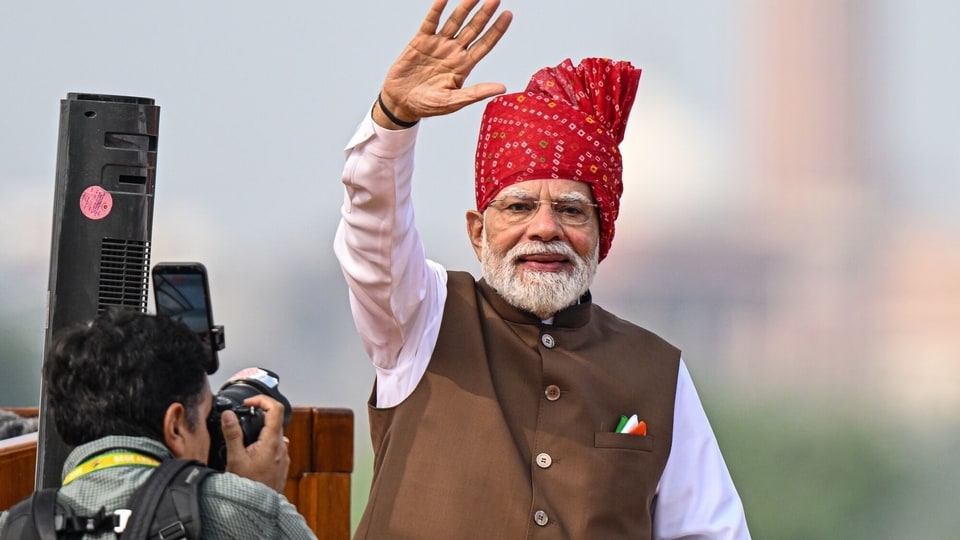
In a post on X, the Congress MP shared a video of the pocket square and said: "Lagta hai sahib ne Urdu mein Tiranga pehna hai. Ya phir Bharat ki jagah Ireland ka Independence Day mana rahay hain."
Deep Dive

Surpiya Shrinate also doubled down on the Congress' swipe and mocked the wearing of the pocket square by the prime minister.
For the Independence Day event, Modi paired his white kurta and chocolate brown vest with the traditional turban, common in Rajasthani and Gujarati culture. He also sported three pocket squares in green, white and saffron.
While the colours of the pocket square were of the tri-colour, they were not in the order of the national flag, hence the Congress' 'Ireland' dig.
Also Read | What is PM Modi's 'Saptadhara' plan to achieve Viksit Bharat: Explained
The Irish flag has three colours - green, white, and saffron from left to right, similar to the pattern seen in PM Modi's pocket squares.
PM Modi's I-Day outfit
For his 13th address from the Red Fort, the prime minister was seen in a classic off-white kurta-pyjama and a brown sleeveless jacket.
Modi's headgear drew attention for its vibrant craftsmanship and cultural resonance. The traditional bandhani or tie-and-dye safa featured a deep red base adorned with fine white and yellow patterned dots, wrapped intricately with a classic long tail (palla) flowing over his shoulder.
The prime minister's signature Independence Day turbans have remained one of the most anticipated visual highlights of the Red Fort ceremony since 2014, when he set the precedent with a bright red bandhej turban complete with a contrasting green tail.
In the past 12 years, the prime minister has shifted to bright yellows in multi-hued bandhani and golden threads; saffron tones; a white turban with saffron and green stripes and bandhani prints blending yellow, green, orange, and red hues.
However, the 2026 style saw a return of the prime minister's very first address at the Red Fort.


