
 E-Paper





Follow the latest breaking news, major developments and agenda-setting stories from India and around the world with the newsdesk at Hindustan Times. Operating round the clock, the desk brings together experienced editors, reporters and correspondents to deliver fast, accurate and contextual reporting across subjects that influence public policy, governance, business, society and international affairs. The HT News Desk covers politics, elections, government policies, the economy, business and markets, science and technology, the environment, law and order, infrastructure, education, climate issues and geopolitics, while closely tracking developments across states, institutions and global capitals. The team also leads coverage of major breaking news events, policy announcements, court proceedings, natural disasters, public emergencies and significant international developments. Reports published by the newsdesk are based on information gathered from reporters on the ground, official statements, government agencies, court records, regulatory filings, recognised institutions and other authoritative sources. Stories undergo editorial scrutiny and verification processes to ensure accuracy, fairness and relevance, and are updated as events evolve and additional information becomes available. Whether covering a key political decision in New Delhi, an economic policy shift affecting millions, a landmark court ruling or a major global event, the HT News Desk aims to provide readers with reliable, fact-based journalism that delivers not only the latest developments but also the context and analysis needed to understand their wider implications.
Dalit women’s group bats for rights at United Nations forum
The All India Dalit Mahila Adhikar Manch (AIDMAM), a collective of Dalit women and girls, which works as an advocacy forum, released a report —Voices Against Caste Impunity: Narratives of Dalit Women — and showed a short documentary, #DalitWomenFight.


In a first, a Dalit women’s collective organised a side event and offered testimonies of caste-based gender violence, at the 38th session of the United Nations Human Rights Council, currently under way in Geneva.
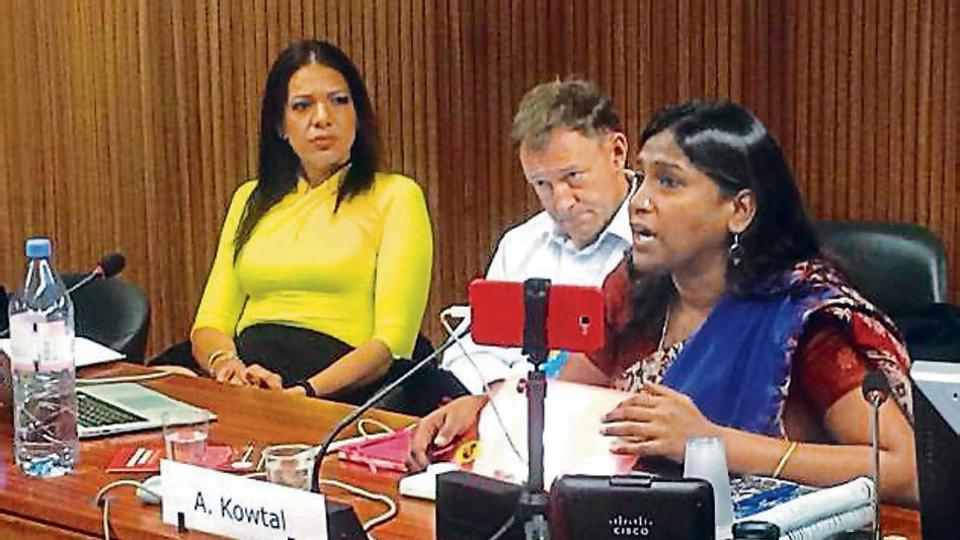
The All India Dalit Mahila Adhikar Manch (AIDMAM), a collective of Dalit women and girls, which works as an advocacy forum, released a report —Voices Against Caste Impunity: Narratives of Dalit Women — and showed a short documentary, #DalitWomenFight.
The film tells the story of a 17-year-old girl from a Scheduled Caste who was sexually assaulted and killed in Haryana in 2017. Her family is still awaiting compensation while one accused named in the FIR is yet to be jailed. This was one of the three testimonies presented by Asha Kotwal, AIDMAM general secretary, at the event.
The report quotes official data on caste-based gender violence and discrimination and puts it in context through several narratives of Dalit women and girls. The National Family Health Survey (4th round) shows that 33.2% women from the Scheduled Castes experience physical violence since the age of 15 compared to 19.7% in the ‘Other’ category. In the past decade (2007-2017), there has been a 66% growth in crimes against Dalits, as per the National Crime Records Bureau.
The report states, “It is important to remember that these figures should not be taken at face value. The number of cases registered is a fraction of the actual number of crimes that take place. In many instances, these crimes do not get reported due to non-cooperative police and judicial machinery, shame and social stigma, and the fear of retaliation by the dominant caste groups.”
“Will the United Nations consider caste-based crimes as one of the most serious human rights crisis?” Kotwal asked. “Caste-based discrimination is a global issue, but India should take stronger initiatives as it has the largest population of Dalit people,” she said.
A panel of experts, including Rita Izsák-Ndiaye, former special rapporteur of the United Human Rights Council for minority issues; Dubravka Simonovic, the UN special rapporteur on violence against women; John Fisher, Geneva director of Human Rights Watch; and Vrinda Grover, advocate with the Supreme Court of India, spoke of the ways in which Dalits are denied justice in India.
“Crimes are committed against Dalit women and girls in India with impunity because there have been no consequences for perpetrators,” said Grover, who joined the discussion over Skype.
In 2016, Izsák wrote a report on caste-based violence faced by an estimated 250 million people worldwide, concentrated in South Asia. The report defined caste-based discrimination as that based on descent, labour stratification, forced endogamy, and the practice of untouchability. However, India refused to accept the report, stating that caste groups cannot be termed as minority.
The UNHRC session, which began on June 18, will end on July 6.


