
 E-Paper



Data-driven governance key to Viksit Bharat, administrative data a strategic national asset: PM's principal secretary
He credited reforms introduced in last 5 years to modernise the statistical ecosystem through new surveys, updated macroeconomic indicators

 Prefer HTon Google


Principal Secretary to the Prime Minister Dr. P.K. Mishra on Monday said administrative data should be treated as a "strategic national asset" to strengthen evidence-based policymaking, improve governance and support India's vision of becoming a developed nation by 2047.
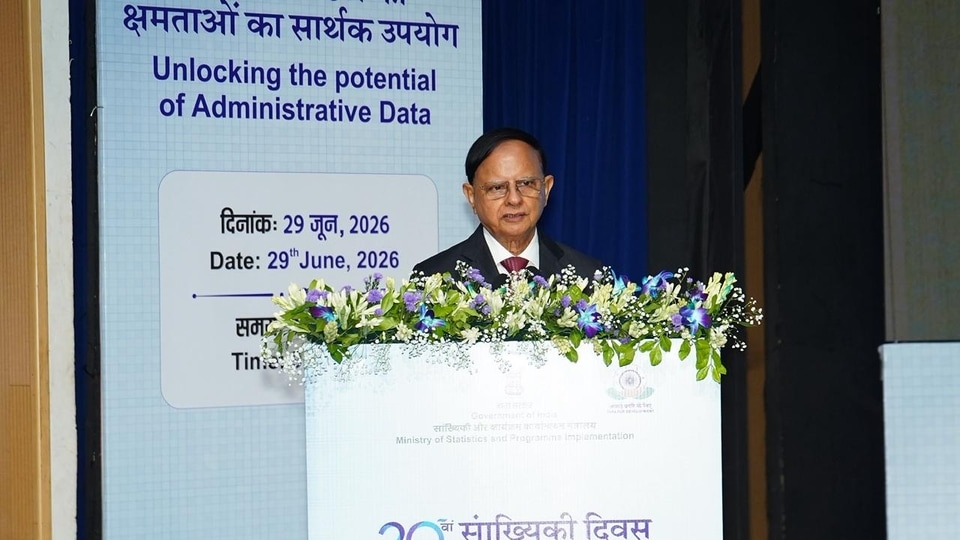
Speaking as the chief guest at the 20th Statistics Day celebrations, Dr. Mishra congratulated the Ministry of Statistics and Programme Implementation (MoSPI) on releasing its Vision Document 2026–31, the Progress Report on the Sustainable Development Goals and the country's first city-level estimates of labour markets and informal enterprises. He also felicitated Professor Arup Bose with the Sukhatme National Award.
Highlighting Prime Minister Narendra Modi's vision of data-driven governance, he said, "This year's Statistics Day theme, 'Unlocking the Potential of Administrative Data’ reflects a transformative step towards strengthening India's statistical ecosystem and evidence-based policymaking" and described it as highly relevant.
Recalling India's pioneering role in statistics, he said the country built one of the world's finest survey-based statistical systems in the 1950s, with the National Sample Survey becoming a globally recognised model. He also paid tribute to renowned statisticians including P.C. Mahalanobis, C.R. Rao and P.V. Sukhatme for their lasting contributions to statistical science.
He noted that India's statistical system had, over time, faced challenges including outdated datasets, delays in data dissemination, fragmented architecture and uneven data quality. He said these concerns prompted a comprehensive reform exercise led by MoSPI, which accepted 216 recommendations for time-bound implementation.
Dr Mishra credited reforms introduced between 2020 and 2025 with modernising the statistical ecosystem through new surveys, updated macroeconomic indicators, improved dissemination and procedural changes. He said the Prime Minister's Office played the role of a catalyst, enabling MoSPI to strengthen the country's statistical framework.
Emphasising this year's theme, he said, "Administrative data should be treated as a strategic national asset, enabling better programme design, targeted service delivery and timely decision-making." He called for interoperable data ecosystems across ministries, states and Union Territories while ensuring the highest standards of privacy, security and confidentiality.
He said MoSPI has modernised surveys through Computer-Assisted Personal Interviewing (CAPI), introduced district-level estimates and high-frequency surveys, and reduced the time taken to release official statistics. Initiatives such as the National Metadata Structure 2.0, Open APIs, e-Sankhyiki, GoIStats, PAIMANA and e-SAKSHI are improving accessibility and interoperability.
Looking ahead, Dr. Mishra said, "Administrative data can become a powerful national asset only when backed by robust standards of quality, privacy and transparency," adding that while Artificial Intelligence offers transformative opportunities, its adoption must be supported by governance frameworks that ensure accountability, explainability and the integrity of official statistics.


