Some 200 years ago, the prosperous Paliwal Brahmin community abandoned their villages near Jaisalmer in western Rajasthan on a single night. Ever since, the ruins of the villages, considered “haunted”, have been closed to tourists after sunset.
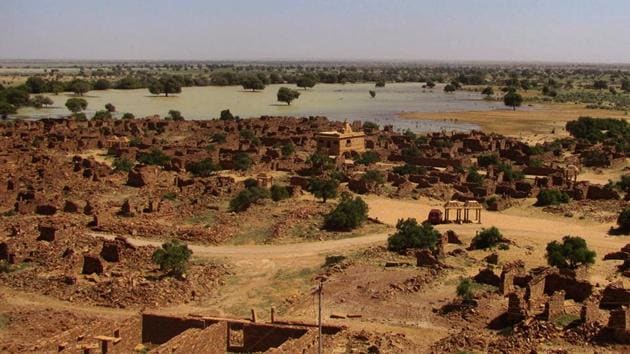
There is no official record of the mass evacuation in the early 19th century, but according to popular folklore, the inhabitants fled fearing persecution by a Salim Singh, a minister of a princely state.
Centuries later, a four-member team of geologists examining the collapsed roofs, fallen joists, lintels and pillars in the Kuldhara and Khabha villages suggests the desolate houses are the result of an earthquake that flattened 84 villages.
The idea is based on evidence of recent tectonic activity along major faults in the region — covering Jaisalmer and adjoining areas that make the region susceptible to seismic activity.
“Archaeologists must excavate the area. Fault lines and skeletons are bound to be seen,” said AB Roy, geologist, lead investigator, and fellow of the Indian National Academy of Sciences.
{{/usCountry}}“Archaeologists must excavate the area. Fault lines and skeletons are bound to be seen,” said AB Roy, geologist, lead investigator, and fellow of the Indian National Academy of Sciences.
{{/usCountry}}Around 18km from Jaisalmer, Paliwal is a protected monument under the Archaeological Survey of India. In Khabha, renovations are restricted to temples and ‘chhatris’, or canopies that usually demarcate funeral sites.
According to researchers, the nature of destruction at Paliwal can be compared to the earthquake-affected areas of Latur in Maharashtra and Bhuj in Gujarat.
Inspecting the ‘ghost’ villages, the team found striking similarities to the remains of Harappan cities such as Mohenjodaro, Dholavira and Lothal. “It is difficult to attribute such massive destruction to the normal processes of weathering and erosion. Neither can it be attributed to social compulsions that led the villagers to abandon the area overnight, without a trace of their whereabouts,” said Roy.
“Drawing parallels to the destruction in Harappan cities led us to consider evidence of archeao-seismicity — the study of ancient earthquakes — to match descriptions recorded worldwide.”
The team evaluated the terrain by looking at topographic maps and satellite images of the region. A seismotectonic map was compiled, with data on faults, lineaments and earthquake epicentres recorded between 1985 and 1991 from the Geological Survey of India.
“We superimposed the locations of a few prominent Paliwal villages. What we found were clusters of villages close to active faults and epicentres. General country rocks in the region include different types of limestone belonging to the Jurassic age,” said Roy.
He added that active fault lines also disrupted the drainage system by offsetting the flow of stream channels. This resulted in saline lakes being formed.
The team, however, suggests earthquakes in Jaisalmer were not of ‘very severe’ intensity. The Paliwal houses collapsed owing to poor construction techniques, and the minimal use of cementing material. “Brick-like blocks were placed on top of each other to construct the walls. Roofs were covered by placing logs — held in place by small square or rectangular-shaped beams — supported by narrow-but-heavy limestone pillars,” stated the paper.
The geologists said the destruction of life and property caused by collapse is likely to have been “quite substantial and virtually total”.
“Only a few may have escaped the fatality. Since the event of destruction, nobody lived in these villages presumably owing to the stories of mysterious deaths,” the paper read.
Till date, the Paliwal community does not celebrate ‘rakshabandhan’. It is instead observed as ‘black day’ as they believe the villagers were forced to flee and abandon their homes on this day.
An unwritten history
The surname Paliwal means a person from Pali (Pali+wal), a district in Rajasthan. Pali was a small kingdom in the Thar desert, and it’s believed that inhabitants from this district migrated to different parts during the Mughal period
In the 13th century, they migrated to Kuldhara (then state of Jaisalmer) to escape what they viewed as the tyrannical behaviour if the king of Pali (source: http://www.paliwalsangh.org.in/)
The Paliwal community, with houses spread over 84 villages, lived in Jaisalmer since the late 13th century. Once prosperous, the Paliwal Brahmins are believed to have evacuated the village en masse overnight in the early 19th century.
Popular folklore suggests the villagers abandoned their homes as they were being persecuted by a man identified as Salim Singh, a minister of a princely state.
There is no official record of this, but it believed Singh wanted to marry the village chief’s daughter. He set a deadline of two days, failing which he would increase taxes on the villagers. Refusing to give the girl to the minister, but fearing him, the village is believed to have fled through a tunnel unnoticed. As the mass evacuation took place on Rakshabandhan, the Paliwal community observes the festival as ‘black day’.