E-Paper



Number Theory: Decoding the push for a global minimum tax
The Council of the European Union approved a directive to introduce a 15% minimum levy on large multinational businesses to eliminate tax avoidance and end a race to the bottom in corporate taxation on December 15.

 Prefer HTon Google


The Council of the European Union approved a directive to introduce a 15% minimum levy on large multinational businesses to eliminate tax avoidance and end a race to the bottom in corporate taxation on December 15. This EU deal is expected to trigger a “domino effect” for a global minimum tax deal, reported a Financial Times article on December 19 (https://on.ft.com/3FC2izf). What is the need for a global minimum tax on multinationals? How much taxes do they evade? A working paper published in November 2022 by the United Nations University World Institute for Development Economics Research (UNU-WIDER) can answer these questions. Here are four things it shows.

Global corporate profits rising as share of global income
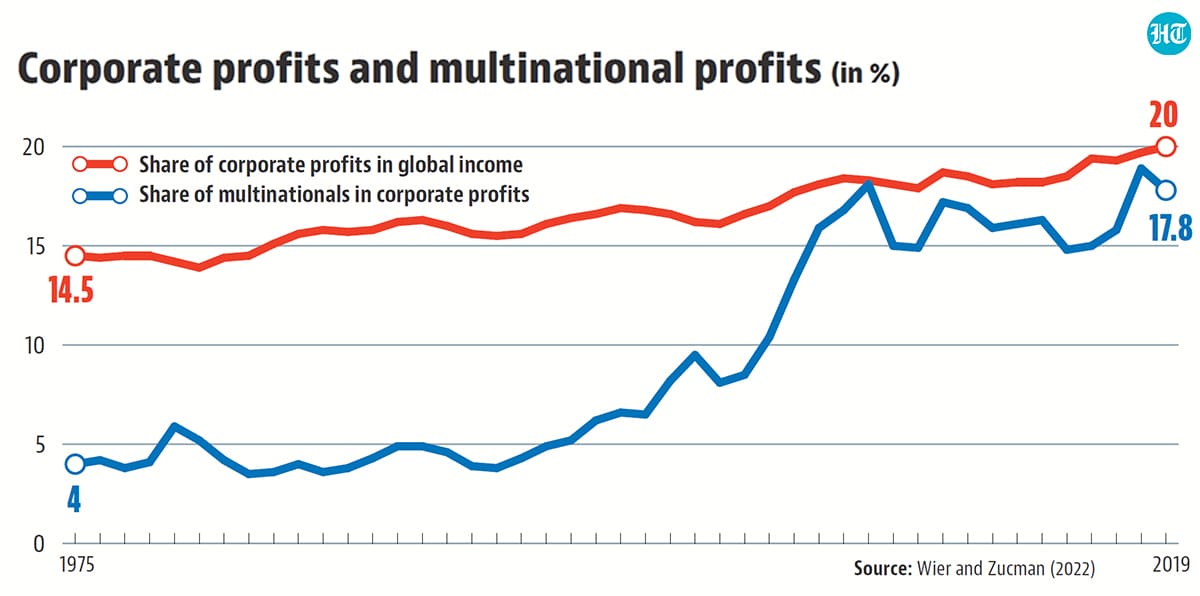
Why is there attention on taxing big businesses directly and appropriately? The UNU-WIDER paper shows that a growing fraction of global economic activity now takes place in the corporate sector rather than in non-corporate businesses. The share of corporate profits in global GDP was 20% in 2019, up from 16.2% in 2000 and 14.5% in 1975. There is attention on taxing this profit appropriately because the tax revenues from corporate profits have not increased proportionately. The effective global corporate income tax rate has in fact decreased from 23% in 1975 to 17% in 2019.
With the use of new macroeconomic data, the Foreign Affiliate Trade Statistics (FATS), authors also show that multinational companies are driving the growth in profits. The share of such companies in corporate profits has increased from 4% in 1975 to 18% in 2019, with faster growth in this share in this century. To be sure, FATS data is not available for all countries in the world. UNU-WIDER research analysed 86 countries, which constitute 92% of global economic activity and more than 70% of global population.
Structure of multinationals allows them to avoid taxes on profits
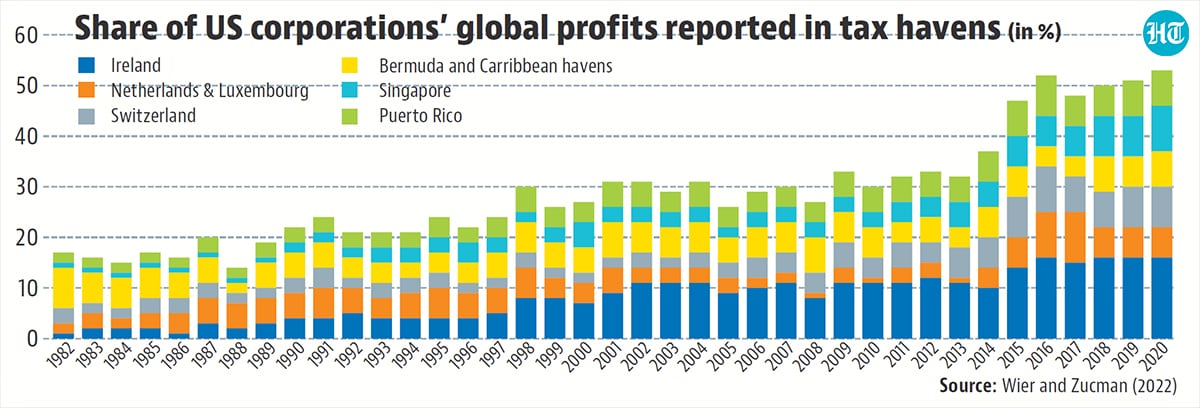
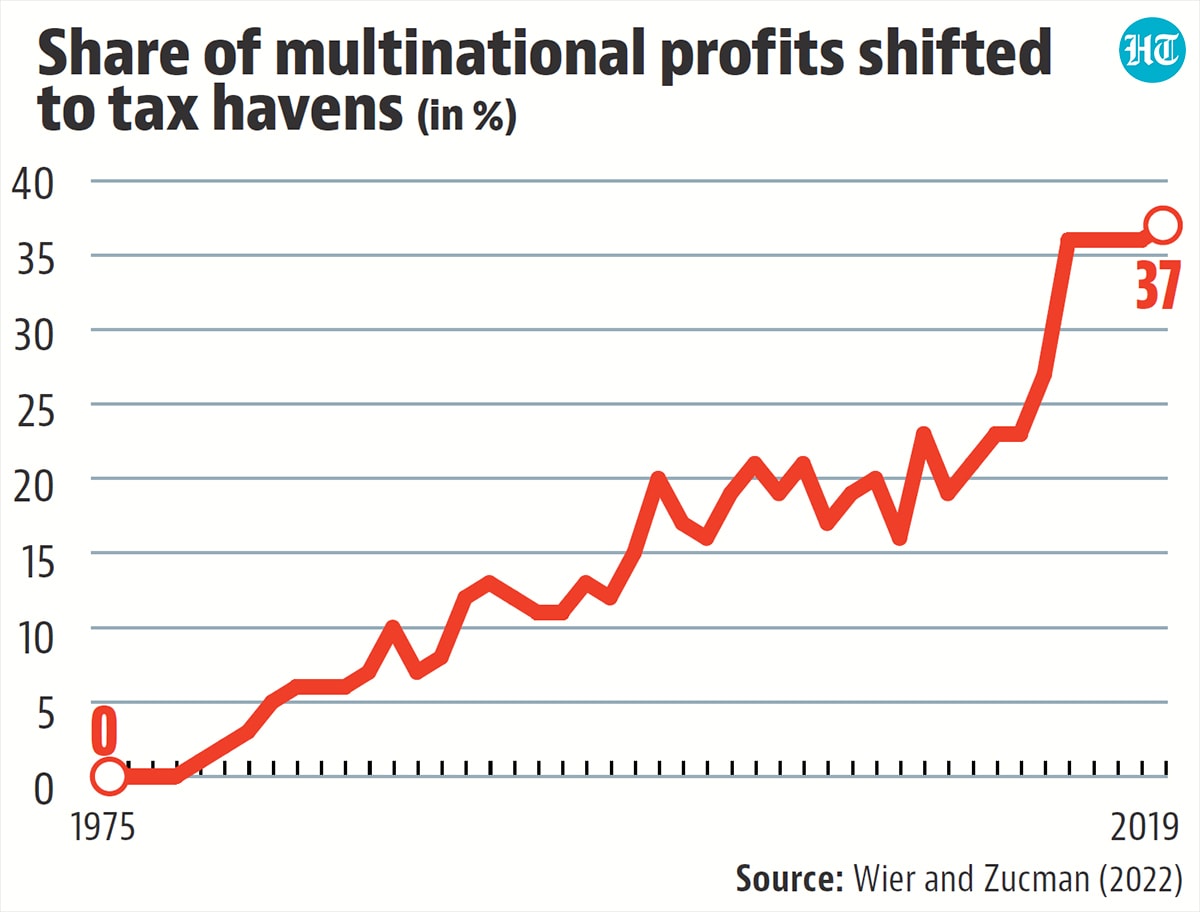
Multinationals driving the growth in corporate profits presents a problem for tax revenues. As the name suggests, such companies can have business operations in multiple countries. This allows them to avoid taxes by shifting their profits to low-tax jurisdictions. For example, according to a 2018 Bloomberg story, Google Alphabet made $19.2 billion in revenues in 2016 in Bermuda, a small island in the Atlantic where it doesn’t own any tangible assets, hardly employs any workers, and where the corporate tax rate is zero (https://bloom.bg/3YLLbUz). The UNU-WIDER research shows that a big increase in such profit shifting over time. The share of multinational profits booked in tax havens has grown from less than 2% in 1970s to 37.4% in 2019. For the purpose of their research, the authors defined tax havens as those nations in which the foreign firms have higher profits-to-wage ratio than the local firms. They identified 11 such countries -- Belgium, Ireland, Luxembourg, Malta, Netherlands, Caribbean, Bermuda, Singapore, Puerto Rico, Hong Kong, and Switzerland.
Which means the world economy now loses a greater share of corporate tax revenue
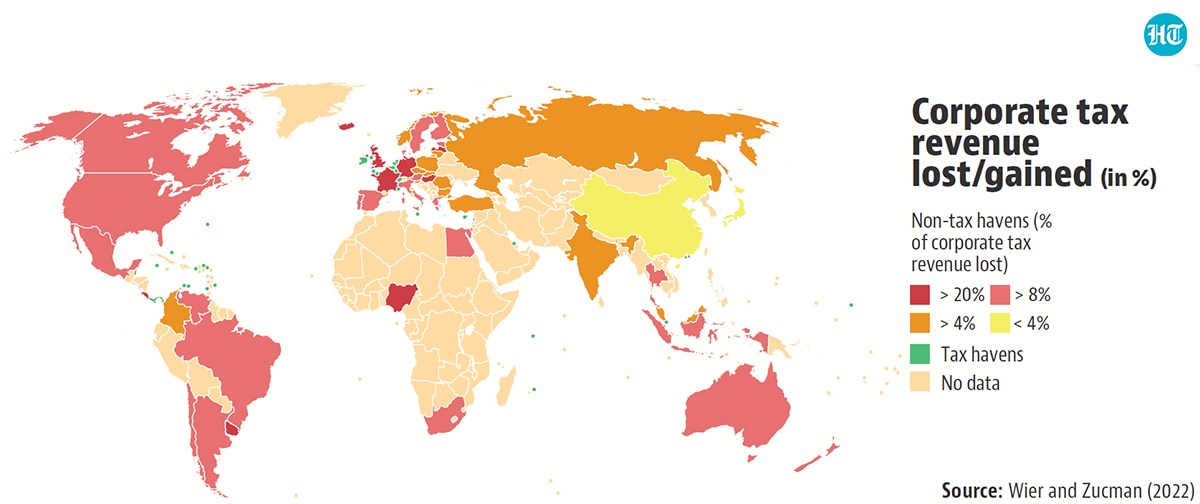
When read together, the two points made above (that multinationals are driving profit growth and avoiding taxes on those profits) suggest an obvious result: an increase in tax revenues lost. The share of global corporate tax revenue lost due to profit shifting has increased from 0.1% in 1966 to 10% in 2019. Among developed countries, Latvia lost the largest share of its corporate tax collections to tax havens at 144% in 2019, followed by Britain at 32%, and Germany at 29%. This number for India has remained relatively steady -- 6.3% in 2019 compared to 5% in 2017 and 8% in 2015.
Impact of tax evasion reforms
To be sure, economies have attempted to fix the issue of tax evasion in the past, too. In 2015, the Organisation of Economic Co-operation and Development (OECD) enacted the Base Erosion and Profit Shifting (BEPS) process to reduce the possibility of tax evasion due to a mismatch between different countries’ tax systems. In 2017, the US implemented its Tax Cuts and Jobs Act, reducing corporate tax rate from 35% to 21%, along with new measures to reduce profit shifting by US multinationals. However, the authors of UNU-WIDER paper found no discernible decline in global profit shifting or in profit shifting by US multinationals (which accounted for about half of global profit shifting) relative to 2015.
“It is possible that absent BEPS and the Tax Cuts and Jobs Act profit shifting would have kept increasing…. However, their effect seems, so far, to have been insufficient to lead to a reduction in the global amount of profit shifted offshore”, stated the authors.