A Delhi court has denied bail to two men who allegedly jumped into the Lok Sabha chamber and released coloured smoke canisters during Parliament proceedings in December 2023, observing that their actions had “spread terror” among lawmakers and visitors and threatened the country’s “sovereignty and integrity”.
Rejecting the second bail applications of Manoranjan D and Sagar Sharma, Special Judge Kiran Bansal of the Rouse Avenue courts, in an order passed on Friday, said there were reasonable grounds to believe that the allegations against the two men were prima facie true, attracting the stringent bail restrictions under the Unlawful Activities (Prevention) Act (UAPA).
“The allegations against the accused persons are grave and serious, as their acts had resulted into disrupting the Parliamentary proceedings and had threatened the sovereignty and integrity of India,” the court observed.
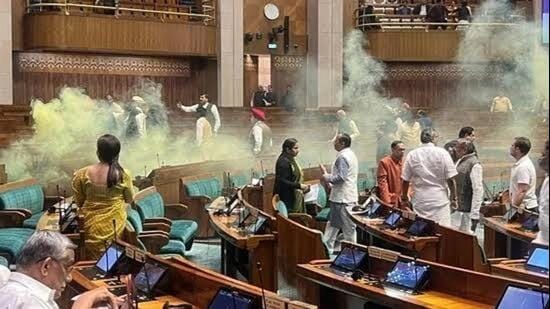
According to the prosecution, on December 13, 2023, at around 1 pm, when the proceedings of the Lok Sabha were being telecast live, Sharma and Manoranjan jumped from public gallery number four into the main chamber.
Sharma allegedly moved towards the Well of the House by jumping over vacant seats before taking out a smoke canister concealed in his shoe and releasing its contents. Manoranjan also allegedly opened a coloured smoke canister inside the chamber. Yellow smoke engulfed parts of the House, prompting MPs and Parliament staff to intervene and apprehend the two men.
{{/usCountry}}Sharma allegedly moved towards the Well of the House by jumping over vacant seats before taking out a smoke canister concealed in his shoe and releasing its contents. Manoranjan also allegedly opened a coloured smoke canister inside the chamber. Yellow smoke engulfed parts of the House, prompting MPs and Parliament staff to intervene and apprehend the two men.
{{/usCountry}}The disruption forced an immediate adjournment of the Lok Sabha proceedings. Simultaneously, outside Parliament, the other two men named in the case, Ranoliya and Amol Shinde, allegedly released similar coloured smoke canisters and raised slogans while throwing pamphlets. They were subsequently apprehended.
Two other men named in the case, Lalit Jha and Mahesh Kumawat, were subsequently arrested, and a First Information Report (FIR) was lodged by the Special Cell under multiple sections of the UAPA, the provision relating to criminal conspiracy and other related offences.
The court, in its order, noted that the incident had caused widespread panic inside the House, with the actions of the two men inflicting terror on those present in the Lok Sabha. “The acts of the accused persons had inflicted terror in the minds of members and the visitors in the Lok Sabha,” it said, adding that images and scenes from Parliament had been broadcast across news channels immediately after the incident.
The court also rejected the men’s argument that they should be granted bail on grounds of parity with the other two people named in the case, Neelam Ranoliya and Mahesh Kumawat, who were granted relief by the Delhi high court in July 2025. It pointed out that the roles attributed to the two men were substantially different from those of the other two.
“However, the present two accused persons had entered the main Parliament and had jumped from the public gallery inside the Lok Sabha main Hall. The smoke canisters were concealed in the shoes and the Parliament proceedings were disrupted due to the act of the two accused persons,” the court said.
Explaining the distinction in their roles, the court noted that Ranoliya had remained outside Parliament and refused to enter the building, while Kumawat was not even in Delhi on the day of the incident and had not attended the group’s last two meetings.
The court also declined to accept the defence argument that prolonged incarceration and the likely delay in the trial warranted their release.
It said that bail under Section 43D(5) of the UAPA could not be granted merely because of delays in proceedings and that the case was already pending a decision on framing of charges.
The two men have been in custody since December 14, 2023. Their lawyers argued that the investigation was complete, with the main chargesheet and four supplementary chargesheets already filed, and that their continued incarceration would amount to an indefinite deprivation of personal liberty.
They also contended that the alleged conduct did not constitute a terrorist act, that no toxic substance had been used and that there was no material to suggest an intention to cause damage to life or property.
Rejecting these submissions, the court held that the material collected during the investigation, including witness statements and documentary evidence, satisfied the statutory threshold for denying bail under the anti-terror law.
The investigation, as detailed in the prosecution’s reply to the bail applications, alleged that the incident was the culmination of a conspiracy that had been planned over several months, with Manoranjan and Sharma playing central roles.
Investigators claimed that Manoranjan had begun exploring the possibility of targeting Parliament as early as 2022. A witness, Vaidyanath, allegedly told investigators that Manoranjan had contacted him that year to enquire about Parliament’s security arrangements.
The prosecution further alleged that Manoranjan and Sharma used social media platforms to recruit associates and organised meetings in Mysuru and Gurugram, where they discussed plans to disrupt Parliament to attract national and international media attention.
During one such meeting in February 2022, Manoranjan allegedly proposed creating chaos in Parliament to draw attention and generate funds, according to the prosecution. He also reportedly showed the group a video of a 2018 incident in Kosovo’s Parliament, where tear gas was used to disrupt proceedings, and drew a rough sketch of the Indian Parliament, the police told the court.
The prosecution claimed that the group subsequently decided to use smoke canisters concealed inside specially modified sports shoes to gain entry into the Parliament building. Sharma allegedly procured smoke canisters in July 2023, while the group purchased shoes in August that year and carved cavities into their soles to conceal the canisters.
Investigators also alleged that Manoranjan visited Parliament on July 25, 2023, to assess security arrangements and carry out reconnaissance. The group allegedly decided to execute the plan on December 13, coinciding with the anniversary of the 2001 Parliament attack, when the House was expected to observe a moment of silence in memory of those killed, police said.
The court took note of the prosecution’s claim that the men were aware of a threat issued by designated terrorist Gurpatwant Singh Pannu regarding an attack on Parliament on December 13, 2023, and deliberately chose the same date to execute their plan.
The judge also highlighted allegations that the men had taken steps to destroy evidence before the incident, including erasing data from their mobile phones, destroying SIM cards and handing over their devices to Lalit Jha, who was allegedly tasked with burning them and recording and circulating videos of the incident.
“The fact that all the accused persons have erased all the data before the incident and had handed over their mobile phones alongwith SIM Cards to accused Lalit Jha who was assigned the task of destroying the mobile phones also, cannot be ignored,” the court observed.
The court also noted that witness statements indicated that meetings had been organised to discuss the alleged plan and that the men had intended to create a situation of terror and disrupt Parliament on the anniversary of the 2001 attack.