The Supreme Court said on Monday an emergent meeting of the Upper Yamuna River Board (UYRB) be held on June 5 so that the problem of water scarcity in Delhi is properly addressed. The Supreme Court was hearing a Delhi government plea seeking a direction to Haryana to release the surplus water provided by Himachal Pradesh to Delhi to mitigate its ongoing water crisis.
The court will hear Delhi's plea for additional water from Haryana on June 6 and has requested the minutes of the meeting and suggestions on the steps taken.
ALSO READ- Delhi’s water augmentation plans fail to take off
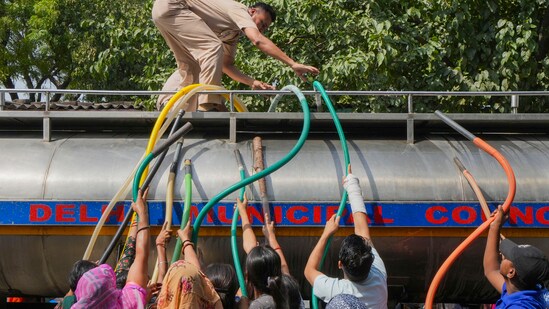
As India's capital faces a severe water shortage, many residents are waiting in long queues for water tankers. On May 31, the Delhi government approached the Supreme Court to request additional water from Haryana immediately.
ALSO READ- Delhi water crisis deepens, ₹2,000 fine for these activities | 8 points
The Delhi government said it filed the petition due to the acute water shortage caused by severe heat conditions in North India, especially in Delhi. The plea requested Haryana to "immediately and continuously release water at the Wazirabad barrage."
ALSO READ- Arvind Kejriwal's ‘appeal’ to BJP over acute water crisis in Delhi
{{/usCountry}}ALSO READ- Arvind Kejriwal's ‘appeal’ to BJP over acute water crisis in Delhi
{{/usCountry}}Delhi water minister Atishi said the heatwave has increased water demand while the water level in the Yamuna has decreased. She said the water level at the Wazirabad pond was 674.5 ft last year, but only 671 ft of water has been released despite multiple requests. This has affected all water treatment plants due to low water levels in the Wazirabad barrage. Atishi said that they have requested more water from the Haryana and UP governments.
ALSO READ- Delhi: Residents scramble with vessels after tanker amid water crisis| Video
In response to the crisis, the Delhi government announced on May 30 that a central control room would be set up to monitor the water supply across the city. The control room will be led by an IAS officer. Atishi also announced a helpline number, '1916', for residents to request water tankers.