E-Paper



Delhi, Gurugram flooded after another spell of rain
A sharp downpour on Sunday flooded key roads in Delhi and Gurugram, causing traffic chaos, flight diversions, and two child fatalities.

 Prefer HTon Google


A sharp downpour on Sunday brought Delhi and its neighbouring cities to their knees for the umpteenth time this monsoon, as key roads flooded, traffic came to a standstill, flights were diverted and two children were killed in incidents linked to the sudden showers, the quantum of which also deviated sharply from the Met department’s prediction after the agency’s latest inaccurate forecast this season.
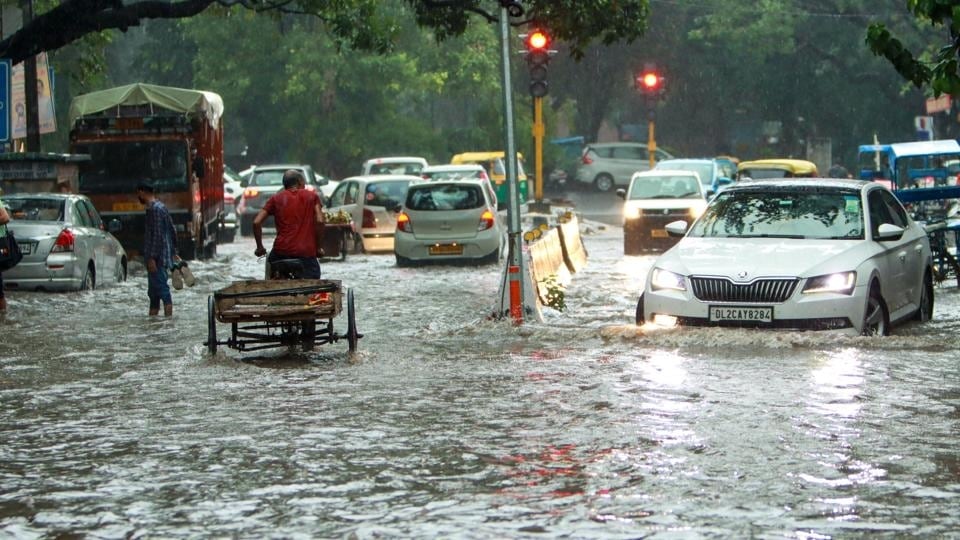
Local agencies and traffic police said neighbourhoods across Delhi and Gurugram were flooded, with vehicle breakdowns and uprooted trees only adding to the chaos in two cities which have struggled to keep their head above the water during an unpredictable monsoon, which has exposed the region’s fragile civic infrastructure.
The India Meteorological Department (IMD) on Saturday issued a “yellow alert” for Delhi and its surrounding regions, warning of “light to moderate rain”, which the agency defines as showers between 2.5mm and 64.4mm. The agency only upgraded this alert to “orange” at 9am on Sunday. By then, though, large swathes of Gurugram and several parts of Delhi were already inundated.
Also Read | Rain mayhem continues in Delhi, ‘yellow alert’ in place for the week
IMD classifies rainfall between 2.5mm and 15.5mm as “light”, between 15.6mm and 64.4mm as “moderate” and upwards of that as “heavy”.
Data from Gurugram’s automatic weather station (AWS) showed that the city received 20.5mm rain in the 24 hours till 8.30am on Sunday, much of it after 5.30am. The city then received another 80mm in the next nine hours, data from the same station showed, pushing the rain well past “moderate” and deep into the “heavy” zone.
The agency’s prediction also missed its mark in some parts of Delhi. For instance, Najafgarh received 36.5mm of rain till 8.30am. During the same period, the Ridge and Delhi University stations in north Delhi clocked 35.6mm and 27.5mm of rain respectively.
The showers continued into the afternoon.
Also Read | Delhi rains: Unraveling the cloudburst conundrum
Between 8.30am and 5.30pm, Najafgarh received another 28.5mm, even as sharp spells battered more parts of the city, including Mayur Vihar (57mm), Aya Nagar (49.4mm), Palam (45.2mm), Lodhi Road (30.8mm) and Safdarjung (28.8mm), which is Delhi’s base weather station.
Safdarjung has now received 185mm of rain this month. Its monthly average for August is 233.1mm.
IMD did not comment on its missed predictions.
The agency’s predictions have been inaccurate on a string of occasions. For instance, on June 28, when the monsoon arrived in Delhi-NCR, the agency initially issued a forecast of “light to moderate rain”. However, Delhi was pummelled by upwards of 200mm rain. More recently, on August 1, several stations in Delhi recorded over 100mm in rainfall, even as the initial forecast was for “light to moderate” rain.
An IMD official on Sunday evening said the rain “will continue till the early hours of Monday”.
Mahesh Palawat, vice-president at Skymet, a private weather forecaster, said that two cyclonic circulations – one over northeast Rajasthan and another over southeast Uttar Pradesh – fed the region moisture, apart from the monsoon trough passing over Delhi and the National Capital Region (NCR).
“These factors combined to feed moisture and it remained overcast throughout the day. Intermittent rain is expected to continue on Monday, with most places recording similar moderate showers. Isolated parts may even record heavy rain,” he said.
The showers hobbled commuters yet again.
The Delhi traffic police issued advisories, asking people to avoid waterlogged stretches, which included the Mehrauli-Badarpur Road; Outer Ring Road from Chirag Dilli to Nehru Place; Anuvrat Marg; Najafgarh Phirni Road and Rohtak road, among others.
The Municipal Corporation of Delhi (MCD) said it received 25 complaints of either waterlogging or fallen trees across the city. Waterlogging was recorded at Rohini’s Sector 4, Sector 19 Dwarka, Naraina Industrial Area, Rohini’s sector 15, Sagarpur East, Netaji Subhash Place, Prem Nagar, Nawada, Mangolpuri and Mukherjee Nagar.
Trees were uprooted at a string of neighbourgoods, including Mandawli, Madipur, Uttar Nagar, Kamla Nagar, GK-1, Civil Lines, Kalkaji, West Punjabi Bagh, Hari Nagar, Bindapur and Rajouri Garden, among other places.
Meanwhile, the wall of a government school in New Ashok Nagar collapsed, crushing several vehicles that were parked beside it. No people were injured.