E-Paper



Delhi hits annual rain mark in just 8 months
Delhi received over 100mm of rain in three days, pushing annual rainfall past the average and nearing last year's total.


Showers of over 100mm in Delhi over three days have pushed the total rainfall this year past the city’s annual average of 774.4mm, and brought it within touching distance of last year’s cumulative number, with four months of 2024 still to go, according to officials data and weather experts.
Safdarjung, Delhi’s base weather station, received 88.9mm of rain on Thursday,9.8mmon Wednesday and 16.8mmon Tuesday. The city has now clocked 882.1mm rainfall this year, a few millimetres short of the 888.6mm last year.
Nearly 95% of this rain has come in just three months – June, July and August, which has been the year’s wettest month by some distance – with the first five months of 2024 largely dry due to the unusual absence of western disturbances, weather scientists pointed out.
Delhi’s rain record is 1,534.5mm in 1933, followed by 1,526.8mm in 2021.
On average, the city receives 82% of its year’s rain during the monsoon months of June, July, August and September and the rest is spread out over the other eight months.
The Capital got just 44.7mm rain between January and May, the driest start to the year since 2018, as record heatwaves scorched the city.
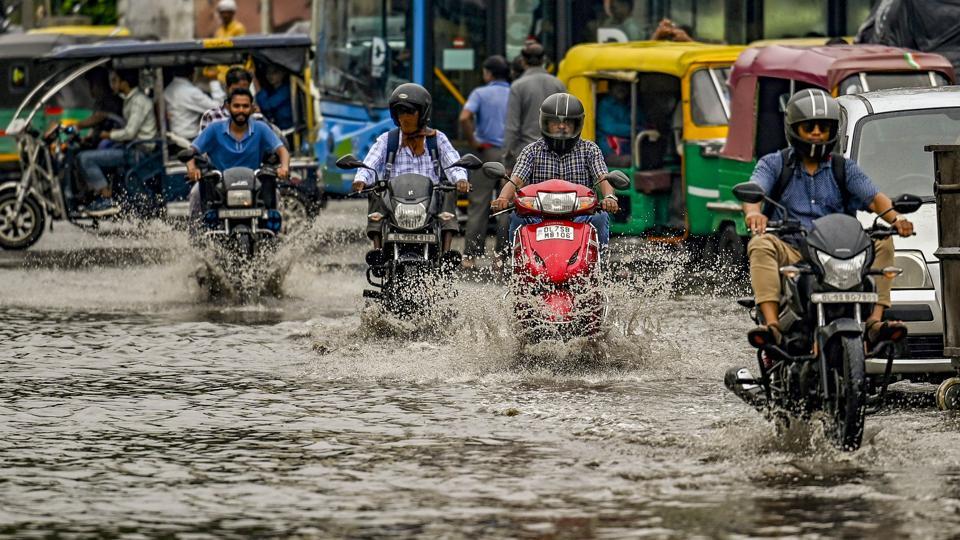
Thursday’s rain hampered commutes and public transit once again as Delhi woke up to flooded streets and uprooted trees.
It was also another instance of the India Meteorological Department’s (IMD) forecast missing the mark by a wide margin. The agency on Wednesday issued a “yellow alert”, warning of “light to moderate” rain. However, the overnight showers alone eased past the yellow alert threshold.
IMD classifies rainfall between 2.5mm and 15.5mm as “light”, between 15.6mm and 64.4mm as “moderate”, and upwards of that as “heavy”.
An IMD official said a combination of the monsoon trough and active weather systems, which included a cyclonic circulation, a western disturbance and a deep depression “led to more rain than anticipated”.
The rain threw a spanner in traffic, leading to chaos during the morning rush hour throughout the city. Several parts of Sarita Vihar, Qutub Minar Metro station, Saket, Mukarba Chowk, Aazadpur, Mahipalpur, and Mehrauli-Badarpur Road were waterlogged. The entire section of Rohtak Road, from Nangloi towards Tikri Border, was inundated.
The Delhi traffic police also issued an advisory for impacted traffic near the airport, even as Dhaula Kuan was flooded once again.
Rains this year have been patchy even in the monsoon months, said experts.
“Before August, we had a very heavy rainfall spell in June and then a heavy rainfall spell at the end of July. Other than that, it was mostly patchy rain, with the trough limited to central India,” said Mahesh Palawat, vice-president of Skymet Meteorology.
June recorded 243.4mm of rain, well above the long-period average (LPA) of 74.1mm. There was a slight deficit in July, with 203.7mm, as against the average of 209.7mm. In September, Delhi normally receives 123.4mm rain.
August, Palawat said, has been an outlier.
“La Nina conditions appear to be playing a part this month as well, but the monsoon trough has been close to the region and we have seen consistent rain,” he said.
Delhi normally receives an average of 233.1mm rain every August. However, with two days still to go, the city this August has already received 390.3mm of rain (44.2% of the year’s overall precipitation), the most in the month since 2016.
MeT officials did also stressed that August has been an unusual monsoon month.
“It has been an unusual August, with rain recorded on almost all days. This has largely been down to the trough being close to Delhi-NCR for the majority of the month. We have also seen active weather systems developing that have been feeding moisture,” said an IMD official.
Palawat said though Delhi receives little rain in the winter months of January and February, it does usually get one or two good spells from March to May due to western disturbances.
However, this year, he said that both cyclonic circulations and western disturbances were fairly weak. “We saw cloudiness, but it did no rain in those months. By May, the lack of western disturbances led to increasingly high temperatures and subsequent heatwaves,” he said.
There were also 18 complaints of trees falling from East of Kailash, Mansarovar Garden, Vivek Vihar, Shankar Road, Amethi Market, Saket, Shastri Nagar, East Moti Bagh, Johripur and Sultanpuri, among other locations.
The agency has predicted only light, patchy rain on Friday, with no showers expected over the weekend.