E-Paper



Delhi ready for cloud seeding, awaits IMD’s green signal: Sirsa
Officials confirmed that two experienced commercial pilots conducted the trial runs over northwest Delhi to prepare for the real operation

 Prefer HTon Google


The Delhi government is “fully prepared” to carry out cloud seeding in the Capital to induce artificial rain, environment minister Manjinder Singh Sirsa said on Wednesday, adding that four days of trial flights have already been conducted over the “target area”. The project, which the government has claimed will reduce air pollution around Diwali, now awaits a final go-ahead from the India Meteorological Department (IMD).
“Our aircraft is ready at Meerut. The pilots have familiarised themselves with the flight path. We’re only waiting for IMD’s green signal and the right cloud conditions. If all goes well, the first trial could happen even on the day-after Diwali or the following day, if conditions are suitable,” Sirsa said at a press conference.
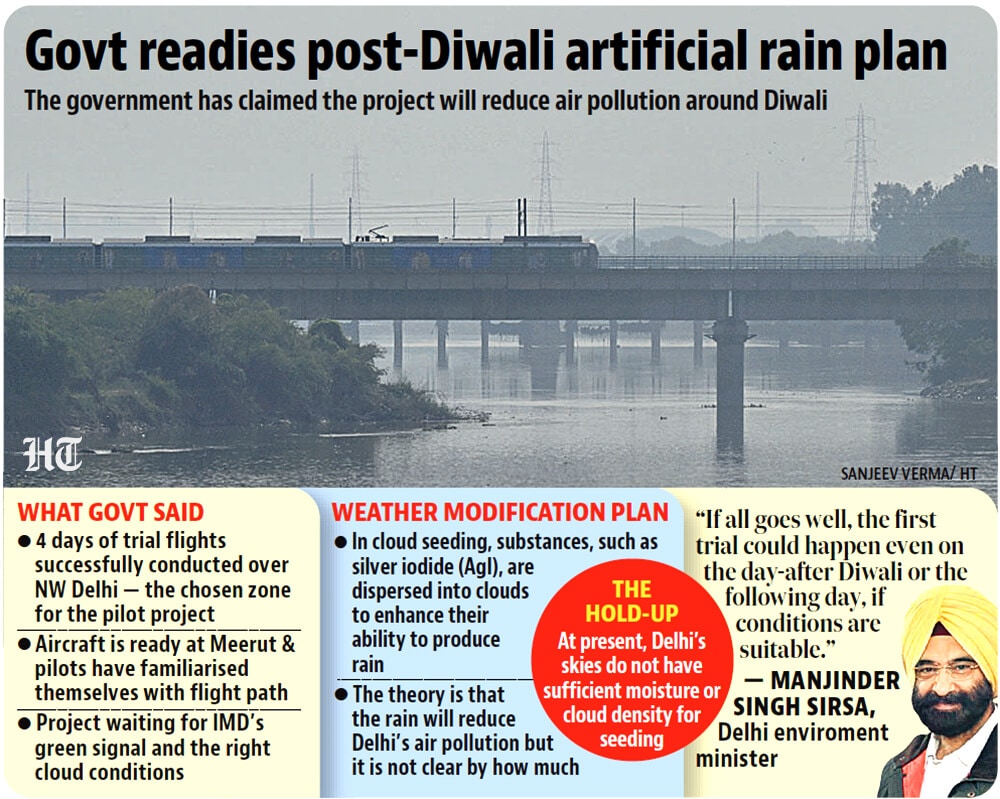
Officials confirmed that two experienced commercial pilots conducted the trial runs over northwest Delhi -- the chosen zone for the pilot project -- to prepare for the real operation. “The four-day trial was successful with no technical challenges,” Sirsa said.
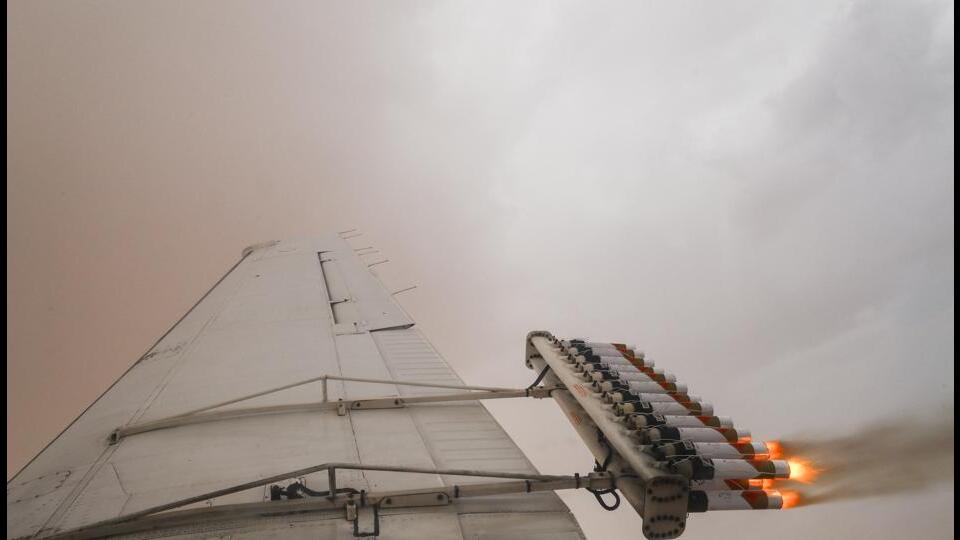
Cloud seeding, a weather modification process, involves dispersing substances such as silver iodide (AgI) into clouds to enhance their ability to produce rain. The Delhi project is being executed in collaboration with the Indian Institute of Technology (IIT) Kanpur, which has modified its Cessna-206H aircraft specifically for this purpose.
According to IIT Kanpur scientists, Nimbostratus clouds, which typically form between 500 and 6,000 metres above ground level, are ideal for seeding, but they must contain at least 50% moisture. At present, Delhi’s skies do not have sufficient moisture or cloud density for seeding to be effective. “We are closely monitoring atmospheric conditions, waiting for the right window,” said an IIT official involved in the project.
The theory is that the rain will reduce Delhi’s air pollution; there is no clarity by how much, but rain usually sees a significant improvement in air quality, sometimes by as much as 50-80 points in the Air Quality Index (AQI).
“If the AQI is ‘very poor’, it may improve to ‘poor’, and if it is in ‘poor’, it may improves to ‘moderate’. You are not likely to see a significant improvement,” explained Dipankar Saha, former head of CPCB’s air laboratory, adding that a lot of other factors – wind speed, the area of influence and the intensity of rain – would influence matters. “It if is a drizzle to light rain, it will not make much difference. One needs good intensity and strong winds to have a washout effect,” Saha said.
Officials said five trials are planned, all over northwest Delhi. Each test will be conducted at varying humidity levels – 50%, 70%, and below 50% – to assess the feasibility of artificial rain under different conditions. “We’ll also analyse water samples after each trial to ensure there’s no harmful environmental impact,” said a senior environment department official.
The Delhi government had signed a Memorandum of Understanding (MoU) with IIT Kanpur on September 25 to conduct the trials, with the Directorate General of Civil Aviation (DGCA) granting permission a day earlier. The DGCA’s letter, dated September 23 and seen by HT, allowed the use of IIT Kanpur’s aircraft between October 1 and November 30, subject to strict conditions – no flights over restricted or prohibited zones, no aerial photography or survey, no foreign crew involvement, and prior Air Traffic Control clearance.
More than 10 other government bodies, including the Union ministries of environment, defence, and home affairs, as well as the Airports Authority of India, the Bureau of Civil Aviation Security (BCAS), and the Uttar Pradesh government, have also cleared the project.
The Delhi Cabinet had on May 7 approved the ₹3.21-crore plan. Originally, the trials were scheduled for late May and early June, but were postponed due to the onset of the southwest monsoon. A revised window in August-September was also missed as the monsoon lingered until its official withdrawal on September 24.
Last month, Sirsa had announced tentative dates between October 7 and 9 for the first trial, with a backup window of October 9-11. However, unexpected showers from a western disturbance forced another postponement. “Weather is the biggest variable here… Our team – from IIT Kanpur scientists to pilots – is on standby. The moment we get the right conditions, we’ll begin,” the government official cited above said.
Sunil Dahiya, founder and lead analyst at the think-tank Envirocatalysts, however remained apprehensive. “We have seen such experiments in Dubai, where cloud seeding was done to tackle droughts, but the aim was not to reduce pollution. In Pakistan, something similar was tried but the AQI rebounded almost instantly,” Dahiya said, stating for it to make a difference in Delhi - the entire city would have to be seeded, with high-intensity rains required, to tackle air pollution. “So far, we don’t even know if there will be rain, let alone enough rain to bring down AQI,” he said.