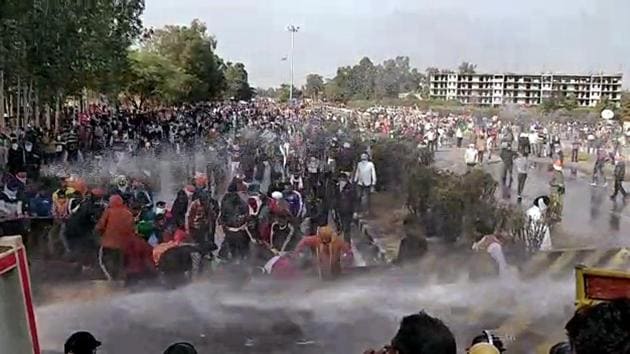
Thousands of farmers from Punjab, Haryana, Uttarakhand and Uttar Pradesh clashed with police on Thursday, travelling toward the national Capital, where they plan to protest three farm laws enacted recently. Cultivators on tractors and trucks flung police barricades into a river near Ambala district, as police stopped them with tear gas and water cannons. The farmers are set to resume their march on Friday.
What’s stoking the farmers’ uprising?
Farmers want the Narendra Modi government to revoke three contentious laws approved by Parliament in September. The laws essentially change the way India’s farmers do business by creating free markets, as opposed to a network of decades-old, government-controlled agricultural markets. These laws are The Farmers’ Produce Trade and Commerce (Promotion and Facilitation) Act, 2020, the Farmers (Empowerment and Protection) Agreement on Price Assurance and Farm Services Act, 2020 and the Essential Commodities (Amendment) Act 2020.
Also read | Ready to resolve differences: Union agriculture minister Tomar invites protesting farmers for talks on Dec 3
How do the new laws change farm trade?
Together, the laws allow businesses to freely trade farm produce outside the so-called government-controlled “mandi system”, permit private traders to stockpile large quantities of essential commodities for future sales, which earlier only government-approved agents could, and lay down new rules for contract farming.
{{/usCountry}}Together, the laws allow businesses to freely trade farm produce outside the so-called government-controlled “mandi system”, permit private traders to stockpile large quantities of essential commodities for future sales, which earlier only government-approved agents could, and lay down new rules for contract farming.
{{/usCountry}}Why do farmers oppose these new rules?
Farmers say the reforms would make them vulnerable to exploitation by big corporations, erode their bargaining power and weaken the government’s procurement system, whereby the government buys staples, such as wheat and rice, at guaranteed prices.
What is the MSP system?
Farm unions fear the new rules could pave the way for the government to stop buying grains at guaranteed prices, officially called minimum support prices (MSP), leaving them at the mercy of private buyers. The government, on the other hand, has insisted it will continue to purchase farm produce at MSPs. An MSP is a federally determined floor price aimed at preventing distress sale.
What’s the government’s argument?
The government has said these new rules will bring big retailers, online grocers and exporters to farmers’ doorstep. The amended Essential Commodities Act will spur investment in supply chains. The contract farming law will allow farmers to tailor their production according to a corporate buyer’s requirement.
Is the crisis going to be resolved anytime soon?
Agriculture minister Narendra Singh Tomar and railways, food and consumer affairs minister Piyush Goyal had held day-long negotiations with farmers on November 13. The discussions were inconclusive, but both sides had agreed to continue negotiations in the future. The next round of talks is slated for December 3.