Missile scientists from the Defence Research and Development Organisation (DRDO) will physically open and examine the suspected cargo seized at Kandla port from detained Chinese ship Dai Cui Yun, bound for Port Qasim, Karachi, on Friday to ascertain whether the 2005 Indian law against weapons of mass destruction (WMD) and the UN convention on the same subject can be invoked against both the consignee and consignor.
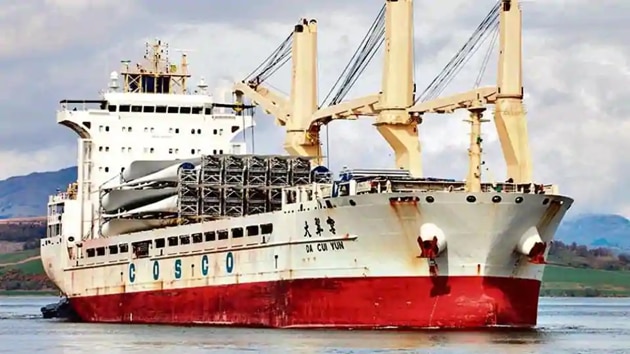
Based on a high-level intelligence tip-off, the Department of Revenue Intelligence and Kandla Customs detained the Chinese ship on February 3 for misdeclaring a “dual use” industrial autoclave, which can be used in the manufacture of ballistic missiles, as an industrial dryer. The ship left the Chinese port of Jiangyn on January 17.
As reported in HT, the Chinese ship Da Cui Yun was allowed to leave for final destination Port Qasim on Thursday evening after signing guarantees with the Kandla Customs. The ship left Kandla Port at 7.31 pm on Thursday and is expected at Port Qasim at 1.30 am on Saturday. The autoclave has been seized by the Kandla customs and will be opened for examination today.
For starters, even before the final inspection is carried out, Indian authorities have decided to charge the ship under the Customs Act for wrong declaration of goods, according to an official familiar with the matter who asked not to be named. The ship could be released as per procedure after charges are formally slapped against it, the official said. “But that decision is yet to be taken,” he added.
{{/usCountry}}For starters, even before the final inspection is carried out, Indian authorities have decided to charge the ship under the Customs Act for wrong declaration of goods, according to an official familiar with the matter who asked not to be named. The ship could be released as per procedure after charges are formally slapped against it, the official said. “But that decision is yet to be taken,” he added.
{{/usCountry}} 
Initial examination of the orange-coloured equipment had revealed “complex” circuitry inside it, a second official who didn’t want to be named said, adding that “scientists want to carry out a more detailed investigation”.
The autoclave was off-loaded for physical inspection last week and the ship moved from pier to anchorage at the mouth of Kandla creek. A seizure memo has been issued. No police case had been registered till Thursday.
As there is prima facie evidence of a “dual use” item used in a WMD delivery platform, the DRDO scientists will physically examine the 18m x 4m autoclave on Friday. Once the physical verification is done, the government will invoke the Weapons of Mass Destruction and Their Delivery Systems (Prohibition of Unlawful Activities) Act 2005 as well as the UN Convention on WMD. In 1999, the authorities at Kandla Port had booked North Korean ship Ku Wol San carrying missile parts for Pakistan under the Arms Act.
Clause 4(C) of the 2005 law makes it clear that its provisions apply to “any ship, aircraft or any other means of transport registered in India or outside India, wherever it may be.” Under the law, contravention of section 8 pertaining to missile delivery systems attracts a punishment of not less than five years which may be extended up to imprisonment for life with an added fine.
According to Indian national security planners, the seizure of the dual-use autoclave has substantiated Indian assertions over the past two decades that Pakistan’s nuclear programme and its missile delivery systems are borrowed and based on technology from China and perhaps North Korea.
Meanwhile, the security agencies are also looking at the parties involved — Islamabad-based United Construction Company, which was importing the equipment, and Hong Kong-based company General Technology Ltd which booked the consignment.