E-Paper



EPFO tightens rules for private trusts with new SOP
The objective is to ensure better protection and uniformity for employees’ provident fund savings. mint

 Prefer HTon Google


Over 1,250 private trusts managing more than ₹3.50 lakh crore life-savings of nearly 3.2 million employees will have to provide either “better or at least equal” benefits to their workers in comparison to terms offered by government-run Employees’ Provident Fund Organisation (EPFO), according to the new standard operating procedure (SOP).
“Non-compliance by any private trust would result into cancellation of the exemption status,” a senior official said, asking not to be named. Private or exempted establishments are companies that manage their own private provident fund (PF) trust rather than depositing employees’ contributions into the central pool of EPFO. They are both public and private sector firms.
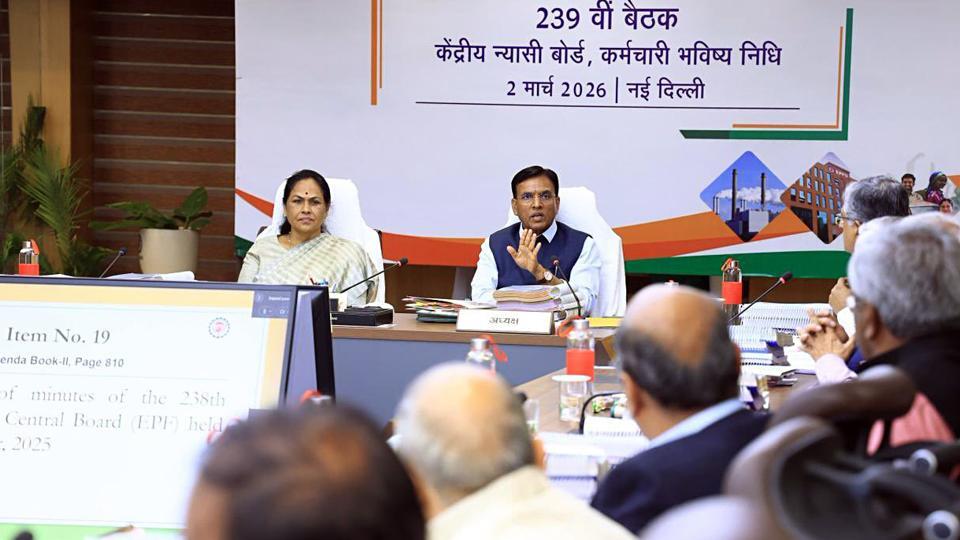
The new and simplified SOP for exemption has been approved by EPFO’s Central Board of Trustees (CBT) chaired by labour minister Mansukh Mandaviya, the official said. The new SOP would consolidate existing four SOPs and the exemption manual into a single comprehensive framework to reduce compliance burden and to promote ease of living, he added.
The new SOP “reiterates and emphasises that benefits provided by an exempted establishment has to be better or at least equal to that provided by EPFO” and in order to protect members, the balances of inoperative accounts and non-KYC accounts have to be transferred to EPFO along with accrued interest, the document said.
The new rule also restricted private trusts to pay arbitrary interests to its members and kept the cap to a maximum of 2%. “To preserve inter-generational equity, higher interest is kept at two hundred basis points above EPFO’s rate of interest,” the SOP said. This provision is inserted as some of the public sector companies were seen giving as high as 30-34% interests to their employees, the official cited above said.
The 133-page document not only provides a clear listing of requisite documents for grant, surrender and cancellation of exemption, but has also reduced the number of documents required for different processes of exemption. It seeks to lay down a comprehensive mechanism regarding monitoring, inspection, compliance reporting, adherence to investment norms and timely settlement of claims.
The SOP also provides an end-to-end digital process for surrender and transfer of past accumulations. The technology-driven governance approach will make audit of exempted establishments more transparent and efficient, the official said. “The objective is to provide clarity and uniformity in the supervision of exempt trusts functioning under the oversight of the EPFO,” the official added.
In order to protect ordinary employees’ interests, the SOP also made it mandatory for private trusts to have an online portal for grievance resolution, which shall be integrated with EPFO’s public grievance handling system. “All grievances of stakeholders shall be routed to the exempted establishment online through EPFO’s public grievance system,” it added.
“This SOP marks a shift towards a technology-enabled, risk-based, and stakeholder-centric regulatory system,” the document said. It encourages voluntary compliance, reduces administrative burden, enhances transparency, safeguards members’ funds, and builds trust among employers, employees, and regulators, thereby supporting sustainable governance and ‘Ease of Doing Business’, it added.
Some of the exempted establishments as per EPFO’s August 2024 listing are — Bokaro Steel, Jindal Stainless, TVS Motor Co, Raymond Ltd, Larsen Toubro Ltd, Wipro, Infosys, Tata Tea Ltd, Reliance Industries Ltd, BHEL, Hindustan Unilever, Hindustan Petroleum Corp Ltd., Indian Oil Corp Ltd, Bharat Petroleum Corp Ltd, and NTPC Ltd.