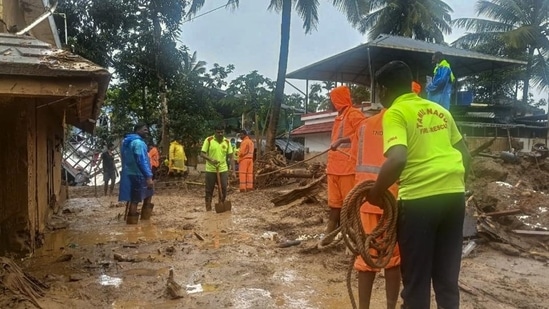
A day after landslides flattened entire settlements in Kerala’s Wayanad, experts said the monsoon’s changed character due to climate change has made several parts of the country susceptible to climate disasters, and Kerala especially so because of its unique location and topography.
A major reason for erratic rainfall is availability of a lot of moisture or water vapour due to warming of the sea surface. Increased water vapour is triggering erratic rainfall patterns. And the situation is made worse by poor planning and mindless development.
On July 30, in 24 hours till 8.30 am, several parts of Kerala recorded extremely heavy rain (over 200 mm or 20 cm). For example, Vadakkancherry in Thrissur recorded 34 cm, Alathur in Palakkad recorded 30 cm, Vadakara in Kozhikode recorded 28 cm and Vyttiri in Waynad recorded 28 cm. But overall since June, Kerala has not had a great monsoon. As on July 30, Kerala had a 5% rain deficiency.
Read more: Wayanad landslides: 160 bodies recovered, rescue operations underway | 10 points
The immediate reason for continued heavy rainfall over Kerala in the last few days is an active off-shore trough along Kerala coast with a cyclonic circulation in the lower levels over the South-East Arabian Sea and adjoining Lakshadweep Islands off Kerala coast, India Meteorological Department explained. This along with strong south-westerly/westerly wind (upto 45 kmph) along and off Kerala coast in the lower level of atmosphere led to convergence of moist winds and orographic upliftment due to the Western Ghats.
{{/usCountry}}The immediate reason for continued heavy rainfall over Kerala in the last few days is an active off-shore trough along Kerala coast with a cyclonic circulation in the lower levels over the South-East Arabian Sea and adjoining Lakshadweep Islands off Kerala coast, India Meteorological Department explained. This along with strong south-westerly/westerly wind (upto 45 kmph) along and off Kerala coast in the lower level of atmosphere led to convergence of moist winds and orographic upliftment due to the Western Ghats.
{{/usCountry}}A similar pattern of rainfall was recorded in 2019 and 2021, years when parts of Kerala recorded flash floods. Kerala has recorded severe flooding and landslides in 2018, 2019, 2021 and this year, in the past decade.
There’s no shortage of moisture.
“The moisture is supplied from the entire Arabian Sea, via the monsoon flow. Warmer seas lead to more moisture supply through evaporation. The monsoon moisture flow moves over hilly regions and gets uplifted, forming multi-cell clouds leading to large amounts of rainfall,” explained Roxy Mathew Koll, climate scientist at Indian Institute of Tropical Meteorology.
“Warming produces more water vapour in the atmosphere and clouds develop higher. Thus it leads more intense rainfall,” added M Rajeevan, former secretary, ministry of earth sciences and climate scientist.
Read more: Delhi rain: Schools to remain closed today amid heavy waterlogging, congestion
Why is Kerala vulnerable?
The elevation in Kerala ranges from 48 metres (m) below sea level in the backwaters and other low lying areas to 2,692 m in the hills . Around 35% of Kerala’s area has elevation of 0-50 m; 39.82% of the area , between 50-500 m ; and 24% above 500 m as per KJ Ramesh, former director general of IMD based on data from National Remote Sensing Centre.
The state has seen a very sharp increase in mean and maximum temperatures over all districts during monsoon season as per trends since 1901 monitored by IMD Pune. This summer Kerala recorded five heat wave days between April and June, unusual for a state which normally records moderate temperatures because of the coast.
The monsoon is also weakening over Kerala. Using data from 1901-2012, Koll’s team at Indian Institute of Tropical Meteorology found that the rainfall is decreasing over central South Asia – from south of Pakistan through central India to Bangladesh. Over India, the decrease is observed over central and north India, and the Western Ghats (Kerala) particularly, their study published in 2015 found.
The same team also revealed in a 2017 study that widespread extreme rain events across central India have tripled since 1950. These severe weather events result in largescale floods and catastrophic loss of life and property across Gujarat, Maharashtra, Madhya Pradesh, Chhattisgarh, Telangana, Odisha, Jharkhand, Assam, Meghalaya and parts of Western Ghats – Goa, north Karnataka and central Kerala.
“Monsoon patterns have definitely changed . Earlier during the Monsoon season, we used to witness uniform rains and no convective activity, but now we see rains which are more of pre-monsoon characteristics that include thundershowers. Kerala has not been witnessing typical monsoon rains and has been struggling to achieve its average rainfall. Despite these heavy showers, it is yet to surpass its average rainfall so far. Also, with the rise in air as well as ocean temperatures, there has been a drastic increase in the moisture. The Arabian Sea has been warming at a faster rate, pumping moisture into the atmosphere, making it unstable. All these factors are directly linked to global warming,” said Mahesh Palawat, vice president, climate and meteorology at Skymet Weather in a statement.
“Climate change is drastically changing rainfall patterns in Wayanad. What was once a cool, humid environment with year-round drizzles and monsoon rains, is turning into one marked by drier, hotter summers and intense downpours during the monsoons. This change has increased the risk of landslides,” Mariam Zachariah, Research Associate, Imperial College London added in a statement on Wednesday.
The impacts of climate change are only exacerbated by poor land-use planning.
“There are two problems--the local landslide early warning system did not trigger and we do not have a landslide route map. The landslide route map can tell us what is the path that a landslide can take. It’s important to note that only the valley area where the landslide started is high on landslide susceptibility but the areas downstream are not at high risk. Human intervention definitely did not cause the landslide but I think the river banks and floodplains along Choolarmala, etc are not suitable for settlements or construction,” added KS Sajin Kumar, Kerala based geologist.