New Delhi India may flag the European Union’s move to impose a carbon tax on imports during the upcoming G20 trade ministerial in Jaipur on behalf of developing and least developed countries, as it is a non-tariff barrier hindering a robust and reliable global supply chain, two persons aware of the development said.
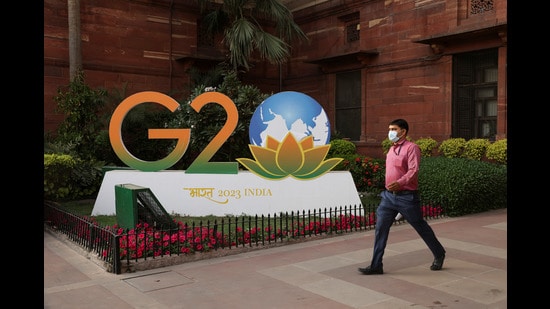
India, both as G20 president as well as an individual member, may raise issues pertaining to carbon border adjustment mechanism (CBAM) with the EU, both multilaterally as well as bilaterally, at different forums of the G20 Trade and Investment Ministers Meeting (TIMM) in Jaipur, they said, requesting anonymity.
There are several bilateral talks expected from Wednesday on the sidelines of the two-day ministerial (August 24-25), which is expected to be opened on Thursday with Prime Minister Narendra Modi’s video message, they said. “Besides in bilaterals, topics like inclusive trade for global growth and resilient global value chain will be discussed at the ministerial,” one of them said.
Bilateral meetings are expected with key trading partners such as the US, the UK, Canada and the EU on the sidelines of the G20 ministerial, a second person said. “Besides the India-EU free trade agreement, CABM and Trade & Technology Council (TTC) are also likely to on the India-EU bilateral agenda,” he said.
CBAM is a tariff on carbon-intensive products to offset carbon leakage and it may see up to 35% tariff on imports of high-carbon goods such as steel, iron ore and cement from India, he said, adding that this move is against the principle of equity and is seen as a trade barrier.
{{/usCountry}}CBAM is a tariff on carbon-intensive products to offset carbon leakage and it may see up to 35% tariff on imports of high-carbon goods such as steel, iron ore and cement from India, he said, adding that this move is against the principle of equity and is seen as a trade barrier.
{{/usCountry}}Carbon leakage occurs when companies based in the EU move carbon-intensive production abroad to countries where less stringent climate policies are in place, or when EU products get replaced by more carbon-intensive imports, according to the European Commission’s website. The tax will be implemented in phases from October 1 and becomes fully effective in January 1, 2026.
India would like to directly engage with EU on CBAM, experts said.
“Instead of pursuing the matter through the World Trade Organization, India aims to negotiate directly with the EU to secure favourable conditions for its small manufacturers. As a significant exporter of steel and aluminum, India seeks exemptions from the Carbon Border Adjustment Mechanism (CBAM) imposed by the EU,” according to a June report by Primus Research.
“While India has already filed a discussion paper with the WTO addressing the impact of environmental regulations on trade, it believes that direct negotiations with the EU could lead to a quicker resolution,” said the report prepared by Primus Partners, a consultancy.
The CBAM would lead to trade distortion, particularly for developed and least developed countries, the second person said, citing a United Nations Conference on Trade and Development report published in July 2021.
Several countries have raised concerns in different trade fora about the implementation of the CBAM, particularly regarding the potential creation of trade distortions and the need to implement special treatment to least developed countries, said the report titled ‘A European Union carbon border adjustment mechanism: implications for developing countries’.
“Moreover, considering the cumulative contribution of the European Union and the United States to CO2 emissions, countries such as China, Brazil, India, and South Africa continue to argue that the primary obligation to reduce emissions falls upon developed countries,” it said. “For some countries, the CBAM could be seen as going against the principle of common but differentiated responsibilities.”
India and EU may also discuss their TTC agenda in the bilateral meeting in Jaipur. TTC talks may involve cooperation in strategic sectors such as semiconductors and may strive to concluding a memorandum of understanding next month, the first person said.
The TTC is a coordination platform to address key challenges pertaining to trade, technology and security. The first ministerial meeting of TTC was held on May 17 in Brussels, co-chaired by external affairs minister Subrahmanyam Jaishankar, commerce minister Piyush Goyal and minister of state for IT Rajeev Chandrasekhar representing India, and executive vice-presidents Margrethe Vestager and Valdis Dombrovskis from the EU.
India is striving to build consensus among G20 members over five key agenda at the TIMM in Jaipur -- trade for growth and prosperity, resilient trade and global value chain, integrating micro, small and medium enterprises in global trade, logistics for trade, and WTO reform. Adoption of a G20 trade and investment ministerial statement is expected on Friday after the conclusion of the meeting, the first person said.
Founded in 1999, the G20 comprises 19 countries, including Argentina, Australia, Brazil, Canada, China, France, Germany, India, Indonesia, Italy, Japan, South Korea, Mexico, Russia, Saudi Arabia, South Africa, Turkey, the UK, the US and the EU. The G20 members represent around 85% of the global GDP, over 75% of global trade and about two-thirds of the world population. Besides G20 members, other invitees at TIMM are Bangladesh, Egypt, Netherlands, Oman, Singapore and the United Arab Emirates.