For the first time, scientists from the Zoological Survey of India (ZSI) in Kolkata have developed a forensic kit based on DNA fingerprints that could help authorities track illegal trading of pangolins – the world’s most trafficked animal.
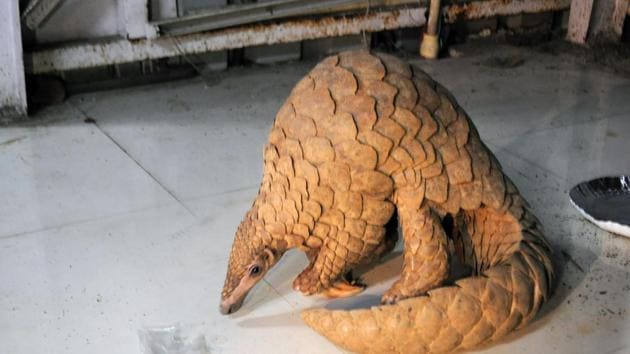
The new kit named the ‘Pangolin Indexing System’ uses DNA markers to identify the unique individuals from the animals’ scales that are frequently seized by security agencies. Till date, authorities were only able to give a rough estimate of the animals killed based on the presumption that one Indian pangolin yields one kilogram and one Chinese pangolin yields half a kilogram of scales.
“So, if 10 kilos of scales were seized, going by the presumption, authorities used to roughly estimate that 10 Indian pangolins might have been killed. But now, the new system would help us to identify each individual that was killed by poachers for their scales,” said Kailash Chandra, director, ZSI. This system will aid in genetic surveillance of the large seizures, he added.
Also read: Rare pangolin rescued from smuggler, accused arrested
{{/usCountry}}Also read: Rare pangolin rescued from smuggler, accused arrested
{{/usCountry}}Out of the eight species of pangolins found across the globe, two – the Indian Pangolin and the Chinese Pangolin – are found in India. They are trafficked – mostly to China and other south-east Asian countries - for their meat and scales. Many times live ones are also smuggled even though they enjoy the highest level of protection under Schedule I of the Wildlife (Protection) Act, 1972 of India.
“Till date, it was very difficult to identify an individual from the scales, the species and the region from where it came. But we have developed a DNA marker system which could identify each individual from a bag full of scales. In the follow-up, we are now developing a region-specific DNA database for pangolin covering the entire distribution range,” said Mukesh Thakur, who is a scientist and the coordinator of Centre for Forensic Sciences at ZSI who also led the research.
The scientists now plan to work with the International Union for Conservation of Nature’s Pangolin special group to draft a pangolin identification guide by which species of pangolins can be identified.
This would allow security agencies, such as the Wildlife Crime Control Bureau, forest and wildlife department, to get an estimate of the number of individuals killed, the species – Indian or Chinese - and their origin.
The ZSI’s findings have been published in the International Journal of Legal Medicine, a peer-reviewed International journal brought out by Springer.
“We are going through the research contents. It seems to be a very important study and a big jump forward in tackling pangolin trade in India. We have to find out the practicality and how it could be effectively utilized in the field,” said Tilotama Verma, additional director of Wildlife Crime Control Bureau.
A study published by a wildlife trade monitoring network TRAFFIC in 2018 estimated that close to 6,000 pangolins were seized from illegal trade, involving India, over the period 2009–2017. However, an estimated total of 5,772 animals is likely to be an under-estimate as an unknown fraction of illegal wildlife trade is detected.
“We have been doing this for quite a long time for tigers because we have a huge countrywide repository. If we find tiger bones, we would be to tell how many tigers do they belong to and which part of the country the animal came from – central India, Terai or maybe the Western Ghats – because tigers from specific geographical locations have different markers,” said YV Jhala, senior scientist at the Wildlife Institute of India.