E-Paper



Face of Patidar quota agitation, one-time critic Hardik Patel joins BJP
Patel’s defection is seen as an attempt to remain relevant in Gujarat, where BJP has been in power continuously for 28 years

 Prefer HTon Google


Ahmedabad: Former Congress leader Hardik Patel, 28, on Thursday joined the Bharatiya Janata Party (BJP) seven years after he came into prominence as the face of the agitation for quotas in jobs and educational institutes for his Patidar community and emerged as a critic of the party. Patel quit Congress last month. He joined the party three years earlier and was elevated as its working president.
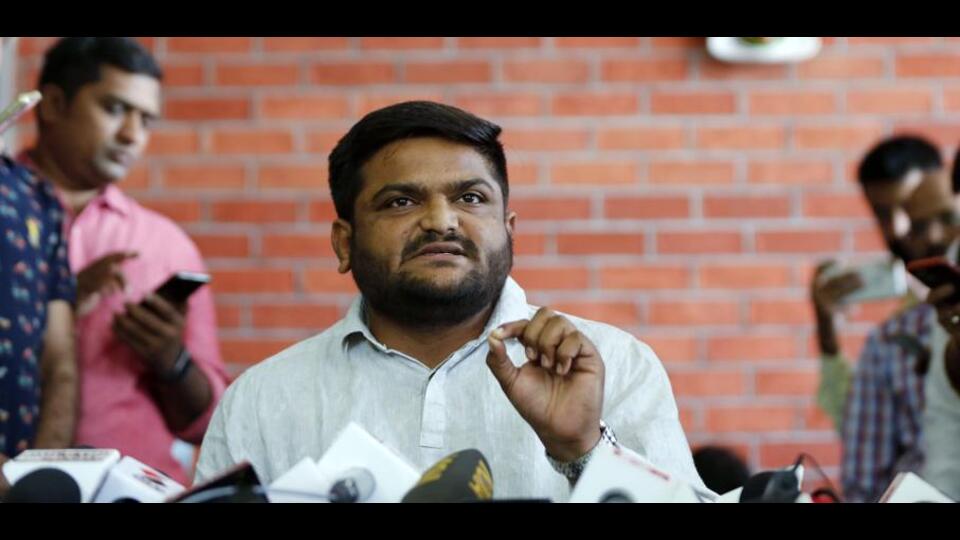
Patel’s defection is seen as an attempt to remain relevant in Gujarat, where BJP has been in power continuously for 28 years. Political commentator Jai Mrug said Patel finally seems to have come to terms with realpolitik. He added the BJP’s gesture is mere tokenism, which means that his political innings has only begun.
A BJP leader said Patel, who joined the party in presence of its Gujarat chief C R Paatil and other state leaders, will have to work his way into the party. “His ability to work as part of a team and his discipline as a party member will all be tested. There is no decorated role for him and he will have to prove his worth,” said the leader, requesting anonymity.
Patel, who attempted to revive the quota agitation by sitting on an indefinite hunger strike four years back, is on a path of redefining his political career. He was 24 and yet to be eligible to contest assembly elections then. He is now expected to fight his first election for the Gujarat assembly due in December. The Supreme Court in April stayed Patel’s conviction in a 2015 rioting and arson case related to the quota protests. The convictions barred him from contesting elections.
Patel, who in 2018 vowed to continue his fast even if he lost his life till his community gets the quota, was shifted to a hospital after two weeks when he faced breathing problems. His kidney was also impacted due to the hunger strike but the quotas remained elusive. Patel sat on the hunger strike three years after he came into the limelight by addressing a rally in Ahmedabad of about half a million people. In his address, Patel criticised the BJP and laid out his community’s demands. A police crackdown and detention of Patidar leaders followed as the rally turned violent. The violence spread across Gujarat and claimed at least 12 lives.
The BJP performed poorly in the local elections held months later in December 2015 and lost to Congress in rural areas. This was among the reasons that prompted chief minister Anandiben Patel to step down.
Hardik Patel emerged as a major crowd-puller known for his oratory. He would speak on a wide range of topics--from farm distress to unemployment. He was critical of Union home minister Amit Shah and alleged the BJP offered him ₹1,200 crore. In 2016, Shah’s public address to Patidars in Surat was disrupted after Hardik Patel’s supporters created a ruckus.
Hardik Patel also criticised Prime Minister Modi’s policies, especially the 2016 demonetisation and GST implementation. After maintaining he would not join any party, he offered support to Congress ahead of the 2017 polls. The BJP’s tally in the assembly fell to 99 in the 182-member House.
Former Jawaharlal Nehru University professor Ghanshyam Shah said Hardik Patel’s defection will not make much difference to either BJP or Congress. “It did not make much impact in 2017 and I do not think it will make much in 2022,” He added Hardik Patel enjoyed support in 2015 from college students amid declining jobs and many of his colleagues have since deserted him or become inactive. “He has failed to create any base.”
Hardik Patel’s Patidar community accounts for about 12-14% of Gujarat’s population and has been among BJP supporters for over three decades. Patels are a major factor in around 55 assembly seats.
In 2017, the BJP fielded 29 Leuva Patels and 23 Kadva Patels. Congress nominated 26 Leuva and 21 Kadva candidates. According to a Lokniti-Centre for the Study of Developing Societies’ post-poll survey in 2017, 68% of Kadva Patels and 51% of Leuva Patels voted for the BJP in 2017 compared to 78% and 63% in 2012. Congress’s vote share among the Patidars increased. As many as 27% of Kadvas and 46% Leuvas voted for it in 2017 compared to 9% and 15% in 2012.
Hardik Patel is joining the BJP as it is working to get Patels back in its fold before the 2022 elections and Modi has addressed at least half a dozen events of the community in the last three months.
Hardik Patel’s resignation letter was scathing in its criticism of the Congress and its leaders. He said they did not have a roadmap for the people, were non-serious, and behaved as if they hated Gujarat and Gujaratis.
Congress leader Shaktisinh Gohil said Hardik Patel was in touch with the BJP for the last six months for the withdrawal of his cases. “This is politics of opportunism and nothing else. Gujarat understands this.”
At least a dozen cases, including two related to sedition, remain pending against Hardik Patel. A court in Ahmedabad accepted the state government’s proposal to withdraw a 2017 case against him. In one of the cases of sedition, he is accused of instigating people to vandalise public property. Hardik Patel was arrested and subsequently released on bail in August 2015. A court later banished him and he spent six months in Rajasthan.