E-Paper



Five factors that helped BJP defy anti-incumbency in Haryana
Here are five factors that look like to have helped the saffron party, which appears to be making a stunning comeback for the third consecutive term

 Prefer HTon Google


Initial trends of the Haryana assembly election results indicate that the ruling Bharatiya Janata Party (BJP) is defying anti-incumbency to score a hat-trick.
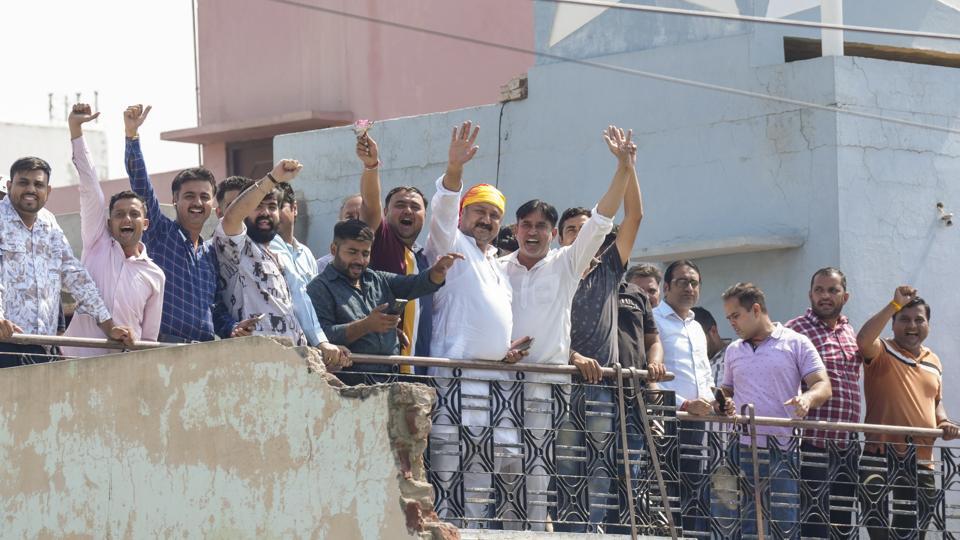
Here are five factors that look like to have helped the saffron party, which appears to be making a stunning comeback for the third consecutive term.
Change of guard
Strong anti-incumbency, voters’ fatigue, disillusioned youngsters and angry farmers were issues that led the BJP to break the alliance with the Jannayak Janta Party (JJP) and replace Manohar Lal Khattar with Nayab Singh Saini as the chief minister.
Snapping ties with its 2019 post-poll ally on March 12 and appointing Saini, an OBC leader, as chief minister have turned out to be gamechangers, contrary to what political pundits were claiming.
Saini is the first leader from other backward classes (OBC) to become the chief minister of Haryana. Apart from the most vocal 30% Jats and 34% BCs of Haryana, Dalits are 16%, and 23% are Punjabis, Brahmins, Rajputs and Aggarwals; while Ahir, Gujjar and Sainis are around 11% in Haryana.
The BJP’s worry was the consolidation of Jats and Dalits in favour of the Congress. The more the Jats became vocal about favouring the Congress, the more the BJP exploited the situation by consolidating non-Jat voters. The belligerent Jats had started celebrating Congress’s return to power much before the votes were cast, while the non-Jat voters remained mum about their next political move.
What further helped the BJP was the series of 126 decisions taken by the Saini’s government during his 70-odd days in office.
Backing of backward class
During a Backward Classes Samman Sammelan in Mahendragarh on July 16, Union home minister Amit Shah highlighted Haryana’s move to increase the ceiling for the so-called creamy layer of other backward classes (OBCs) to ₹8 lakh from ₹6 lakh. The state government’s focus on BCs, which account for just under a third of the population of the state. The Haryana government enhanced reservation for Group-A and Group B of the BCs in local administrative bodies. Saini had announced that the reservation for the BC in Group-A and Group-B posts would be increased to 27% from the present 15%.
Brand Modi intact
Prime Minister Narendra Modi was a big attraction during the campaigning for the October 5 election. Modi along with Union home minister Amit Shah held 14 rallies in the state. People gave credence to what Modi was assuring to the electorate. The credibility of the Union government and the series of decisions taken to ensure corruption-free governance by the BJP-led government in Haryana were highlighted to the hilt. A series of pro-farmer steps taken by the Centre helped in making inroads into the hearts of the cultivators, who were divided between the Congress and the BJP. The steps taken to address concerns of Agniveer scheme turned the tide in favour of the BJP.
The trends indicate that for the electors of Haryana, Brand Modi is intact.
Clean governance
Despite a short stint, the Saini-led minority government took a slew of populist decisions almost daily to blunt the anti-incumbency of two terms of the BJP and attempt to soften public mood. A few contentious decisions taken by former CM Khattar were reversed or tweaked to send out a message loud and clear that the government was on a course-correction. The merit ensured in government jobs resonated among beneficiaries and gave a ray of hope to youngsters aspiring to get government jobs on merit.
Lok Sabha verdict wake-up call
The Lok Sabha election verdict was a wake-up call even though the BJP won five of the 10 seats and secured a lead in 44 assembly segments. The Congress had got a lead in 42 assembly seats and its ally the AAP (now contesting separately) secured a lead in four segments.
The result was a jolt for Saini because in the 2019 Lok Sabha elections, the BJP won all 10 Lok Sabha seats in Haryana after registering leads in 79 assembly segments. Five months later in the October 21, 2019, assembly polls, the BJP won 40 seats and fell short of six MLAs to cross the magical halfway mark.
In this backdrop, the Lok Sabha verdict had set the alarms bells ringing within the BJP that was grappling with factionalism and a disenchanted cadre. Post the Lok Sabha verdict, the government woke up to ground realities. Corrective steps were taken to solve problems people were facing with the Parivar Pehchan Patra (PPP) and property IDs, the twin flagship schemes that had fuelled public anger.
The RSS ground push helped the BJP, particularly in the urban areas.