A new research paper has concluded that fragmentation of habitat has already disrupted the natural evolutionary process in wild tigers and will continue to do so in future as anthropogenic pressures increase, leading to higher inbreeding and lower survival.
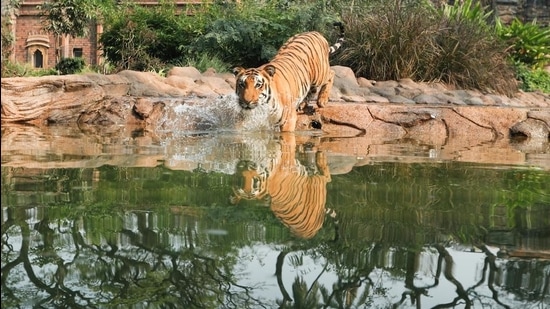
A team of researchers from Stanford University, the National Centre for Biological Sciences (NCBS) in Bengaluru, and various zoological parks and wildlife NGOs sequenced 65 genomes from four of the surviving tiger subspecies—Amur tigers, Bengal tigers, Sumatran tigers and Malayan tigers—over a period of three years to gain insight into the genomic variation in tigers.
The study published in journal of Molecular Biology and Evolution published on February 16 suggests that these four tiger subspecies are genetically distinct but there is inbreeding among Indian tigers, which is a result of isolated populations due to habitat loss. “What the paper points out is that although Indian tigers as a whole (all Indian tigers looked at in this study) have the highest amount of variation compared to any other subspecies, some Indian tigers do show signs of possible inbreeding or founding events (loss of genetic variation). We do not see this, by comparison, in the Russian far east or Amur tigers. They have very low variation, but individuals do not appear to be inbred,” explained Uma Ramakrishnan, co-senior and co-corresponding author, NCBS. Another co-author from India is YV Jhala, Wildlife Institute of India’s faculty of wildlife science dean.
Also Read | Mumbai’s Byculla zoo reopens after Covid shutdown, draws 1,400 visitors on Day 1
{{/usCountry}}Also Read | Mumbai’s Byculla zoo reopens after Covid shutdown, draws 1,400 visitors on Day 1
{{/usCountry}}Several individual tigers in India had low genetic variation, suggesting possible inbreeding, but tigers from northeast India were the most different from other populations in India.
Genomes of Amur tigers suggest adaptation to the extreme cold, while those of Sumatran tigers suggest adaptation based on body size, which is comparatively smaller. “The tiger is an excellent example of the myriad historic events that sculpt species’ genomic diversity and points to the importance of understanding this diversity as we attempt to stave off extinction of our most precious species on Earth. While some populations demonstrate the importance of adaptation to local conditions, other evidence suggests that particular populations may suffer the effects of climatic change in the Anthropocene,” co-senior author Elizabeth Hadly of Stanford University said in a statement issued by NCBS.
The study suggests that extreme fragmentation and high human population density in India has resulted in isolated populations, where individuals may be more likely to mate with relatives (inbreeding). In contrast, despite low Amur tiger population densities in the Russian Far East, individual movement is not hindered by significant barriers and there is less inbreeding.
“Tigers will continue to lose genetic variation. Further, inbreeding due to living in small and isolated populations could cause inbreeding depression, or lowered survival. We do not have any evidence for inbreeding depression yet, but it is something we should study,” Ramakrishnan added.
The paper has recommended managing local populations by minimising anthropogenic pressures as a conservation strategy for future. “In summary, ongoing human impacts like fragmentation will likely continue to disrupt natural evolutionary processes in wild tigers. Managing local populations to minimise human impact may be the key to species survival, and the important conservation strategy for the Anthropocene. Additional historical and genomic sampling may provide an informed roadmap for genetic rescue and augmentation.”
Genetic variation is like money in the bank: the more you have, the better your chances of survival in the future. Population bottlenecks decrease genetic variation, especially in endangered species, the NCBS statement said.