Future military power will depend less on the number of platforms a country possesses and more on how quickly it can sense, understand, decide and act, Defence Minister Rajnath Singh said on Saturday, stressing the importance of self-reliance and international cooperation amid the changing nature of warfare.
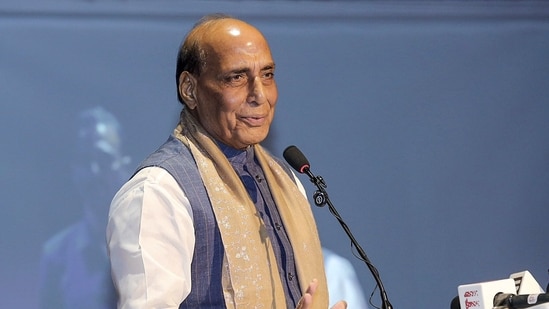
Addressing participants of the second edition of Exercise Tarang Shakti 2026 at Air Force Station Jodhpur, Singh said modern warfare was expanding beyond land, sea and air into space, cyberspace, the electromagnetic spectrum and the information domain. He highlighted the growing role of drones, unmanned systems, artificial intelligence, electronic warfare and long-range precision weapons in military operations.
Hosted by the Indian Air Force (IAF) from September 26 to October 12, the multinational exercise brought together air forces from seven countries — Australia, Bangladesh, France, Germany, Sri Lanka, the United Arab Emirates and the United States — with another 32 nations participating as observers.
Also Read | IAF chief ribs US general over F-35 at combat drills
Building on the inaugural edition held in 2024, the exercise brought together combat, transport, surveillance and air-to-air refuelling capabilities, enabling joint mission planning, operational learning and closer coordination. Indigenous platforms, including the Light Combat Aircraft Tejas and Light Combat Helicopter Prachand, also featured in the exercise.
{{/usCountry}}Building on the inaugural edition held in 2024, the exercise brought together combat, transport, surveillance and air-to-air refuelling capabilities, enabling joint mission planning, operational learning and closer coordination. Indigenous platforms, including the Light Combat Aircraft Tejas and Light Combat Helicopter Prachand, also featured in the exercise.
{{/usCountry}}Singh said “India had adopted self-reliance in defence as a national policy, recognising the need to produce its own weapons and critical technologies to withstand prolonged conflicts and periods of uncertainty.” Self-reliance, he said, meant developing domestic capacity to design, manufacture, maintain and upgrade critical defence technologies, without retreating into isolation.
He cited indigenous programmes such as the Tejas fighter aircraft, Dhruv, Rudra and Prachand helicopters, the Akash air defence system and the Advanced Medium Combat Aircraft (AMCA). India, he said, was keen to cooperate with like-minded countries in research, joint development, production, maintenance, training and innovation.
Also Read | LCA Mk-1A, LCA Mk-2, MRFA: Key projects new IAF chief is expected to push
“The defence relationships of the future will be about technology and trust, not just about platforms,” Singh said.
Multinational exercises, he said, allowed air forces to exchange operational knowledge, test procedures and learn from different approaches to training and mission planning.
“Different nations. Different aircraft. Different experiences. But one sky. That is the message of Tarang Shakti,” he said.
Also Read | Defence Ministry sets record straight on Operation Sindoor fallen heroes’ 2025 honour
Singh urged the IAF to incorporate lessons from the exercise into its training, tactics, technology, doctrine and future capability development. Referring to Operation Sindoor, he said it had demonstrated the IAF’s ability to conduct precise, calibrated and effective operations in pursuit of national security objectives.