Prime Minister Narendra Modi on Tuesday said that financial crimes and terrorism were linked through “dirty money”, and urged Interpol to facilitate wider global cooperation to deal with the dual threat, rather than letting these issues be tackled at the local level.
Law enforcement agencies have to devise new procedures to deal with the menace, the Prime Minister said at the 90th General Assembly of Interpol, the international organisation that coordinates worldwide police collaboration and crime control.
“Let communication, collaboration and cooperation defeat crime, corruption, and terrorism,” Modi said, while inaugurating an assembly that is being held in India for the first time in 25 years, and has representatives from 195 countries in attendance. Union home minister Amit Shah and Interpol president Ahmed Naser Al-Raisi were on the dais with Modi.
Calling on the global law-enforcement community to work faster to “eliminate safe havens” for terrorists, criminals and the corrupt, Modi said when the “forces of good cooperate, the forces of crime cannot operate”. “The pace of change of these dangers is faster than earlier. When threats are global, the response cannot be just local. It is high time that the world comes together to defeat these threats,” Modi said.
During his speech, Modi listed five principal international crimes — terrorism, corruption, drug trafficking, poaching and organised crime — and detailed why each of them needs both a concerted and coordinated effort.
{{/usCountry}}During his speech, Modi listed five principal international crimes — terrorism, corruption, drug trafficking, poaching and organised crime — and detailed why each of them needs both a concerted and coordinated effort.
{{/usCountry}}But he particularly drew the link between financial crimes and global terror.
“Corruption and financial crimes have harmed the welfare of the citizens of many countries. The corrupt find a way to park the proceeds of crime in different parts of the world. This money belongs to the citizens of the country from which they have been taken. Often, this has been taken from some of the poorest people in the world. Further, it is such money that is pushed into evil activities. This is one of the major sources of terror funding,” Modi said.
“From illegal drugs that destroy young lives to human trafficking; from weakening democracies to the sale of illegal arms, this dirty money funds many destructive enterprises,” he added.
The PM’s remarks on terrorism come at a time when the global money laundering and terrorist financing watchdog — Financial Action Task Force — is set to decide at a plenary meeting this week whether to remove Pakistan from its “grey list” of countries facing enhanced monitoring. Pakistan was included in the grey list in June 2018 for failing to do enough to counter terror financing and money laundering.
In his 14-minute speech, Modi said that India has been dealing with cross-border terrorism from long before the world woke up to it — a reference to Pakistan-based and supported terror outfits — and called for a global order where the problem is tabled holistically.
“At a time when nations and societies are becoming inward-looking, India calls for more, not less, international cooperation. Global cooperation for local welfare — is our call,” Modi said.
This, the PM added, was because diverse legal and procedural frameworks at the local level were not enough to tackle threats that are changing rapidly in a technology-driven world.
“There is a need for the global community to work even faster to eliminate safe havens. There can be no safe havens for the corrupt, terrorists, drug cartels, poaching gangs, or organised crime,” he said.
“At the click of a button, an attack can be executed or systems can be brought to their knees. Each nation is working on strategies against them. But what we do within our borders is no longer enough. Establishment of early detection and warning systems, protecting transportation services, security for communication infrastructure, security for critical infrastructure, technical and technological assistance, intelligence exchange — many of these things need to be taken to a new level,” Modi added.
The Prime Minister, to this end, also asked Interpol to speed up “red notice” requests for the fugitive offenders. “Police and law enforcement agencies need to devise procedures and protocols to increase cooperation. Interpol can help by speeding up red notices for fugitive offenders,” Modi said.
Interpol is often criticised by experts for sitting on India’s request for red notices against wanted fugitives involved in terror attacks or high-value frauds. A “red notice” allows 195 member countries to track and arrest a fugitive in their respective jurisdiction. Currently, there are 780 red notices active on India’s request, of which 205 are related to criminals wanted by the Central Bureau of Investigation (CBI).
Underlining India’s efforts for global causes, the PM said from climate targets to Covid-19 vaccines, India has shown willingness to take the lead in any crisis. “And now, at a time when nations and societies are becoming inward-looking, India calls for more, not less, international cooperation. Global cooperation for local welfare – is our call,” he said.
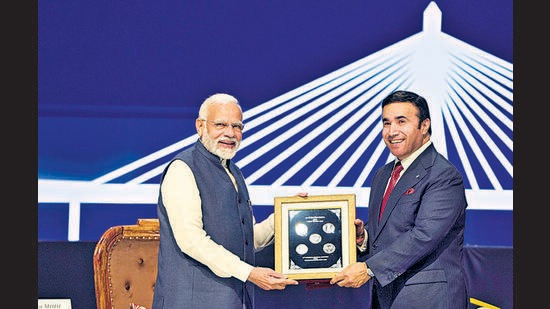
Speaking at the event, Interpol president Al-Raisi said he was committed to a modern Interpol, enhancing transparency and supporting collaboration between police organisations of member countries.The PM also released a commemorative postage stamp and a ₹100 coin to mark the 90th General Assembly.
During the four day event — from October 18 to 21 — the Interpol member countries will discuss issues pertaining to cross-border terrorism, international fugitives, cyber crimes, financial crimes, online child sexual abuse, organised crime, and war crimes.
“Criminals have no notion of national boundaries. Be it economic crimes, money laundering or terrorism, they are operating from all over. There is definite need for elaborate sharing of information, so that crimes can be solved faster. Prioritising global cooperation will lead to solve the crimes faster and even prevent them. So, the call given by PM is the way forward,” said former CBI director Rishi Kumar Shukla.