The Indian Space Research Organisation (ISRO) Chief S Somanath revealed on Monday that the country’s space agency is gearing up to achieve a significant milestone with a Geosynchronous Launch Vehicle (GSLV) mission scheduled in January set to become the 100th launch from the Sriharikota spaceport.
The 99th launch from Sriharikota was Monday's PSLV-C60 mission which successfully placed two spacecraft for conducting the Space Docking Experiment in a circular orbit.
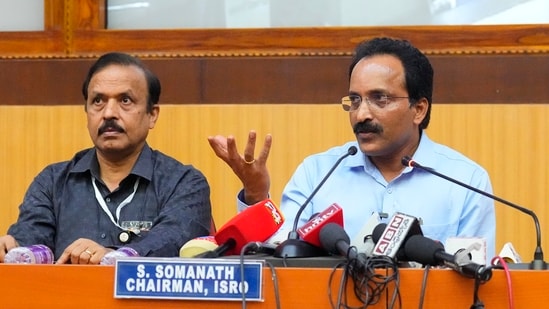
"So, all of you have seen the majestic lift-off and the launch of the SpaDeX (Space Docking Experiment) rocket, and for us, this is the 99th launch of any vehicle from Satish Dhawan Space Centre so, that is also a very important number. So, we are going for the 100th launch at the beginning of the next year", Somanath told the press after the launch of the PSLV-C60 mission, PTI reported.
SpaDeX mission is a cost-effective technology demonstrator mission for the demonstration of in-space docking using two small spacecraft launched by PSLV.
According to the space agency, the primary objective of the mission is to develop the technology needed to achieve in- space docking and undocking using two small spacecraft.
{{/usCountry}}According to the space agency, the primary objective of the mission is to develop the technology needed to achieve in- space docking and undocking using two small spacecraft.
{{/usCountry}}Somanath expressed hope that many more Space Docking Experiments would be taken up by the scientists in the coming days.
"It is really an important mission with (India's) space sector reforms and expansion of space activities. There will be many more SpaDeX varieties including complex missions of docking systems in the coming days," he said
ISRO chief hopeful about the coming year
On future launches planned by ISRO, S Somanath expressed hope that the space agency will have many missions in the coming year of 2025.
“In 2025, we will have many missions to start with the GSLV launching the (navigation satellite) NVS-02 in the month of January," he told reporters.
ISRO successfully placed a navigation satellite onboard the GSLV-F12/NVS-01 rocket in May 2023. This GSLV rocket successfully deployed the NVS-01 navigation satellite, weighing about 2,232 kg into a Geosynchronous Transfer Orbit (GTO).
The NVS-01 was the first of the second-generation satellites envisaged for the Navigation with Indian Constellation (NavIC) services.
Meanwhile, referring to the rescheduling of the PSLV-C60 rocket from the earlier planned 9.58 pm to 10 pm on December 30, Somanath said, scientists do a conjunction study to check whether a satellite going to an orbit comes very close to another satellite while travelling in the same orbit.
"If you find there is any close proximity (between satellites), then we have to move the current satellite a little bit. Either, we delay it (the launch) or make it early, so that this proximity condition does not occur," he said.
Scientists undertook time to fix the launch for the lift-off and decide on the best time which gives the maximum distance to be away from the other satellite in the orbit, he added.