
 E-Paper



HAL helped IAF 24 hrs a day in Op Sindoor, says Rajnath
Defence Minister Rajnath Singh praised HAL's 24/7 support to the IAF during a recent conflict, highlighting new production lines for LCA Mk-1A and HTT-40.

 Prefer HTon Google


Defence minister Rajnath Singh on Friday hailed round-the-clock support provided by aircraft maker Hindustan Aeronautics Limited (HAL) to the Indian Air Force during the four-day military confrontation between India and Pakistan in May, adding that the firm ensured that the country’s fighter jets and helicopters were battle-ready at all times.
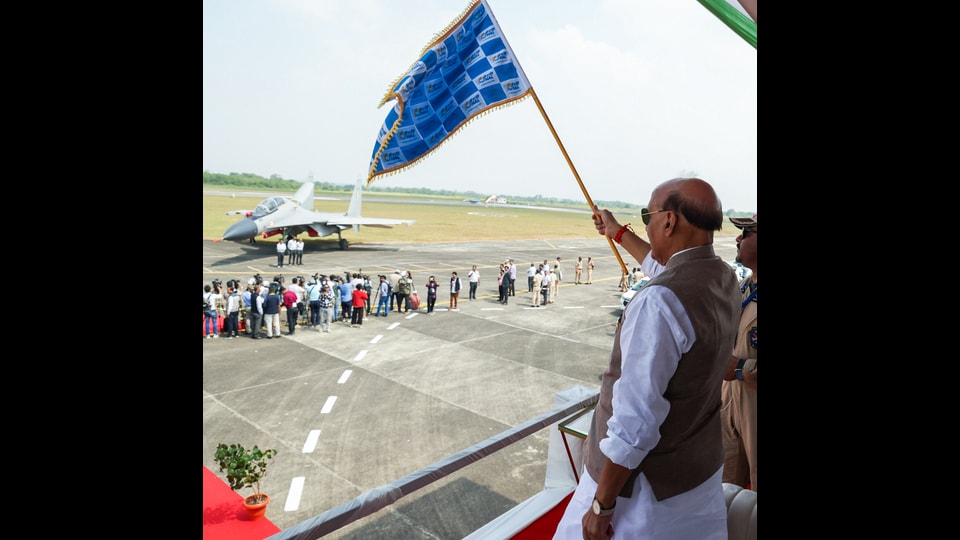
“HAL provided support at various operational sites 24 hours a day during Operation Sindoor. It ensured the IAF’’s operational readiness by carrying out prompt maintenance on fighter jets and helicopters,” Singh said at Nashik after inaugurating new production lines of the light combat aircraft (LCA Mk-1A) and the HTT-40 basic trainer to meet the air force’s growing needs.
He also flagged off the first LCA Mk-1A produced at Nashik.
HAL’s Nashik Division had integrated the BrahMos supersonic cruise missile with the IAF’s Russian-origin Su-30 fighter jets.
“The Nashik team performed the crucial task of installing the BrahMos missile on the Su-30, which destroyed terrorist hideouts during the operation. This proved that when it comes to national security, we can make our own equipment and protect ourselves with it,” Singh said.
Operation Sindoor marked New Delhi’s direct military response to the April 22 Pahalgam terror attack in which 26 people were killed. India launched the operation in the early hours of May 7 and struck terror and military installations in Pakistan and Pakistan-occupied Kashmir (PoK).
The inauguration of the LCA Mk-1A production line --- India’s third, and the first outside Bengaluru --- comes weeks after the defence ministry signed a ₹62,370-crore contract with HAL to buy 97 more LCA Mk-1As for the IAF which is wrestling with a worrying shortage of fighter jets.
“LCA Mk-1A and HTT-40 production lines are proof of government-industry-academia synergy. No challenge is too big if faced together,” Singh said, acknowledging the trust placed by the IAF in the two platforms. The new contract for 97 aircraft took the total number of LCA Mk-1As ordered by the government so far to 180 — it had ordered 83 such fighter jets for ₹48,000 crore in February 2021 to shore up the IAF’s fighter fleet.
To be sure, none of the fighters ordered four years back has been delivered yet. The IAF could get the delivery of the first of the 83 jets shortly.
HAL can build 16 Mk-1As every year in Bengaluru, and the Nashik production line will help it ramp production to a total of 24 jets.
The HTT-40 production line is HAL’s second, and the first outside Bengaluru. HAL hopes to deliver the first HTT-40, powered by Honeywell’s TPE331-12B turboprop engine, to the IAF in January 2026 and 11 more before the financial year ends under a ₹6,838-crore contract signed two years ago with the government for 70 locally made basic trainer aircraft.
A large part of Singh’s address focused on boosting self-reliance in the defence manufacturing sector. “The country, which once imported 65-70% of critical military hardware, is now manufacturing 65% of the equipment on its own soil,” he said, adding that the government was committed to increasing it to 100% in the times to come.
HAL chief DK Sunil termed the successful operationalisation of the LCA Mk-1A and HTT-40 production from Nashik as a testament to the firm’s capacity for expansion. “HAL’s Nashik Division’s capacity to produce indigenous advanced fighters, in addition to Su-30s, has added momentum to our production efforts to meet delivery timelines. It has also resulted in the creation of around 1,000 jobs and the development of more than 40 industry partners in and around Nashik, aligning with the government’s goal of forging an effective public-private partnership,” he added.
The Nashik Division was set up in 1964 for the licensed production of MiG-21 fighters --- the last of which were decommissioned by the IAF in September. The division has produced more than 900 aircraft and overhauled another 1,900 military aircraft, from MiG-21 and MiG-27 to Su-30.


