Happy Diwali, but do not lower your guard against Covid-19
Covid-19 cases in India have been falling, more than a billion doses of vaccines have been administered, most studies show the high prevalence of Covid antibodies among people, and high frequency indices on the economy and mobility are looking up
Covid-19 cases in India have been falling, more than a billion doses of vaccines have been administered, most studies show the high prevalence of Covid antibodies among people, and high-frequency indices on the economy and mobility are looking up. On all these counts, this Diwali is a lot better than last year. Yet, two years of experience with the pandemic – researchers estimate November 17, 2019 to be a likely date when the first Covid-19 case was detected in China
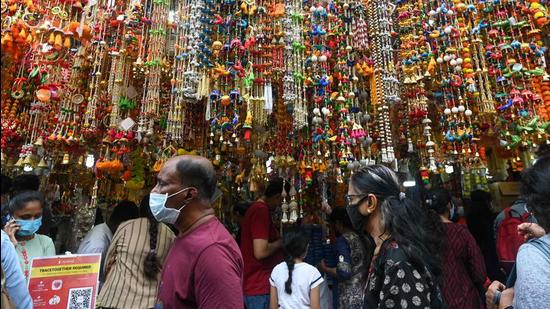
People queue outside a shop to buy goods and decorative ornaments on the eve of Diwali. (AFP Photo)
Even better vaccinated Europe is witnessing a surge
{{^usCountry}}{{/usCountry}}
The biggest change between now and a year ago, as far as the global fight against the pandemic is concerned, has been the availability of vaccines. There is a massive inequality among countries when it comes to vaccination coverage. However, what is really concerning about the recent spike in Covid-19 cases is the fact that even countries with higher vaccination coverage are experiencing a rise in number of Covid-19 cases. For example, the share of population which has been fully vaccinated in Hungary and Germany is 60% and 66%, yet, these countries are at the top of the list in terms of growth in number of daily new cases.
India accounts for only 3% of global cases right now
The seven-day average of India’s contribution to new Covid-19 cases was just 3.12% on November 2. This number has been declining with brief interruptions for 176 days now and is far lower than both peaks of India’s contribution to global cases. In the week ending 11 September 2020, India contributed 34% to global cases (the first peak of India’s share in global cases). In the week ending May 10 this year – the second peak of India’s contribution – the country’s share was 50.5%.
Past Covid-19 surges associated with public events and festivals
While India’s Covid-19 trajectory is on the decline right now, a disruption in this will not be surprising in the festival season. India’s first wave – in terms of 7-day average of cases – peaked on 16 September 2020. This number kept falling until October 31. However, from November 1 (five days after Dussehra) to November 8, the growth rate of cases was positive on six days. From November 19 (five days after Diwali) to November 24, the growth rate was again positive. Cases continued to decline after that until another cocktail of mass gatherings – the Kumbh Mela starting January (despite being officially restricted to April), Holi and the election campaign in four states (the polls were announced on February 26) led to a surge in cases. To be sure, this is also when the Delta variant struck in India. For close to three months -- from February 15 to May 6 -- the growth rate of seven-day average of cases remained positive every day, leading to a second wave peak on May 9 (seven-day average of 391,819 cases) that was four times as big as the first wave peak (average of 93,617 cases).
A middling share of fully vaccinated people means India needs to remain cautious
While India has done a credible job in administering at least one dose of Covid-19 vaccine to almost 80% of its adult population, only 36% of adults has been fully vaccinated. European countries with higher shares of fully vaccinated population are experiencing a surge in cases.
The festive season has seen some much-needed momentum in economic activity and mobility levels and sustained efforts are being taken towards normalizing other important activities such as resumption of physical classes in schools and colleges. It will be a travesty if a reversal in the caseload trajectory on account of carelessness were to disrupt the much-awaited normalization of the economy, education and life in general.
Abhishek Jha is Assistant Editor-Data at Hindustan Times. He uses statistical programming to generate newsworthy insights from large datasets. He is part of the team that produces Number Theory, a daily data story feature of the paper’s print edition. Since March 2024, he has been writing Weather Bee, a weekly column for the Hindustan Times website. He is a chemical engineer by training, who specialises in stories related to weather, climate, and the environment. Jha has been at HT since 2018, where he offers data-driven perspective and analysis on politics, environment, weather, climate, economy and society. His work includes data coverage of elections in India and abroad, including the 2019 and 2024 Lok Sabha elections; the disasters and extreme weather resulting from changing climate, such as floods, droughts, heat waves, cold waves, and dwindling snow cap in the Himalayas; the factors that drive poor air quality in northern India; the changing patterns of land use; the Covid-19 pandemic and its impact on labour market conditions; the changing pattern of consumer spending seen in the new consumer spending surveys; and social norms seen in the surveys such as the National Family Health Survey.
Get Latest News, breaking headlines, and top India News, and today real-time updates from across the nation. Stay informed on politics, government policies, crime, Today Weather, and major developments on Hindustan Times
Get Latest News, breaking headlines, and top India News, and today real-time updates from across the nation. Stay informed on politics, government policies, crime, Today Weather, and major developments on Hindustan Times
Home/India News/Happy Diwali, but do not lower your guard against Covid-19
SHARE THIS ARTICLE ON
{{#usCountry}}{{/usCountry}}
Notifications
Get breaking alerts directly from the newsroom
Notifications are on!You'll be notified when news breaks