
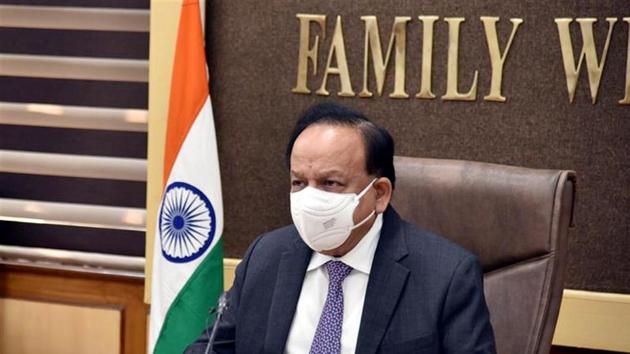
Union health and family welfare minister, Dr Harsh Vardhan, on Monday approved the health data management policy of the National Digital Health Mission (NDHM) that intends to digitise the entire healthcare ecosystem of India by creating digital health records and creating and maintaining registries for healthcare professionals and health facilities. The moves comes in a bid to ensure a smooth interoperable framework for the multiple partners associated with healthcare delivery to individuals in the country.
The National Health Authority (NHA), which is the implementing agency, has also notified the final approved policy.
The NHA had placed the draft of the policy in the public domain between August 20 and September 21, to seek feedback and suggestions from citizens and stakeholders soon after the launch of the NDHM by the Prime Minister Narendra Modi.
After extensive stakeholder consultations and feedback, the policy was further modified based on inputs received from the public.
Also read: Don’t go during the pandemic - AIIMS appeals as nurses’ union threaten strike
“After over a month of soliciting feedback from various stakeholders and the general public, we received 910 comments and suggestions via 6,983 emails and through the website. Many of these inputs and suggestions were found to be quite pertinent and deserving more attention. We incorporated them to revise the draft policy and sent it to the Union Ministry of Health and Family Welfare for final review and approval. We are happy that the policy has been approved by the health minister and we can now start the field preparations for the roll-out of the NDHM across India,” said Indu Bhushan, CEO, NHA.
The policy acts as a guidance document across the National Digital Health Ecosystem (NDHE) and sets out the minimum standard for data privacy protection that should be followed across the board to ensure compliance with relevant and applicable laws, rules and regulations.
{{/usCountry}}The policy acts as a guidance document across the National Digital Health Ecosystem (NDHE) and sets out the minimum standard for data privacy protection that should be followed across the board to ensure compliance with relevant and applicable laws, rules and regulations.
{{/usCountry}}Participation of an individual in the NDHE will be on a voluntary basis. Those who wish to participate will be issued a unique health ID after verification through a valid government document, including the Aadhaar card.
However, use of Aadhaar card for verification will also be voluntary, and failure or refusal to make use of Aadhaar would not result in the denial of access to any health facility or service under the policy.
The National Digital Health Blueprint, 2019, recommends that a federated architecture be adopted, instead of a centralised architecture, for the management of digital health data to ensure interoperability, technological flexibility and independence across the NDHE.
Government will now work on the guidelines for the implementation of the policy that is likely to be updated from time to time to make it more relevant in the current times.
ABOUT THE AUTHOR
Follow the latest breaking news, major developments and agenda-setting stories from India and around the world with the newsdesk at Hindustan Times. Operating round the clock, the desk brings together experienced editors, reporters and correspondents to deliver fast, accurate and contextual reporting across subjects that influence public policy, governance, business, society and international affairs. The HT News Desk covers politics, elections, government policies, the economy, business and markets, science and technology, the environment, law and order, infrastructure, education, climate issues and geopolitics, while closely tracking developments across states, institutions and global capitals. The team also leads coverage of major breaking news events, policy announcements, court proceedings, natural disasters, public emergencies and significant international developments. Reports published by the newsdesk are based on information gathered from reporters on the ground, official statements, government agencies, court records, regulatory filings, recognised institutions and other authoritative sources. Stories undergo editorial scrutiny and verification processes to ensure accuracy, fairness and relevance, and are updated as events evolve and additional information becomes available. Whether covering a key political decision in New Delhi, an economic policy shift affecting millions, a landmark court ruling or a major global event, the HT News Desk aims to provide readers with reliable, fact-based journalism that delivers not only the latest developments but also the context and analysis needed to understand their wider implications.