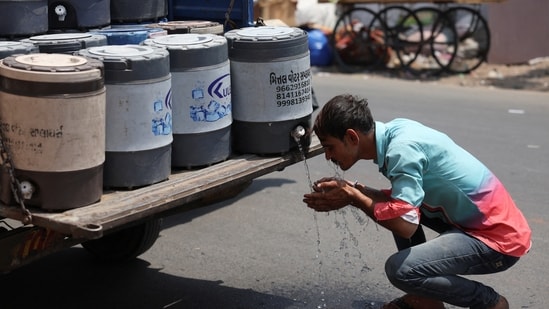
Delhi felt like a furnace for a fourth straight day on Monday when six of the fifteen NCR weather stations recorded temperatures exceeding 46 degrees Celsius (°C), prompting weather officials to extend a red alert till Friday and the government to order schools still open to shut for summer vacations.
The Safdarjung station, the base station for the capital, recorded a maximum of 44.1°C, just half a notch below the threshold at which it would be classified as a technical heatwave.
Amid heatwave, Delhi's peak power demand touches May's highest-ever level
In at nine least other National Capital Region (NCR) stations, the maximum was high enough to formally be called a heatwave as the mercury soared to meet the 4.5-degrees-higher-than-normal yardstick for the label.
The meteorological technicalities aside, the weather felt equally oppressive across the region, and in fact most of northwest India, where hot, strong winds continued to blow under the glare of strong sunshine.
All government schools are closed with effect from May 11 but “it has been observed that some government-aided and unaided recognised private schools are still open during ongoing severe heat waves… Therefore, all the heads of [such] schools are advised to close the schools for summer vacation with immediate effect,” said a circular by the department of education, Delhi government.
{{/usCountry}}All government schools are closed with effect from May 11 but “it has been observed that some government-aided and unaided recognised private schools are still open during ongoing severe heat waves… Therefore, all the heads of [such] schools are advised to close the schools for summer vacation with immediate effect,” said a circular by the department of education, Delhi government.
{{/usCountry}}The scorching conditions first set in on Friday, when the maximum crossed 45°C at nine stations in the region. On Monday, a total of 11 stations logged temperatures higher than 45°C and the India Meteorological Department warned the peak could soar to 48°C in parts of NCR in the coming days.
Najafgarh in Southwest Delhi recorded the country’s hottest temperature with a maximum of 47.4°C, followed by Sirsa (47.2) in Haryana and Mungeshpur (47.1) in northwest Delhi.
The high temperatures and a working day also saw Delhi’s peak power demand touch 7,572 MW, the highest so far this year and higher than last year’s peak power demand. Delhi’s all-time high of 7,695 MW was recorded in June 2022.
The coming week will also see election campaigning reach a fever pitch in the Capital, which will go to polls on Saturday. The IMD has issued a “green” alert for that day, which indicates no extreme weather event is likely, but the agency also predicted conditions to not be too different.
“There has been no change in weather conditions over the last few days. Heatwave to severe heatwave conditions were recorded in Delhi NCR again, with a slight drop in temperature in comparison to Sunday. There are chances the maximum could touch 45°C at Safdarjung by Tuesday and possibly 46°C by Friday. The same maximum is likely on Saturday too,” said an IMD official, asking not to be named.
Last May, Delhi logged no heatwave days, while four such days were recorded in May 2022. In April 2022, nine such days were recorded — although not on consecutive days.
Mahesh Palawat, vice president at Skymet meteorology, said large parts of northwest India were facing uncomfortable weather primarily due to clear skies and dry westerly winds. “These winds are blowing from dry Rajasthan and Balochistan, where temperatures are equally high. There is no moisture in the air, which makes the heat harsh and makes standing outside difficult,” he said.
The IMD has three colour-coded alerts for weather events across the country, with the highest form of alert currently in place for most parts of northwest India. The first, a yellow alert is issued to alert the public about a weather event. The second, an orange alert, is issued, asking people to be prepared for an extreme weather event. The highest red alert is issued when an extreme weather event requires extreme vigil and caution from the people.
The Met office on Monday, continued to ask people to stay indoors as much as possible, adding hydration, even when not thirsty, was advisable in this heat.
Delhi’s minimum temperature — recorded overnight — too is on the rise and was recorded at 29.2°C. This was three degrees above normal and the highest minimum so far this year.
Delhi’s power discoms, BSES, and Tata Power DDL said they were able to handle the peak power demand without any outages or problems. BSES subsidiaries, BRPL and BYPL, said they successfully met the peak power demand of 3,274 MW and 1,664 MW respectively in their jurisdictions.
A Tata Power DDL spokesperson meanwhile said it successfully met a peak power demand of 2,178 MW in its jurisdiction.
Experts say with this prevailing heatwave, it was important to have action plans in place while also generating awareness about the possible impact of such weather.
Close schools for summer vacation immediately, says Delhi govt amid heatwave
“This summer season, the effect of El Nino has caused an increase in temperature across various states in India and it is thus imperative for all the cities and states in India to develop their heat action plans. These plans must provide a detailed list of adaptation and mitigation measures for citizens, communities, and decision-makers to cope with the ongoing heatwaves,” said Vishwas Chitale, senior programme lead, Council on Energy, Environment and Water (CEEW), adding that Delhi’s draft Heat Action Plan needed to be notified and implemented soon.
“The plan includes generating awareness among citizens about the potential impacts of heatwaves, establishing infrastructure such as cooling shelters and providing public access to clean drinking water in public spaces,” he added.
In terms of air quality, Delhi’s air remained poor for an eighth consecutive day. The average Air Quality Index (AQI) improved marginally from 243 (poor) on Sunday to 226 (poor) on Monday.