In Himachal Pradesh's Parvati Valley, a picturesque tourist destination in the Kullu district, a multi-agency operation is underway against illicit cannabis cultivation.
Parvati Valley has become infamous for the production and trafficking of high-quality hashish(hash). An NCB officer said the crackdown aims not only to nip the problem in the bud by targeting cultivation at its source but also because drugs sourced from elsewhere are sold or marketed as originating from the region in north India.
Hashish (and marijuana) is sold at several times the normal street price after being tagged as a product of the sacred Parvati Valley. Officials believe sustained action against illicit cultivation across the valley, which lies beside the Parvati River, is crucial to prevent its exploitation as a narcotics trade hub.
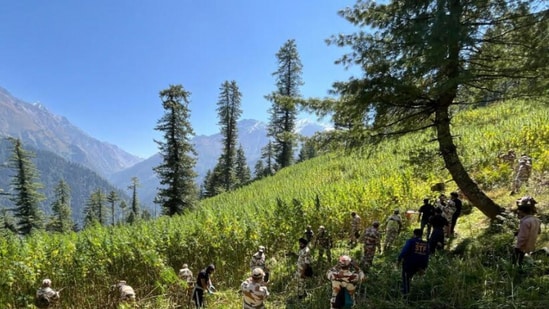
An NCB spokesperson said that at least 592 acres of illicit cannabis cultivation have been destroyed in Kullu over the last two months. The teams used current and historical satellite images to track and destroy the cultivation by burning it. Over the last two months, different agencies have scaled slopes ranging from 2000 to 4000 metres to destroy cannabis cultivation in the valley.
“The joint operation was carried out by the Narcotics Control Bureau(NCB), Indo-Tibetan Border Police(ITBP), Himachal Pradesh police and the State forest department in Parvati Valley. The teams climbed steep forested slopes at 2100- 3050 m near Tosh to reach heights inaccessible by road. The teams cut and burned the illicit crop on site, with geo-tagged photographs. Teams are now moving to Kasol for the next phase. Different agencies collaborated on this operation," the spokesperson added.
Officials said the drive is part of the Centre’s war on drugs, which aims to dismantle drug networks by December 31, 2029 - a target announced by Union home minister Amit Shah last month. HT has seen a government plan to achieve zero illicit cultivation in known areas (hotspots) by December 2027.
Parvati Valley as a drug hotspot
{{/usCountry}}Officials said the drive is part of the Centre’s war on drugs, which aims to dismantle drug networks by December 31, 2029 - a target announced by Union home minister Amit Shah last month. HT has seen a government plan to achieve zero illicit cultivation in known areas (hotspots) by December 2027.
Parvati Valley as a drug hotspot
{{/usCountry}}The valley in HP’s Kullu district is often in the news for tourists, including many foreigners visiting the beautiful valley to use and smuggle the famous Parvati Valley hashish. In recent years, it has also been in the news for the rave and drug parties.
Earlier this year, Russian psytrance and dark electronic DJ DashAlien Dazura, born Daria Kuzminykh, a Moscow-born artist, also known online as Dasha and Dishaleen, died from a suspected drug overdose in a hotel in Kasol.
On June 6, the Himachal Pradesh High Court also directed the police and the administration to investigate complaints about rave parties. The Himalayan Environment Protection Society, Kullu, had earlier complained to the court about 'rave parties' in Kasol, Jibhi, Manali and other parts of Kullu. The court was also informed that "entry tickets to these parties ranged from Rs. 5000/- to Rs. 7,00,000/- and the videos of these parties are available on the website, and drugs are openly available at such events."
“The crackdown will ensure that the region is not exploited for narcotics. On the streets, many a time, people also sell hashish or marijuana by branding it as sourced from Parvati Valley. It is said that the temperature, water, air, and the altitude of the valley make it the best place across India for cannabis cultivation. This is why the hash that comes from the cannabis plant of Parvati Valley is in high demand," one NCB officer, who asked not to be named, said.
"This region in Kullu is a historical and spiritual place, but is often in the news for the wrong reasons. 90% of tourists come here for spiritual tourism, meditation, and trekking to places such as Kheerganga and Tosh. The 10% who indulge in drugs and rave parties are the reason why the valley has gained notoriety. It may take time, but if the crackdown on cannabis cultivation is continuous and illicit cultivation reaches zero, no one will be able to not just sell drugs from here but also misuse the valley's name to sell their product," the officer added.
Anti-drug vision document
Identifying hotspots and destroying cultivation are among the key measures mentioned in the government’s Vision Document 2026-2029. Home minister Amit Shah launched the Vision Document 2026-2029 on June 26, which contains measurable targets and a three-year national plan covering policing, prevention, and rehabilitation.
Prime Minister Narendra Modi has vowed to make India drug-free by 2047. India’s nodal anti-drug agency, the Narcotics Control Bureau (NCB), finalised the vision document after consulting with different agencies and presenting it twice to Shah before approval, publication, and circulation among stakeholders.
According to the Vision Document, the government aims to have “zero illicit cultivation in known areas by December 2027 and in all areas by December 2029.”