
 E-Paper



Homecoming: India’s mission to bring back its lost artefacts
The repatriation of antiquities to India has seen been upscaled by several folds in the past few years

 Prefer HTon Google


New Delhi: When Prime Minister Narendra Modi returned to India after a three-day visit to the United States (US) in September, he brought along good news on the repatriation of antiquities front.
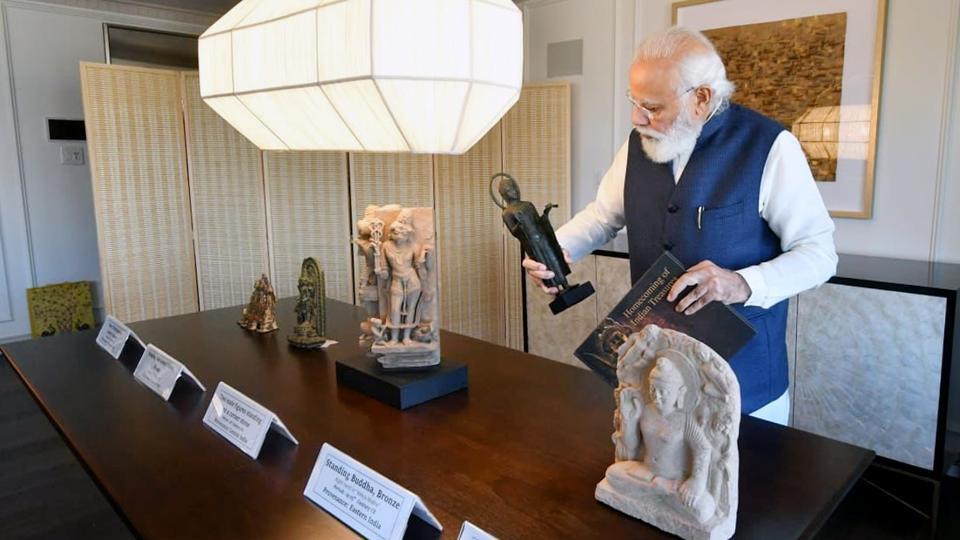
The US had offered to return 157 artefacts and antiquities, which include items ranging from an exquisite bronze Nataraja from the 12th Century and a one-and-a-half metre bas relief panel of Revanta in sandstone from the 10th Century among others treasured idols and artefacts. The process of return of the antiquities is ongoing and should be completed by the end of December or early January, as per Archaeological Survey of India (ASI) officials.
Subsequently in November, during an episode of Mann Ki Baat, Modi announced that an ancient idol of the goddess Annapurna, stolen from India about a century ago, was being brought back from Canada. The idol was eventually returned to the Uttar Pradesh (UP) government.
The repatriation of antiquities to India has seen been upscaled by several folds in the past few years. Last month, G Kishan Reddy, Union minister for culture, tourism and development of the Northeastern region, shared that prior to 2014, only 13 idols and heritage objects were returned to India. As per ASI data, a total of 119 antiquities have been brought back to India. Prior to 2014, 13 antiquities were brought back before 2014 while 106 antiquities were brought back after 2014.
An ASI official, who did not wish to be quoted, said, “The ASI is continuously working towards retrieving lost antiquities. The government has also been cooperative on this front and we hope to continue with our efforts.”
Bringing back lost artefacts
As per sources in the ASI, the official custodian of all such repatriated artefacts, the repatriation process is an ongoing process that can sometimes take months or even years.
DN Dimri, former ASI joint director-general, who also served as the director of the department of antiquities since 2014 said that the process usually involved consultation at multiple levels. He shared that antiquities in the country had been taken away in two phases — before and after Independence. The exodus increased particularly post-1972 when the Antiquities and Art Treasures Act came into place. The repatriation of antiquities in India is carried out as per the guidelines framed under the Antiquities and Art Treasures Act, 1972. Under the act, the movement of antiquities out of the country is banned.
“The movement of antiquities that are taken out of the country since 1972 counts as illegal export. Whenever such antiquities emerge in the international market, ASI, and other agencies initiate proceedings to get them back. Since the illegal export is ongoing, the retrieval process is also ongoing,” said Dimri.
Where do returned antiquities go?
As per the policies of repatriation, the retrieved objects have to be returned to the place of origin. However, the department also ensures that the custodian of the retrieved objects has the means of safeguarding the antiquities under their watch.
“By and large, the antiquities are returned back to the space of origin. While bringing the antiquities back to India, sometimes, we also take consent from the persons or the institutions from where they were stolen and assess the security arrangements at the original space of origin,” said Dimri.
However, despite an assessment from the standpoint of security, various antiquities have been stolen from the country. In response to a question in the Lok Sabha last week, G Kishan Reddy, recently shared that 14 antiquities had been stolen from centrally protected sites in the past six years.
Dimri said that while the museums and other places had security arrangements, the ministry and ASI did not have arrangements to stop the movement outside the country since customs authorities looked into the export of objects. “Tracking the channel through which the antiquities are being illegally exported since the customs are not able to manage all the channels. Sometimes the customs seek our opinion, but by and large, they do not work in tandem with the ASI,” said Dimri, adding that it was difficult to know the status of stolen antiquities and how many of them had crossed the Indian borders. He said that since 2014, he had initiated a review of the cases of stolen antiquities.
Way forward for antiquities
While as per the policies in place, antiquities are returned to the place of origin, sometimes, they are displayed in exhibitions or museums. While experts contend that displaying antiquities would benefit history lovers and curious visitors, the policies in place do not offer much scope for the same. “Some of the antiquities can be displayed in museums by the ASI. They are already displaying a number of antiquities that have been repaired at Purana Qila,” said Dimri.


