
 E-Paper



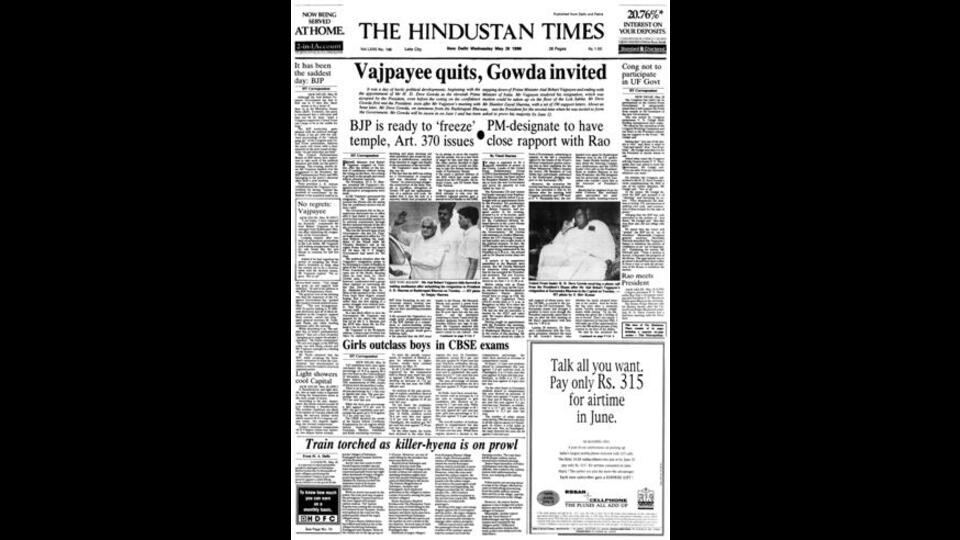
HT This Day: May 29, 1996 -- Vajpayee quits, Gowda invited
It was a day of hectic political developments, beginning with the stepping down of Prime Minister Atal Behari Vajpayee and ending with the appointment of Mr H. D. Deve Gowda as the eleventh Prime Minister of India. Mr Vajpayee tendered his resignation, which was accepted by the President, even before the voting on the confidence motion could be taken up on the poor of the Lok Sabha.

 Prefer HTon Google


It was a day of hectic political developments, beginning with the stepping down of Prime Minister Atal Behari Vajpayee and ending with the appointment of Mr H. D. Deve Gowda as the eleventh Prime Minister of India. Mr Vajpayee tendered his resignation, which was accepted by the President, even before the voting on the confidence motion could be taken up on the poor of the Lok Sabha. Mr Deve Gowda first met the President, soon after Mr Vajpayee’s meeting with Mr Shanker Dayal Sharma, with a set of 190 support letters. About an hour later, Mr Deve Gowda, on summons from the Rashtrapati Bha-wan, met the President for the second time when he was invited to form the Government. Mr Gowda will be sworn in on June 1 and has been asked to prove his majority by June 12.
BJP is ready to ‘freeze’ temple, Ar t. 370 issues
PRIME Minister Atal Behari Vajpayee resigned on Tues- day, after the debate on the motion of con6dence without facing the voting on the floor, but vowing to go back to the people and return with an absolute majority.
The President, Dr S. D. Sharma, accepted Mr Vajpayee’s resignation and asked him to continue till alternative arrangements were made.
As Mr Vajpayee announced his resignation, the Speaker adjourned the House sine die saying that the confidence motion was no more valid.
The Government fell on the inauspicious thirteenth day in office after it had failed to muster support but had successfully spoken to its national constituency through the live national telecast of the two daysproceedings of the Lok Sabha.
This was the shortest span of any Government-the late Charan Singh remained in office for 171 days without seeking the confidence of the House while Mr Chandra Shekhar’s rule as the eighth Prime Minister had lasted for 224 days. Mr V. P. Singh’s Government had lasted for 341 days.
The political situations after Mr Vajpayee’s resignation seems to be returning to a state of fluidity in spite of the 14-party group United Front. A section of the groups MPs came out of the House shouting Desk ka neta kaisa ho...Deve Gowda jaisa ho... They were, however, confronted with a which insisted on reiterating fact that Desh ka neta aisa ho...Mulayam Singh jaisa ho... Most of the partners of the United Front kept their fingers crossed hoping that it was enthusiasm rather than the first inkling of a power struggle even without power. They were separated by the security staff.
In a last-ditch effort to save his Government Mr Vajpayee was assisted by his allies wthe Akali Dal led by Mr S. S. Barnala and the HVP who chose Mr Jai Prakash to be its spokesman.
Mr Vajpayee in his 90-minute address, a major part of which was taken by repeated interruptions, heckling and plain shouting and what anywhere else would be construed as misbehaviour, switched from emotion to anger and finally to the acceptance of the inevitable.
Mr Vajpayee’s main thrust today was on:
* The fact that the BJP was willing for a Government of consensus and was therefore re to “freeze” its controversial pledges: the construction of the Ram Temple in Ayodhya, abrogation of Article 370 and the implementation of a uniform civil code. He added that it was the lack of a majority which had prompted the BJP from focussing on any controversial subject inviting comments from die benches on their sacrificing principles for power.
* He accused the Opposition of a single point programme-removal of the BJP instead of a commitment to nation-building adding that this was reactionary and negative and the would give a befitting reply.
* He asserted that the BJP stood by its pledge to serve the country and the people, but in a rare burst of anger he also said that this was reactionary and negative and the people would give a befitting reply.
* He asserted that the BJP stood by its pledge to serve the country and the people, but in a rare burst of anger he also said that in case the other parties decided to fight unfairly his would not hesitate to take the debate beyond the walls of Parliament House.
* He made a spirited defence of the RSS which had come under attack from the CPI leader, Mr Indrajit Gupta, and JD leader Ram Valas’ Paswan.
Mr Vajpayee in an obvious last ditch attempt to win over the southern regional parties gave a special word of thanks to the DMK leader in the House, Mr Murasoli Maran and quoted a poem from the Tamil poet Subramanium Bharati which said...”My mother has 30 crore faces but she has one heart...” and the attempted rendering in chaste Tamil drew the loudest applause from the DMK benches without any sign of support. Mr Vajpayee asserted that there was misunderstanding of his party’s stand on one culture...that culture was multifaceted, multilingual and multi-religious and his party stood by preserving each individual identity within the mother image framework.
To sow confusion in the opposition ranks, Mr Vajpayee quoted from newspapers stating that Mr Deve Gowda had publicly acknowledged the spotless image of the RSS which had resisted the Emergency even while those parties who were now his (Deve Gowda’s) allies were supporting the Emergency.
The Prime Minister’s speech was held up for nearly 45 minutes as an uproar was created by the Opposition and the Speaker ultimately allowed Mr Vajpayee to quote from the report after stating, that the member should authenticate it. Rebutting the implied allegations that the BJP represented the upper caste or Manuvadi groups the Prime Minister asserted that his party had the highest number of Scheduled Caste MPs as well as a sizeable section of Scheduled Tribe MPs.
Finance Minister Jaswant Singh today appealed to the United Front and Congress to see reason even at this juncture and not make national interest subservient to their own political interests by frustrating the first genuine attempt in Independent India to forge a “common understanding”.
Speaking on the confidence motion in the Lok Sabha, Mr Jaswant Singh said Prime Minister Atal Behari Vajpayee had made the first genuine attempt to arrive at the lowest common multiple” (LCM) among various political parties in national interest as Parliamentary or elective democracy was nothing but a compromise.
Resuming the debate on the motion of confidence moved in the Lok Sabha yesterday, Dr Murli Manohar Joshi built up a strong case against the United Front and the Congress party. He said these parties had joined hands to oust the Atal Behari Vajpayee-led BJP coalition Government which was trying to bring value-based politics.
He said Mr Vajpayee’s tenure as the Prime Minister would go down in the country’s annals for initiating value-based politics and would not be judged for the duration it ruled.
Amid repeated interruptions from UF and Congress benches. Dr Joshi said Hindutva was the finest example of spiritual coexistence. The UF constituents and their allies had distorted the meaning of Hindutva in the name of secularism, he added.
Justifying the formation of the Government by Mr Vajpayee who was invited as the leader of the single largest party, Dr Joshi said the BJP did not indulge in horse-trading to win the trust vote. He alleged that the BJP’s opponents had joined hands in the post-poll scenario despite contradiction in their approach during the electioneering.
He ridiculed the unity among various constituents of the United Front and wondered how they could be one with numerous contradictions.
Mr S. S. Barnala (Akali Dal) attacked the Congress party and accused it of pushing Punjab into turmoil for partisan ends.
He said the people of Punjab had been discriminated against since independence though Sikhs decided to throw their lot with India on their own volition at the time of partition.
He referred to the operation Blue Star and anti-Sikh riots in 1984 and regretted that thousands of people were killed in the riots and not a single word of sympathy was expressed to assuage the hurt sentiments of the Sikhs.
Mr G. G. Swell (Ind) accused the BJP of polarising the country between the cow-belt and the non-cow belt.
Ms Meira Kumar (Cong) said the BJP should not have accepted the invitation to form the Government when it knew that it was not in a position to muster majority.
The Opposition onslaught was mounted by former UP Chief Minister and Samajwadi Party leader Mulayam Singh Yadav and CPI leader Indrajit Gupta.
Accusing the BJP of always adopting double standards to gam political mileage, Mr Yaday said this was amply reflected in its ambivalent stand on Mathura and Kashi.
“They say that Mathura and Kashi are not on their agenda at present. But they never specify that it will not be on their agenda at any point in future,” he said.
He wondered why the BJP made a fuss about immigrants from Bangladesh and Pakistan and said this phenomenon (of Bangladeshis settling into India) would lead to formation of a federation of India, Pakistan and Bangladesh. This evoked a sharp protest from BJP benches.
Charging the minority Government with throwing all norms to the wind while clearing Enron project’s Power Purchase Agreement, Mr Yaday said the United Front after coming to power would review the decision as it smacked of corruption.
He said the BJP would not have accepted the President’s invitation to form the Government knowing fully well that it was in no position to gain majority.
“The formation of the Government itself is a sort of corruption”, Mr Yaday said.
Mr Mulayam Singh Yadav’s allegation of a secret meeting of the BJP leaders being held at Haryana Bhavan to save the Vajpayee Government by any means sparked off strong protests from the treasury benches.
Mr Inderjit Gupta (CPI) said tie BJP Government should be voted out “lock, stock and barrel” as there was a “battle of ideologies”.
Constantly disrupted by BJP members, the veteran CPI leader had a dig at them, saying “how reach you love your own voice”.


