
 E-Paper



Railway safety commissioner flags human error in Balasore tragedy
The Railways has decided not to go public with the CRS report to ensure there is no influence or interference on the CBI probe.

 Prefer HTon Google


The Commissioner of Railways Safety (CRS) has pointed out human error as the cause of the June 2 triple-train accident in Odisha’s Balasore district, two Railways officials familiar with the CRS report told HT on Saturday.
The officials, however, refused to divulge any details on the faults pointed out in the report, which has been kept under wraps to ensure it did not influence a parallel probe being carried by the Central Bureau of Investigation (CBI).
HT learnt that the report has clearly pointed out human error.
Also Read: After Balasore tragedy, seven families, their grief and an unending wait
Asked if any other involvement was indicated in the report, the official added: “The sabotage angle, if any, will only be probed by CBI,” one of the officials said, requesting anonymity.
The CRS report was sent to the general manager of the South Eastern Railways (SER), the division where the accident took place, and to the chairman railway board (CRB) Anil Kumar Lahoti via an email on Wednesday, the official said. “The report was shared to only these two officers and is accessible to only a handful topmost officials in the ministry,” the official cited above said.
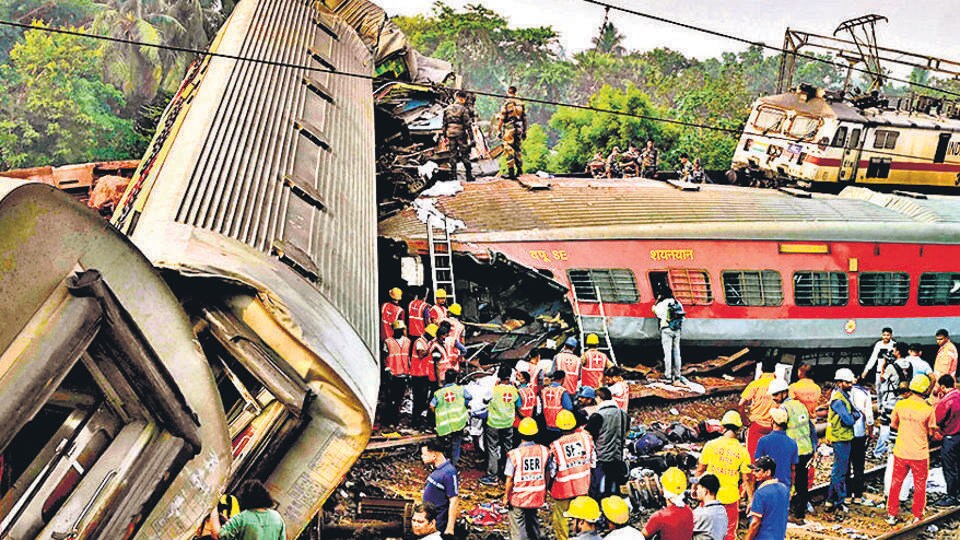
On June 2 evening, three trains — Kolkata-Chennai Coromandel Express, Bengaluru-Howrah Superfast Express and a goods train — were involved in one of the worst railway tragedies in the country in the last three decades that left at least 293 dead and nearly 1,100 injured in Balasore. Following the accident, two parallel investigations — one by the CRS and another by CBI — were ordered.
Also Read: Railway official dismisses reports of staff absconding after Balasore accident
The Railways has decided not to go public with the CRS report to ensure there is no influence or interference on the CBI probe into the accident, a second official said, also declining to be named.
“We will not be disclosing the CRS report because of another ongoing independent enquiry (of CBI). This is to ensure that this report does not in any way influence or interfere with the other report,” the second official said. “We will take cognisance of both the reports and make an overall evaluation of the incident and then take whatever steps necessary.”
The official also alleged that the staff handling the signalling system were found to be negligent. “Negligence of the staff while following the standard operating procedures [SOPs] of the electronic interlocking system has been the cause of the accident,” the official said. “Hence, human error on the part of the staff from the signalling and telecommunications (S&T) and traffic departments have been said to be the cause of the tragic triple train crash.”
Also Read: Lessons from history for the Balasore tragedy
Days before the CRS report was submitted, the railway board had ordered a double-locking arrangement for all its relay rooms with train controlling mechanisms, relay huts [having signalling and telecommunications equipment of level-crossings], and point and track circuit signals.
While the board did not release the findings of the report, preliminary findings suggested that the safety protocol of testing the signalling system before allowing a train to pass was not followed. Moreover, the signalling staff continued to attend work even after the reconnection memo was issued.
According to a third official familiar with the matter, initial findings of the report also pointed out that even though the reconnection memo was received by the station master, the work was not complete, for the technician responsible for it bypassed the system.
The findings also suggested that the technician bypassed the system because the work was not complete and he rigged the location box to get a ‘green signal’ for the Coromandel Express.


