
 E-Paper



IAF chief receives 1st LCA trainer from HAL, 7 more to come by Mar ‘24
The twin seater light combat aircraft Tejas is set to fill a key training role in the air force and double as a fighter if needed

 Prefer HTon Google


State-run plane maker Hindustan Aeronautics Limited (HAL) on Wednesday handed over the first trainer version of the light combat aircraft (LCA) Tejas to Indian Air Force (IAF) chief Air Chief Marshal VR Chaudhari at a ceremony in Bengaluru, with the twin seater set to fill a key training role in the air force and double as a fighter if needed, officials aware of the matter said.
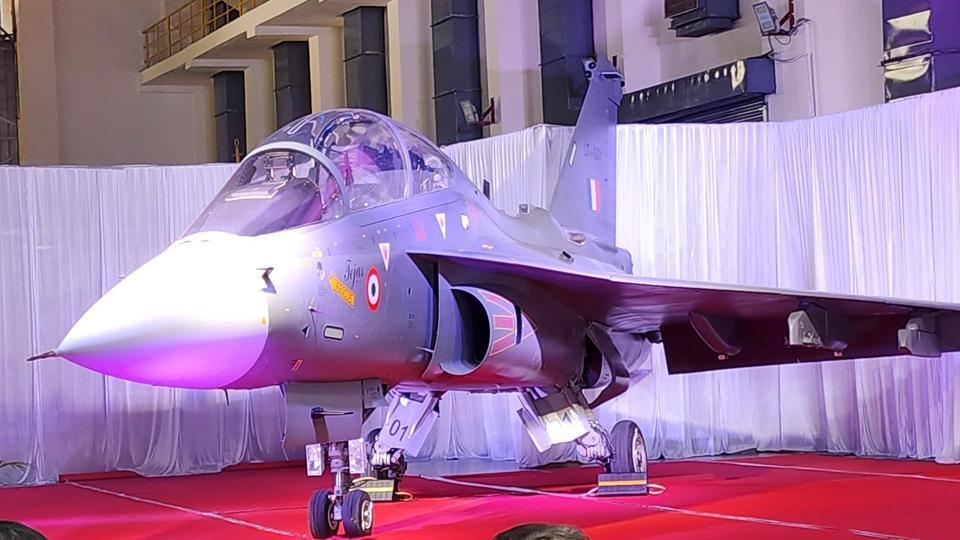
The aircraft is part of an earlier order for 40 Mk-1 jets in the initial operational clearance (IOC) and the more advanced final operational clearance (FOC) configurations --- the first variants of the LCA. Of the 40 Mk-1s, the IAF has inducted 32 single seater jets and raised two LCA squadrons. The remaining eight aircraft are trainers.
HAL chief C B Ananthakrishnan said seven more twin seater aircraft will be delivered to the IAF by March 2024.
“The production of the LCA twin seater variant adds India to the list of very few countries who have created such a capability and have them operational in their defence forces, another feather in the cap of ‘Aatmanirbhar Bharat’ initiative,” HAL said in a statement.
The trainer aircraft comes with contemporary concepts and technologies such as “relaxed static-stability, quadraplex fly-by-wire flight control, carefree manoeuvring, advanced glass cockpit, integrated digital avionics systems and advanced composite materials for the airframe,” it added.
The delivery of the first trainer aircraft came a day after Chaudhari announced that a ₹67,000-crore contract for 97 more Mk-1A jets was likely to be concluded soon. This order will follow a ₹48,000-crore contract awarded by the government to HAL two years ago for 83 such fighter jets, including 10 trainers.
The LCA is set to emerge as the cornerstone of the IAF’s combat power in the coming decade and beyond. The IAF, the world’s fourth largest air force, is expected to operate more than 350 LCAs (Mk-1, Mk-1A and Mk-2 versions), with a third of those already ordered, some inducted, and the rest figuring prominently on the air force’s modernisation roadmap and expected to be contracted in the coming years.
“The development of LCA Tejas has brought about a shift in our approach to defence procurement. It has demonstrated that India has the talent, knowledge and capability to design, develop and manufacture world-class fighters,” said minister of state for defence Ajay Bhatt, who attended the ceremony.
The induction of the trainers will allow the IAF to post fighter pilots directly to LCA squadrons after they complete their training on Hawks and will ease the conversion training (to fly Tejas) for pilots coming from other fighter squadrons, the officials said.
The newer variants --- Mk-1A and Mk-2 --- will come with significantly improved features and technologies over the Mk-1 aircraft. The indigenous content in the fighter jets will increase progressively. The IAF’s leadership firmly backs the LCA programme. In a recent review, Chaudhari described the fighter aircraft as the flag-bearer of the IAF’s efforts towards the indigenisation of its combat fleet.
India is also looking at building around 130 LCA Mk-2s, which will form an important element of the IAF’s future combat capabilities. Last year, the government gave its nod for developing the Mk-2, and sanctioned ₹10,000 crore for the project. The world’s leading aircraft engine maker GE Aerospace and HAL signed a memorandum of understanding (MoU) in Washington in June to produce the F-414 engines in the country for the LCA Mk-2, during Prime Minister Narendra Modi’s first state visit to the US.
The F-414 has evolved from the F-404 engine that powers the existing LCA variants.
The production of the engines in India will result in the new fighter jet having an indigenous content of around 75% compared to 55%-60% in LCA Mk-1A and 50% in the existing Mk-1 variant.
The LCA project was sanctioned in 1983 as a replacement for the Soviet-origin MiG-21 fighter fleet. The IAF raised its first LCA squadron with two aircraft in July 2016. The existing Mk-1 and Mk-1A variants will replace the IAF’s MiG-21 fighters. The Mk-2 aircraft is planned as a replacement for the air force’s MiG-29s, Mirage-2000s and Jaguar fighters that will start retiring in the coming decade.


