The Centre’s decision to deport an estimated 40,000 Rohingya Muslims to their native country Myanmar has triggered panic among 4,000-odd members of the ethnic group taking refuge in the old city of Hyderabad for the past six years.
Moulana Hameed-ul-Haq (50), a cleric at one of the Rohingya settlements in Balapur, says, “It will be better if we are killed in India than in our own country. We will anyway be killed if we are forcibly sent back.”
Moulana had fled Myanmar after 2011 violence in which thousands of Muslims were allegedly massacred by the Myanmar military and radical Buddhist monks. He reached Hyderabad through Bangladesh along with hundreds of other Rohingyas.
“The Indian government was kind enough to acknowledge us as refugees. The Telangnaa government has been looking after us really well and we feel safe and secure here. Now, suddenly the news about we being sent back has caused a lot of panic among us,” said Moulana .
Sultan Mohammad (70), who arrived in India three years ago after deserting his agricultural land at Rakhine state in Myanmar, works as a teacher in Hafiz Baba Nagar. “The military personnel attacked my house and destroyed all my property. I came to Hyderabad along with my wife and two sons. We are thankful to the Narendra Modi government for allowing us to stay here as refugees. I am nearing death and I want my family to survive,” said Sultan.
{{/usCountry}}Sultan Mohammad (70), who arrived in India three years ago after deserting his agricultural land at Rakhine state in Myanmar, works as a teacher in Hafiz Baba Nagar. “The military personnel attacked my house and destroyed all my property. I came to Hyderabad along with my wife and two sons. We are thankful to the Narendra Modi government for allowing us to stay here as refugees. I am nearing death and I want my family to survive,” said Sultan.
{{/usCountry}}Though the government estimates say there are 40,000 Rohigya Muslims in India, Mazher Hussain, director of Confederation of Voluntary Associations, an NGO which has partnered with United Nations High Commission for Refugees (UNHCR), says the number is not more than 16,000. “They are not illegal migrants as claimed by the government, but are refugees as per the UN convention. In Hyderabad, all of them have been given identity cards by the UNHCR,” said Hussain.
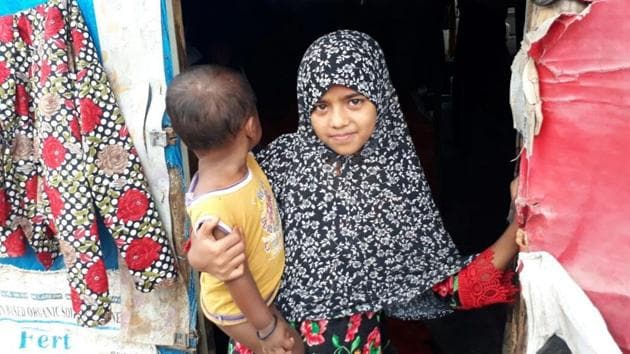
The Rohingya Muslims have been living in subhuman conditions in the slums of Balapur, Hafeezbabanagar, Pahadishareef, Mir MominPahadi and Kishanbagh. Each family pays around ~600 as rent per month.
“Nearly 80% of the Rohigya Muslims living in these settlements are rag pickers or daily wage workers,” Mohammad Moosa Azmi, a registration officer working with UNHCR.
“I get work only twice a week and earn ~450 per day. With that I have to feed the entire family,” said Dil Mohammad (53), who came to Hyderabad from Bouthidoung in Myanmar.