E-Paper



IIT-Madras to begin work on ramjet tech to boost range of army’s rocket arsenal
The army is looking at creating a rocket force at the earliest to boost its combat effectiveness with weapons that can hit targets at longer ranges

 Prefer HTon Google


The Indian Institute of Technology Madras (IIT Madras) is set to begin work on a critical project that seeks to enhance the range of the Indian Army’s rocket arsenal by tapping into ramjet technology, with the initial scope of the firepower boost covering the artillery’s Russian-origin BM-21 Grad and the locally made Pinaka rocket launcher systems, officials aware of the matter said.
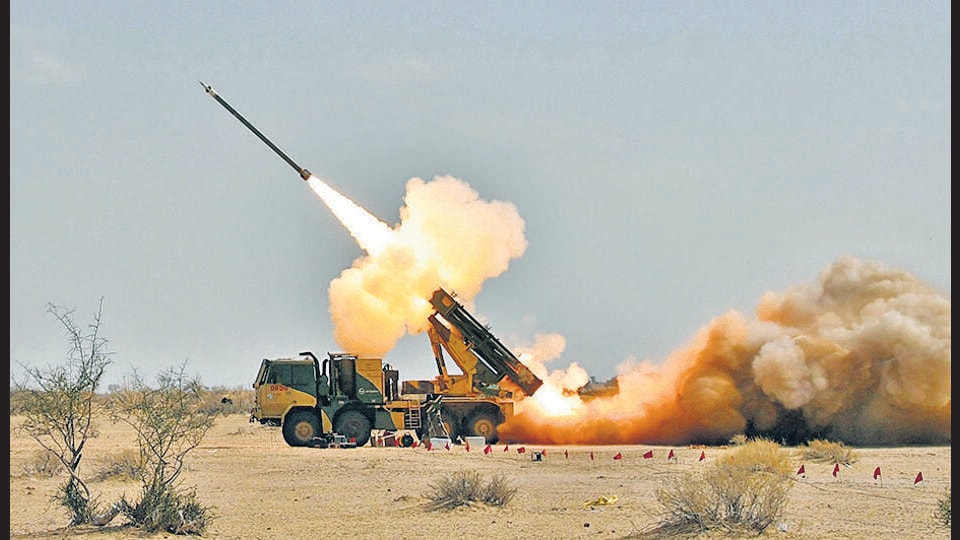
Integrating air-breathing ramjet engines into these weapons is expected to double their range --- from a current maximum of 40 km to 80 km for the Grad, and from 120 km to an impressive 250 km for the Pinaka, the officials added.
“Testing of the ramjet engine on the Grad multiple rocket launcher will begin in March and full operational capability is expected to be validated by the end of 2028 before technology can be transferred to a production partner. We will take up the Pinaka upgrade thereafter,” said PA Ramakrishna, a faculty in the IIT’s department of aerospace engineering.
The development comes at a time when the army is looking at creating a rocket force at the earliest to boost its combat effectiveness with weapons that can hit targets at longer ranges. It also comes on the back of IIT Madras announcing that it has developed and tested ramjet-assisted artillery shells, and the technological breakthrough has set the stage for doubling the range of the army’s major gun systems without compromising their lethality.
The institution is expected to transfer technology for manufacturing ramjet-propelled artillery shells to a production partner by early 2027, HT learns.
“We are looking at replicating with the rockets what we have achieved with the artillery shells. These upgraded systems will offer commanders greater tactical flexibility, deeper strike options and enhanced deterrence, without the need for inducting new platforms,” said Ramakrishna, who led the specialised team that worked on enhancing the range of artillery guns. The team included Lieutenant General PR Shankar (retd), a former director general of artillery.
The IIT Madras innovation integrates a ramjet engine into an existing 155mm artillery shell, replacing the conventional base-bleed unit. This approach enables sustained propulsion after the shell exits the barrel, significantly extending its reach while preserving the shell’s destructive power. A ramjet engine uses the vehicle’s high speed to compress incoming air, mix it with fuel, and generate thrust without moving parts like turbines.
Long-range precision weapons proved effective during Operation Sindoor in May when the Indian military struck terror and military installations in Pakistan and Pakistan-occupied Kashmir (PoK). Between the launch of the operation in the early hours of May 7 and the ceasefire on May 10 evening, Indian forces bombed nine terror camps in Pakistan and PoK, killing at least 100 terrorists, and the Indian Air Force struck targets at 13 Pakistani airbases and military installations.
Cost-effective upgrades to enhance the ranges of the army’s big guns and rockets will complement the ongoing modernisation of the artillery, said an army official, asking not to be named.
The army plans to enhance its firepower, with a greater emphasis on range, mobility, precision attacks, quick strikes and survivability as it ramps up efforts to buy an array of weapons, including guns, rocket systems and missiles. The linchpin of this capability boost, which will cost tens of thousands of crores, is a five-pronged strategy evolved after an assessment of what the artillery regiments need for battlefield supremacy. The strategy hinges on equipping all regiments with advanced 155mm artillery gun systems, inducting rockets and missiles with longer ranges and precision, lethal ammunition, reorganisation of surveillance and target acquisition units, and shortening the sensor-to-shooter loop for swift detection and destruction of targets.
On January 13, army chief General Upendra Dwivedi said a rocket-missile force was the need of the hour as China and Pakistan have already raised their own rocket forces. “And the faster we organise it, the better it will be for our combat effectiveness.”
Ramakrishna said the development of this technology was possible because of the government’s sharp focus on ‘Atmanirbar Bharat’ (self-reliant India) and the introduction of the ‘Professor of Practice’ (PoP) programme that was formalised by University Grants Commission (UGC) in September 2022.
The programme created a new category of positions that brings distinguished professionals and industry veterans without PhDs into higher education institutions, in line with the National Education Policy (NEP) 2020, which envisions integrating vocational education with general education and bridging the industry-academia gap. More than 18,300 professionals and 530 higher education institutions have registered on the UGC’s PoP portal.