E-Paper



In fight against inflation, govt cuts excise on fuel
FM also announces additional fertiliser subsidy of ₹1.10L-cr to aid farmers, ₹200 per LPG refill under Ujjawala scheme to help households

 Prefer HTon Google


Union finance minister Nirmala Sitharaman on Saturday announced a host of measures to provide relief to the people from rising inflation that included slashing of central duties on petrol by ₹8 a litre and diesel by ₹6, giving ₹200 per cylinder cooking gas subsidy to 90 million poor households, reducing customs duty on plastic products, iron and steel, and taking measures to ensure availability of cement in adequate quantity.
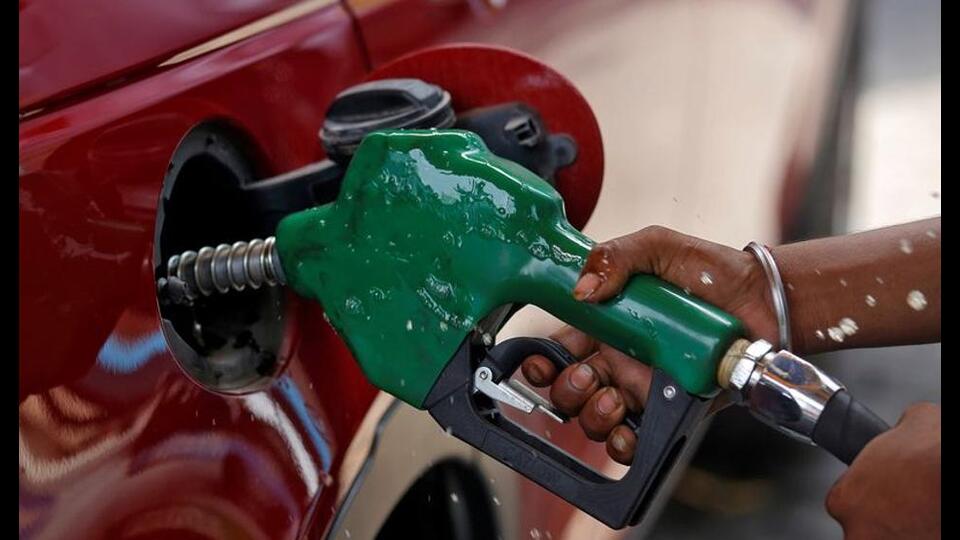
The sharp reduction of central levies on auto fuels, the second in six months, will become effective from Sunday. Experts said the government declared a war on inflation through the measures announced on Saturday.
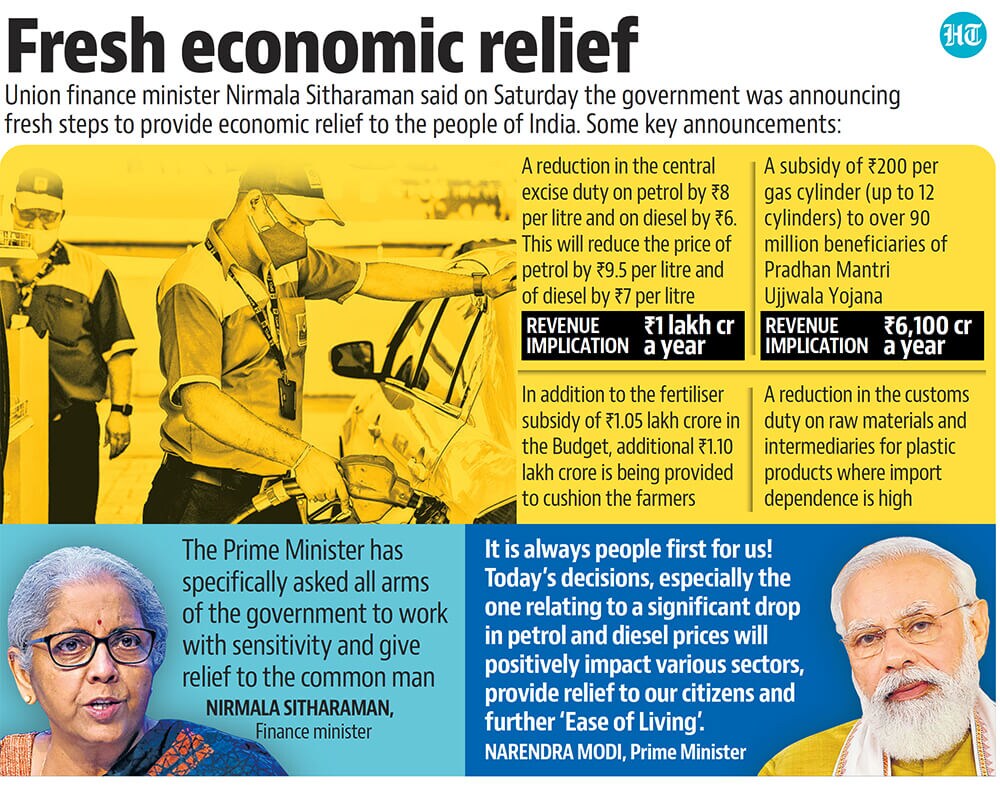
“This will reduce the price of petrol by ₹9.5 per litre and of diesel by ₹7 per litre. It will have revenue implication of around ₹1 lakh crore per year for the government,” the Union finance minister said in a tweet.
Soon after the announcement, Prime Minister Narendra Modi said that people are the first priority for his government. “It is always people first for us! Today’s decisions, especially the one relating to a significant drop in petrol and diesel prices will positively impact various sectors, provide relief to our citizens and further ‘Ease of Living’,” he tweeted.
After the second duty reduction, central excise on petrol will decline to ₹19.90 a litre and ₹15.80 a litre on diesel. The central government on November 3 last year cut central excise on petrol by ₹5 a litre and diesel by ₹10 a litre, which was estimated to result in a loss of ₹1 lakh crore in annual revenue.
Sitharaman also urged states to take similar measures to shield people from soaring fuel rates. “I wish to exhort all state governments, especially the states where reduction wasn’t done during the last round (November 2021), to also implement a similar cut and give relief to the common man,” she said.
During a virtual interaction with chief ministers last month, Prime Minister Modi said it was “injustice” to people living in Opposition-ruled states such as Maharashtra, West Bengal, Telangana, Andhra Pradesh, Tamil Nadu, Kerala and Jharkhand as they did not reduce state taxes on auto fuels.
The central government has also decided to give cooking gas subsidy of ₹200 per cylinder for one year to 90 million household living below the poverty line covered under the Ujjwala scheme to provide them some relief as cost of domestic liquefied petroleum gas (LPG) has surged over ₹1,000 per 14.2kg refill.
“Also, this year, we will give a subsidy of ₹200 per gas cylinder (up to 12 cylinders) to over 9 crore beneficiaries of Pradhan Mantri Ujjwala Yojana. This will help our mothers and sisters,” Sitharaman said. “This will have a revenue implication of around ₹6100 crore a year.”
There are over 305 million households that use domestic LPG cylinders in India. LPG subsidy was withdrawn from most parts of the country, and only a small amount (often below ₹50 per cylinder) was given to some households in far-flung areas, HT reported on May 16.
The decisions have been taken on PM Modi’s instruction to save the poor and vulnerable from the impact of rising prices, Sitharaman said.
“@PMOIndia has specifically asked all arms of the government to work with sensitivity and give relief to the common man,” she said, adding that Saturday’s announcements are in line with the Prime Minister’s “commitment to help the poor and common man”.
India’s retail inflation surged to an eight-year high at 7.8% in April, on soaring food and fuel rates.
“Our government, since when @PMOIndia @narendramodi took office, is devoted to the welfare of the poor. We’ve taken a number of steps to help the poor and middle class. As a result, the average inflation during our tenure has remained lower than during previous governments,” the finance minister said.
Prices are rising in India because of global reasons, she pointed out. “Today, the world is passing through difficult times. Even as the world is recovering from Covid-19 pandemic, the Ukraine conflict has brought in supply chain problems and shortages of various goods,” she said. “This is resulting in inflation & economic distress in a lot of countries.”
Saturday’s announcements included reduced import duties on key inputs to keep prices of final products in check. “We are also reducing the customs duty on raw materials & intermediaries for plastic products where our import dependence is high,” Sitharaman said. “This will result in reduction of cost of final products.”
“Import duty on some raw materials of steel will be reduced. Export duty on some steel products will be levied,” she said. “Measures are being taken up to improve the availability of Cement and through better logistics to reduce the cost of cement.”
The measures announced by Sitharaman would have a revenue implication of about ₹1.5 lakh crore, according to two government officials who declined to be named. The impact is manageable because of buoyancy in both direct and indirect tax revenue, they said.
“The government is committed to protect the poor from inflation and ensure adequate supply of all essential items,” one of them said. “For that, it has enough recourses as India is still world’s fastest growing economy.”
“We are committed to ensure that prices of essential items are kept under control,” Sitharaman said, giving the example of fertiliser subsidy. “Despite rising fertilizer prices globally, we have protected our farmers from such price hikes. In addition to the fertilizer subsidy of ₹ 1.05 lakh crore in the budget, an additional amount of ₹ 1.10 lakh crore is being provided to further cushion our farmers,” she said.
Aditi Nayar, chief economist at ICRA Limited said the reduction in excise duty will help to cool the inflation trajectory going ahead, and complement monetary policy. “We project the May 2022 CPI inflation at between 6.5-7.0%. The fiscal cost, while material, can be absorbed by higher than budgeted revenues through other taxes. We now estimate the tax revenues of the GoI to surpass the budget estimates by at least Rs. 1.3 trillion even after the excise reduction,” she said.
“The government’s swift action shows its intent to bring down the burden on the common man, in addition to bringing down input cost for many sectors… and we do hope that following the Centre, state governments will also respond in the same manner, bringing further relief,” said Sanjiv Bajaj, president of the Confederation of Indian Industry.