India’s latest communications satellite, GSAT-30, to enhance television, telecommunications and broadcasting services was launched successfully by the European commercial launcher Arianespace early on Friday.
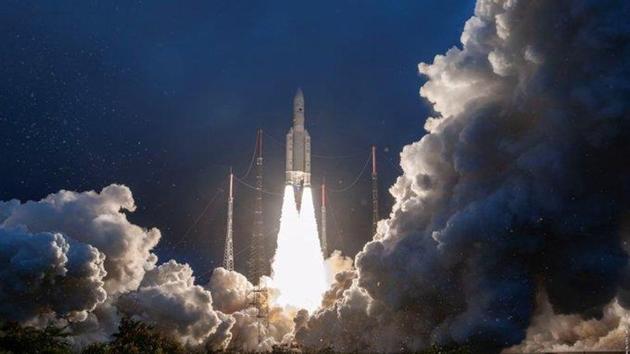
GSAT-30, the Indian Space Research Organisation’s (Isro) first mission of the year, blasted off onboard Arianespace’s Ariane 5 launch vehicle at 2:35am from the Ariane Launch Complex in Kourou, a French territory in the northeastern coast of South America.
After a flight lasting a little more than 38 minutes, the GSAT-30 separated from the Ariane 5 upper stage in an elliptical Geosynchronous Transfer Orbit.
“#GSAT30 successfully separated from the upper stage of #Ariane5 #VA251” Isro tweeted.
Over a few days, the on-board propulsion system will conduct a series of orbit-raising manoeuvres to place the satellite in Geostationary Orbit. During the final stages of its orbit raising operations, the two solar arrays and the antenna reflectors of GSAT-30 will be deployed.
Equipped with 12 C and 12 Ku band transponders, the 3,357kg satellite has a mission life of 15 years and will join the 19 communication satellites that are currently operational.
{{/usCountry}}Equipped with 12 C and 12 Ku band transponders, the 3,357kg satellite has a mission life of 15 years and will join the 19 communication satellites that are currently operational.
{{/usCountry}}The satellite will provide communication services to Indian mainland and islands through Ku-band and wide coverage covering Gulf countries, a large number of Asian countries and Australia through C-band, Isro chairman Dr K Sivan had said.
GSAT-30 will be enhancing and taking over the services of Isro’s ageing communication satellite INSAT 4A, whose official mission life ended in December 2017.
Isro has said GSAT-30 would be extensively used for supporting Very Small Aperture Terminal (VSAT) network, television uplinking and teleport services, digital satellite newsgathering (DSNG), DTH television services, cellular backhaul connectivity and many such applications.
The space agency also said that one Ku-band beacon downlink signal is transmitted for ground-tracking purpose.
Currently, the DTH service providers in the country use 42 transponders on indigenous satellites from the INSAT and GSAT series and 69 transponders on foreign satellites.
On the same flight, the Ariane 5 launch vehicle also placed into orbit a European satellite operator, Eutelsat’s Konnect satellite for enhanced broadband connectivity.
This was the 24th Indian satellite to be launched by Arianespace. The lift-off mass of the satellite was heavy for Isro’s previous launcher GSLV Mk II, capable of launching 2,500kg into a geostationary transfer orbit.
However, the recently operationalised GSLV Mk III for the Chandrayaan 2 mission is capable of launching up to 4,000 kg to the geostationary transfer orbit.
Another communication satellite GSAT-31 had been launched in February last year to maintain continuity of services of INSAT 4A and another INSAT 4CR, whose mission life ended in September 2019.
GSAT-30 comes over a month after the previous PSLV one that put in orbit one Indian Earth Observation Satellite along with nine customer satellites. The space agency is planning another PSLV mission soon with commercial satellites.