The Indian economy is in a peculiar situation. The non-food economy is facing a serious crisis of demand. This crisis has come at a time when the food, especially the vegetable economy, has been hit by a massive supply shock. Given the structural asymmetry and inequality in the Indian economy, the macroeconomic indicators have been affected very differently. Since food prices have a bigger weight in the inflation basket, the headline retail inflation number, captured by the Consumer Price Index (CPI), has reached a five-and-a-half year high at 7.35% in December. Yet, nominal GDP growth in 2019-20 is expected to be 7.5%, the lowest since 1975-76. This is 4.5 percentage points less than the 12% figure assumed in last year’s Union budget, and will create a big crisis on the revenue front.
This situation calls for a serious rethink in policy approach towards the food economy. Here’s why.
As the economy is getting modernised, the share of agriculture in Gross Value Added (GVA) has been coming down. Agriculture, forestry and fishing used to account for 35% of the total GVA in 1990-91. This has come down to 14.1% in 2019-20. Agriculture’s importance in headline GDP growth numbers has reduced considerably, and will go down even more. But there are two fronts where agriculture is still very important for the economy.
More than 40% of India’s workforce is still employed in agriculture, according to data from the 2017-18 Periodic Labour Force Survey (PLFS) conducted by the National Statistical Office (NSO). So farm incomes determine the purchasing power of almost half of India’s workforce. Food items have a 40% weightage in India’s CPI basket. This means that an average Indian household spends 40% of its income on just buying food.
There is an inherent conflict between these two factors. If farm prices go up faster than non-farm prices, then farmers tend to gain. This means they can spend more on non-farm goods. But it entails a squeeze on the budget of non-farmers, who have to spend a larger part of their incomes in buying food. Because non-farmers earn more than 80% of India’s GDP, higher food prices are a problem for the economy.
{{/usCountry}}There is an inherent conflict between these two factors. If farm prices go up faster than non-farm prices, then farmers tend to gain. This means they can spend more on non-farm goods. But it entails a squeeze on the budget of non-farmers, who have to spend a larger part of their incomes in buying food. Because non-farmers earn more than 80% of India’s GDP, higher food prices are a problem for the economy.
{{/usCountry}}If farm prices are depressed vis-à-vis non-farm prices, then non-farmers get to spend more on non-food items, while the farmers experience a decline in income and purchasing power. Because farmers are the single biggest occupational block in the country, a real or perceived squeeze on their purchasing power can translate into political anger.
This is not just an academic problem. In a country where farmers and food are the largest stakeholders in the workforce and household budgets respectively, mismanaging this conflict can have political ramifications.
The Indian state is aware of the importance of handling this contradiction. Food subsidies are the biggest expenditure item in the budget after interest payments and defence. They accounted for 6.6% of the total spending in the 2019-20 Budget. According to a 2018 government release, more than 807 million people were benefitting from the Public Distribution System in India, which provides subsidised food grains at ~1/2/3 per kg. This means that a large section of the population is insulated from a hike in foodgrain prices. Cereals alone account for 10% of an average household’s budget in the country. The Centre also procures a significant share of cereals produced at remunerative prices. In 2018-19, 30% of the total rice and wheat production was procured by the government. Simple speaking, the government intervenes directly to maintain a balance between family budget and farm incomes in the cereal economy.
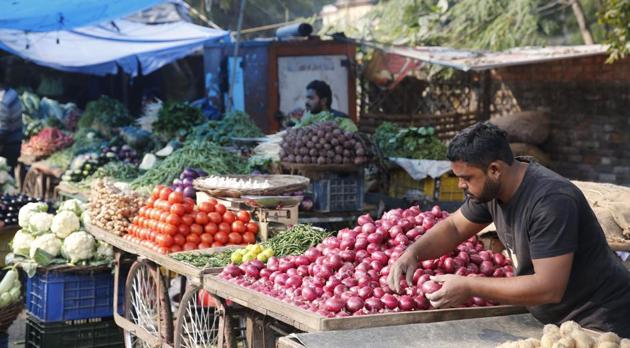
There is no such government intervention in the vegetable economy. This means that when prices crash, farmers go bankrupt. And, when they shoot up, which is mostly because of crop destruction, consumers pay much more without there being a concomitant rise in farmers’ incomes. Given the fact that vegetable prices tend to be the most volatile in the food basket, they are the biggest source of disruption in the farm income-family budget balance.
In an age in which factors related to the climate crisis are likely to lead to more and more freak weather events, supply shocks to the vegetable economy will only increase. Given this, the time may have come to revisit the idea of keeping government intervention confined to just cereals in India’s food economy. A decision to widen the PDS to vegetables will involve a fiscal cost, but it will also provide much needed stability to the basic political economy tension between protecting farm incomes and family budgets against intermit rude shocks, which will only rise in the future.

