Communications minister Jyotiraditya Scindia on Friday rejected billionaire Elon Musk's claim that his satellite internet service, Starlink, was being blocked by "certain oligarchs", asserting that India does not allow a monopoly in any sector.
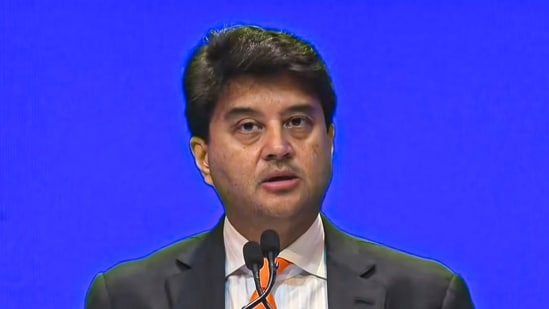
Scindia told reporters at the India Mobile Congress that he wanted to set the record straight.
“Now let me be very clear, India does not allow monopoly in any sector… even as satcom is concerned, there is not a single licensee that has been chosen. Licenses have been given to everyone who wants to provide these licences,” he said.
Scindia said that while there is a lot of conversation about one particular company, three have got satcom licences.
Musk's Starlink, Reliance Jio's satellite venture Jio Satcom and Bharti-backed Eutelsat OneWeb, have already secured licences, while Amazon's Kuiper has expressed interest and is undergoing the process of acquiring a licence to offer satcom services in India.
Deep Dive
Which companies have received satellite communications licences in India?
What must satcom companies do before starting operations in India?
Why has Starlink not started commercial services in India?
On what all remains before any of the three companies can begin services in India, Scindia said the revenue-based charges are almost finalised and each company must meet the security requirements. Telecom Regulatory and the DoT have been in talks on the pricing and are “close to taking the final decision”.
The minister brushed aside the Congress’s criticism. “I don’t think they themselves know whether they are going left or right,” he said in response to a question on a social media post by the Leader of the Opposition in the Lok Sabha, Rahul Gandhi.
{{/usCountry}}The minister brushed aside the Congress’s criticism. “I don’t think they themselves know whether they are going left or right,” he said in response to a question on a social media post by the Leader of the Opposition in the Lok Sabha, Rahul Gandhi.
{{/usCountry}}Scindia said the Congress first objected to a certain person getting a licence and now objects to why its new ally is not getting one. “They don’t have clarity in terms of where they are going. But that is the case with Congress, which is to be expected,” the minister said.
Also Read | Revanth Reddy backs Elon Musk amid Starlink row: ‘Can’t appease crony distractions’
War of words
Scindia’s remarks come amid a back-and-forth between Elon Musk and the Indian government. On Wednesday, Musk claimed that Starlink was being “blocked by certain oligarchs” who were keeping a “monopolistic chokehold on the Indian people”.
New Delhi rejected the charge in a statement on Thursday. The communications ministry said suggestions that Starlink was being discriminated against were “baseless and misconceived” and that India’s framework for satcom services was fair and non-discriminatory. The statement stressed that the security assessment of the three entities was under way and that they were at “broadly the same regulatory stage”.
Hours later, Musk escalated his attack, saying Starlink was licensed to operate in more than 165 countries and had spent five years complying with Indian rules. “So why still no license? Is Ambani the real boss of India?” he asked.
This is when Rahul Gandhi waded in. “Welcome to India, Elon. Wait till you discover the other guy,” the Congress leader said.
Also Read | India rejects Starlink allegations even as Musk escalates attack
Musk’s SpaceX-owned Starlink has received a Global Mobile Personal Communications by Satellite (GMPCS) licence from the government but is awaiting security clearance and spectrum assignment before it can begin commercial services.
At an IMC event on Wednesday, Starlink vice-president Lauren Dreyer said the company had set up 20 gateway sites and was ready to serve “once India is ready”. Starlink has also partnered with Bharti Airtel to explore taking its services to consumers, businesses and rural communities.
In a post on X on Friday, Congress president Mallikarjun Kharge kept up the attack on the government, accusing the Narendra Modi government of handing control of the economy to “favoured capitalist cronies” and ending competition.
“By ending Competition and imposing Monopoly and Duopoly, they have only worked to fill the BJP's coffers, and have ruined the foundation of economic liberalisation,” Kharge said, pointing out that the number of telecom players had fallen from 13 in 2014 to just 3 major private players now.