
Days after it gave India a 30 place jump in its ease of doing business ranking, the World Bank on Saturday said the Goods and Services Tax (GST) and reforms push by the government will catapult the country to high middle income economy in 30 years.
It credited India’s “extraordinary” achievement of quadrupling of per capita income to reforms taken in last three decades.
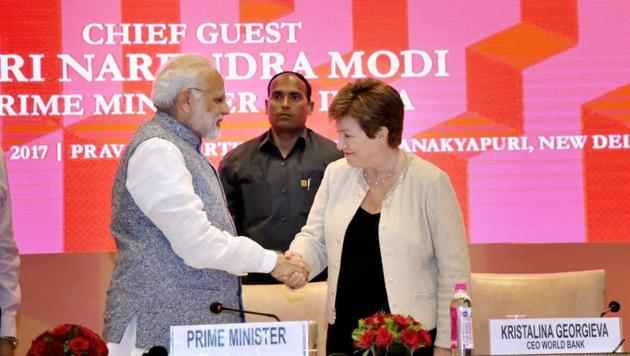
Comparing the achievement of securing 100th rank in the latest Doing Business Report to hitting century in cricket parlance, World Bank chief executive officer (CEO) Kristalina Georgieva said a jump of that nature is very rare since the beginning of the survey 15 year ago.
“It is particularly rare when we talk about size of India. I understand that in a cricket-loving nation hitting a century is a very important milestone,” she said.
{{/usCountry}}“It is particularly rare when we talk about size of India. I understand that in a cricket-loving nation hitting a century is a very important milestone,” she said.
{{/usCountry}}Last week, India moved for the first time into the top 100 of World Bank’s Ease of Doing Business global rankings due to sustained business reforms over the past several years. Last year the report had ranked India at 130.
Speaking at India’s Business Reform even organised by Ministry of Commerce and Industry, she said, high level ownership and championship of reforms is critical for success.
“We have learnt that in reforms what pays off is persistence...what we are recognising in India is that this success today is to be turned into more energy in reforms for the future,” she said.
Praising the efforts of Prime Minister Narendra Modi to carry forward reforms, including unification of indirect taxes, the World Bank CEO said the GST reform creates an incredible opportunity for India to grow through unified internal market.
There is visible impact of reforms on foreign investment, she said, adding that foreign direct investment (FDI) has doubled to $ 60 billion from $ 36 billion in 2013-14.
Besides, she said, investment in infrastructure building, investment in its people and strengthening of cooperative and competitive federalism are foundation for more progress in the future.
“We know that there is a very strong condition that extreme poverty would be history in India. The target date that was set 2026, I understand that the Prime Minister intends to shorten to 2022. Given the track record so far, I have no doubt that would be possible.
“And I have no doubt that when India hits another century, the century of independence in 2047, most people in India would be the part of global middle class. India will be a high middle income country,” she said.
The World Bank appreciated the fact that 60 million Indians in the recent past came out of destitution.
Noting that doing business is very pragmatic way to demonstrate that progress is being made, she said, the World Bank looks at doing business achievements in the broader context.
“What we have seen is remarkable overall success story of India. Extraordinary achievements in the last three decades, the per capita income has quadrupled. It was done with an eye on lifting out people out of poverty,” she said.
ABOUT THE AUTHOR
Follow the latest breaking news, major developments and agenda-setting stories from India and around the world with the newsdesk at Hindustan Times. Operating round the clock, the desk brings together experienced editors, reporters and correspondents to deliver fast, accurate and contextual reporting across subjects that influence public policy, governance, business, society and international affairs. The HT News Desk covers politics, elections, government policies, the economy, business and markets, science and technology, the environment, law and order, infrastructure, education, climate issues and geopolitics, while closely tracking developments across states, institutions and global capitals. The team also leads coverage of major breaking news events, policy announcements, court proceedings, natural disasters, public emergencies and significant international developments. Reports published by the newsdesk are based on information gathered from reporters on the ground, official statements, government agencies, court records, regulatory filings, recognised institutions and other authoritative sources. Stories undergo editorial scrutiny and verification processes to ensure accuracy, fairness and relevance, and are updated as events evolve and additional information becomes available. Whether covering a key political decision in New Delhi, an economic policy shift affecting millions, a landmark court ruling or a major global event, the HT News Desk aims to provide readers with reliable, fact-based journalism that delivers not only the latest developments but also the context and analysis needed to understand their wider implications.