
 E-Paper



India to induct third nuclear-powered ballistic missile submarine: Navy chief
The navy chief said India’s aggressive posturing in Arabian Sea and unmatched maritime domain awareness confined Pak Navy to its own shores during Op Sindoor

 Prefer HTon Google


NEW DELHI: India is on course to strengthen its strategic forces with a new locally-made nuclear-powered ballistic missile submarine named Aridaman, with navy chief Admiral Dinesh K Tripathi on Tuesday confirming that it will be commissioned into service soon.
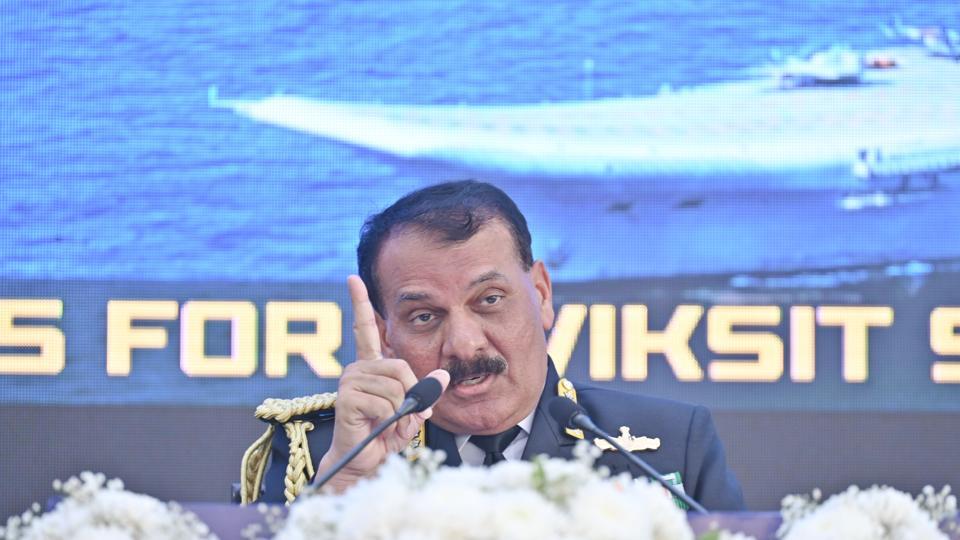
“Aridaman is in the final stages of trials and it will be commissioned soon,” Tripathi said. The navy chief’s comments on the latest development in India’s top secret nuclear submarine programme came at his annual media briefing ahead of Navy Day on December 4. Aridaman will be the navy’s third Arihant-class submarine, and will serve as an undetectable launch platform for missiles armed with nuclear warheads.
Aridaman is set to be commissioned early next year, followed by a fourth SSBN codenamed S-4* in 2027, Hindustan Times has learnt. SSBN stands for ship submersible ballistic nuclear or nuclear-powered ballistic missile submarines.
The navy commissioned its second indigenous SSBN, INS Arighaat, at Visakhapatnam in August 2024, strengthening India’s nuclear triad or ability to launch strategic weapons from land, sea and air. The United States, Russia, the United Kingdom, France and China are the only other countries that can deliver nuclear warheads from a submarine.
India’s first indigenous SSBN, the 6,000-tonne INS Arihant, was commissioned nine years ago and it successfully completed its first deterrence patrol in 2018, with Prime Minister Narendra Modi then triumphantly announcing that the success of the submarine “gives a fitting response to those who indulge in nuclear blackmail.” The fully operational submarine then completed the sea leg of India’s nuclear triad. Arihant is armed with 12 B-05 submarine-launched ballistic missiles (SLBMs) capable of delivering nuclear warheads up to 750 km away.
Both INS Arihant and INS Arighaat stay on continuous deterrence patrols and when the signal goes out from New Delhi, the platforms will be capable of launching nuclear missiles. The last two Arihant-class submarines, Aridaman and S-4*, are expected to be bigger and capable of launching longer range missiles. These SSBNs could be armed with K-4 SLBMs capable of striking targets up to 3,500 km away.
India has more nuclear weapons than Pakistan, but Beijing’s strategic arsenal is bigger than New Delhi’s, said the Stockholm International Peace Research Institute (SIPRI) in a new yearbook released in June. It pegged the number of nuclear warheads in the Indian arsenal at 180 as of January 2025 compared to 172 a year earlier, while Pakistan was estimated to have 170 nuclear weapons --- the same as a year earlier. China’s arsenal consisted of 600 nuclear warheads in January 2025, up from 500 the previous year.
India already has the capability to carry out nuclear strikes with fighter planes and land-launched missiles. The Agni series of ballistic missiles and warplanes such as Rafales, Sukhoi-30s and French-origin Mirage-2000s can deliver nuclear warheads. India’s nuclear doctrine, promulgated in 2003, commits the country to a “no first use” posture, with weapons to be used only in retaliation against a nuclear attack on Indian territory or Indian forces. It further states that nuclear retaliation to a first strike will be massive and designed to inflict unimaginable damage.
Mega submarine project in final stage
The navy chief said that the ₹70,000-crore Project 75I for building next-generation conventional submarines in the country is at an advanced contract negotiation stage. “I am hopeful that the next stage which is contract conclusion will also happen very quickly,” Tripathi said. Mumbai-based Mazagon Dock Shipbuilders Limited (MDL) and German yard thyssenkrupp Marine Systems (tkMS) will build six advanced submarines to sharpen the navy’s underwater capabilities under P-75I.
The first submarine under P-75I will be delivered to the navy seven years after the contract is signed, with the rest at the rate of one per year.
These advanced submarines, a variant of HDW Class 214 vessels, will come with air independent propulsion (AIP) systems. AIP significantly increases a submarine’s underwater endurance and reduces the risk of detection. As part of the contract, tkMS will transfer the submarine’s design and technology to India, enabling the goal of self-reliance in the defence manufacturing sector. The first submarine under P-75I must have a minimum of 45% indigenisation, with the local content going up to 60% in the sixth. MDL and tkMS edged out their only competitor the Larsen & Toubro-Navantia combine for this project.
Op Sindoor hit Pak economy
The navy chief said the four-day military confrontation with Pakistan in May under Operation Sindoor had “a noticeable effect” on the neighbour’s economy. “Many of the major global shipping companies started avoiding going to Pakistani ports. Also, there was an increase in the insurance premiums if you were heading to Pakistani ports and that led to minimising the number of merchant ships willing to take the risk,” he said.
The navy’s aggressive posturing in the northern Arabian Sea and unmatched maritime domain awareness confined the Pakistan Navy to its own shores. The Vikrant carrier battle group played a pivotal role in compelling Pakistan Navy units to stick to the Makran coast.
“We continue to maintain a high tempo of operations, including in the northern Arabian Sea, and robust maritime domain awareness so that we can swiftly respond to any eventuality,” he said.
Rafale-M deliveries to begin in 2029
The first deliveries of the Rafale Marine fighter jets to the navy, under a ₹63,000-crore contract with France, will take place in 2029, Tripathi said. “The navy will get the first set of four Rafale M fighters in 2029.” India ordered 26 Rafale Ms from France in April 2025 for the navy, which will operate them from its two aircraft carriers. The deliveries are expected to be completed by 2031.
The navy currently operates two aircraft carriers --- INS Vikrant and INS Vikramaditya. “Whenever we get a new aircraft carrier, it will be a replacement for Vikramaditya. So for some years we will continue to have only two aircraft carriers,” the navy chief said.
The government-to-government deal for 22 single-seat Rafale M fighters and four twin-seat trainers includes the setting up of a local production facility for the jet’s fuselage as well as maintenance, repair and overhaul (MRO) facilities for engines, sensors and weapons in India. It also includes transfer of technology for the integration of indigenous weapons in India.
The Indian Air Force operates 36 Rafale jets bought from France at a cost of ₹59,000 crore, and the aircraft’s naval variant will bring commonality with the air force’s fighters, creating advantages in training, maintenance and logistics support.


