
India on Monday announced a $1.6-billion economic development package for Nepal alongside initiatives to drive cross-border connectivity and energy and trade cooperation as Prime Minister Narendra Modi and his Nepalese counterpart Balendra Shah unveiled a new joint vision to reset long-standing relations and take them into the future.
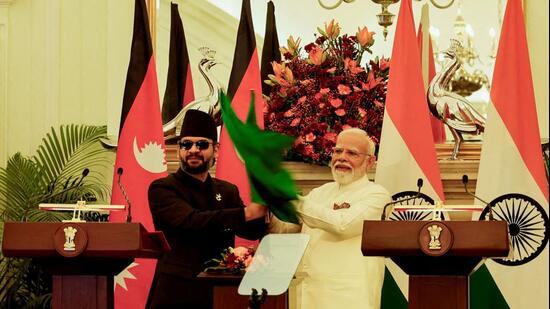
Shah, 36, who came to power in elections held earlier this year following a Gen Z uprising in 2025, arrived in India on Sunday for his first bilateral foreign visit. Following a ceremonial welcome at the Rashtrapati Bhavan on Monday morning, he held talks with Modi to review ties and discuss outcomes aimed at bolstering Nepal’s economy and reconstruction efforts following the devastating flash floods in August.
Nepal PM India visit LIVE updates here
Deep Dive
How much is India’s development package for Nepal, and what will it support?
What connectivity and energy projects did India and Nepal announce?
What areas do the eight India-Nepal MoUs cover?
Modi acknowledged the changes in Nepal, which swept away traditional political parties, and the historic mandate given to Shah that reflects the aspirations and hopes of the new generation. Shah pointed to traditional bilateral ties, which are “as firm as the Himalayas and as vast as the ocean”, and emphasised that the outcomes of his visit must translate into opportunities for Nepal’s youth, tangible access to new markets and investment and business expansion for entrepreneurs.
“The relationship between India and Nepal is not just one of neighbourhood but one of closeness and unwavering trust. We share our joys and our challenges. We are partners in each other’s progress and support each other in difficult times,” Modi said, announcing a development cooperation package of Nepali ₹24,000 crore (Indian ₹15,120 crore or $1.6 billion) to strengthen Nepal’s reconstruction and long-term development following the Bhote Koshi flash floods.
{{/usCountry}}“The relationship between India and Nepal is not just one of neighbourhood but one of closeness and unwavering trust. We share our joys and our challenges. We are partners in each other’s progress and support each other in difficult times,” Modi said, announcing a development cooperation package of Nepali ₹24,000 crore (Indian ₹15,120 crore or $1.6 billion) to strengthen Nepal’s reconstruction and long-term development following the Bhote Koshi flash floods.
{{/usCountry}}The announcement is significant as Nepal had proposed an economic package of $2 billion, half of it in grants, ahead of Shah’s visit.
Modi referred to the Saryu-Kamala Express weekly cross-border train service, which was virtually flagged off by the PMs and links the pilgrimage sites of Ayodhya in India and Janakpur in Nepal, and said the two sides will enhance connectivity between Buddhist and Hindu sacred sites in both countries, including Lumbini and Bodhgaya.
Following the inauguration of a bridge over Mahakali river that links Uttarakhand state with Nepal and the laying of the foundation stone for an integrated check post (ICP) in Banbasa, the two sides will expedite work on the Dodhara-Chandni ICP on the Nepal side to facilitate trade and people-to-people movement, and speed up road, rail and border connectivity projects linking Nepal to Bihar, Uttar Pradesh and other Indian states. “We will provide access to Kandla and Paradip ports to facilitate Nepal’s transit trade,” he said, adding these efforts will give a push to Nepal’s economic development.
Modi pointed to the complementarity between the immense potential for clean energy from Nepal’s rivers and India’s vast energy market, and said the laying of the foundation stone for the 669-MW Lower Arun hydroelectric project and New Delhi’s commitment to the timely completion of the Arun-3 power project are part of this vision.
He noted that India has been a reliable supplier of petroleum products and other essential commodities to Nepal, and maintained supplies of fuel and fertilisers despite serious oil supply challenges this year.
“Today’s inauguration of Phase II of the Motihari-Amlekhganj pipeline and the foundation stone laying of the Jhapa petroleum terminal will further strengthen this partnership,” he said, referring to the plan to build a greenfield oil storage terminal in Nepal with a capacity of 18.9 million litres.
As a nod to Shah’s focus on the aspirations of Nepal’s youth, Modi said India will partner with them in realising their dreams. “We will establish a start-up incubator, an innovation hub and an offshore campus of the Indian Institute of Technology in Nepal. We will expand scholarship opportunities in law and technology for Nepali students in India,” he said.
Both PMs emphasised the importance of the joint vision document with the theme of “developed India and prosperous Nepal” in giving shape to a shared future.
Modi described it as a blueprint and said: “We have clear goals, mutual trust and the ability to achieve them…I am confident that with this spirit, we will transform our shared vision into concrete achievements. And together, we will write a new golden chapter in India-Nepal relations.”
Shah said the joint vision will advance work towards a shared and prosperous future, and noted that “mutual respect, steadfast trust and unbroken goodwill” form the bedrock of bilateral ties. He acknowledged that India, as a dependable and trusted neighbour, has “consistently stood as a first responder in times of natural disasters and difficult hours”.
Shah said his candid and forward-looking talks with Modi were guided by the goal of “strengthening and modernising” the historical relationship. “The need of the hour is to stand on the sturdy foundation of this enduring bond and build strong pillars for the future,” he said, speaking in Nepali.
As the two sides transform bilateral ties through mutual trust, cooperation and shared prosperity into a “transformative development partnership that opens up opportunity for our younger generations”, India and Nepal must address the challenges of climate change through collective action, Shah said. He also invited Indian investors to partner with Nepal and sought expanded direct air connectivity between cities of both countries.
The two sides also concluded eight memorandums of understanding for cooperation in areas ranging from space to health. These included a MoU between the Indian Space Research Organisation (ISRO) and Nepal’s communication ministry on establishing a satellite communication network for using the South Asia Satellite, an MoU on cooperation in health and medicine, and an MoU for academic and research collaboration between India’s National Forensic Sciences University and the Crime Investigation Department of Nepal Police.
Another MoU between India’s National Centre for Good Governance and the Nepal Administrative Staff College will focus a training programme for Nepal’s civil servants of Nepal, while there were also MoUs for cooperation in sustainable urban development, livestock and fisheries development, and ayurveda and other traditional medicine systems.
Shah also invited Modi to visit Nepal and urged Indians to travel to Buddhist and Hindu religious sites in his country.
ABOUT THE AUTHOR
Rezaul Hasan Laskar is Foreign Editor with the Hindustan Times, which he joined in 2015. He began as a journalist in his hometown of Shillong in northeast India and has worked in newspapers and wire services over the years. He moved to New Delhi in 1997 and initially focused on defence, national security, Jammu and Kashmir and the northeast, while also working of foreign policy and international relations. He has been part of the media delegation accompanying PMs on foreign visits and has reported from destinations ranging from Tibet to Ukraine. Between 2007 and 2013, he was the Press Trust of India correspondent in Pakistan, one of only two Indian journalists allowed to report from the country. He extensively covered Pakistan’s domestic politics and the life of the common people, as well as the fallout of the 2008 Mumbai attacks on India-Pakistan relations and the subsequent trial in Pakistan of the suspects involved in the attack. As part of his reportage in Pakistan, he travelled the breadth of the country, from the Swat Valley to Balochistan. Reza’s first gig in journalism was writing a weekly music column, and music – especially classic rock – remains a keen interest. He is also a movie buff and a keen photographer.