India has the largest cultivated area among the Brics nations, but its farms continue to produce far less grain per hectare than China, the bloc’s biggest cereal producer, an analysis of data provided in the Brics Joint Statistical Publication released August 18 showed.
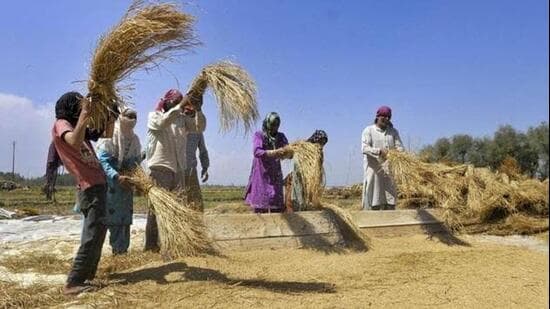
Even though India’s yields of major cereals have risen steadily, they continue to lag heavily behind China.
India’s latest agriculture ministry estimates put rice yield at 2,915 kg per hectare, wheat at 3,591 kg/ha and maize at 3,824 kg/ha in 2025-26. China’s corresponding 2025 yields were 7,205 kg/ha for rice, 5,940 kg/ha for wheat and 6,700 kg/ha for maize, according to China’s National Bureau of Statistics. China harvested 660.2 million tonnes of cereals in 2025, more than double India’s 324.8 million tonnes, the publication showed.
The reasons differ across crops, said Devesh Chaturvedi, former agriculture secretary, arguing that India’s productivity story cannot be explained by a single factor. “There is no one-size-fits-all reason for lower productivity. It varies from crop to crop,” Chaturvedi said.
“In paddy, for instance, most of China’s crop is grown under assured irrigation, whereas in India, some areas are well irrigated while others remain rainfed. In well-irrigated regions such as Punjab, India’s paddy yields match those of China,” he said. He added that India also grows indigenous rice varieties such as Basmati, which have lower yields than hybrids but fetch higher prices for farmers.
{{/usCountry}}“In paddy, for instance, most of China’s crop is grown under assured irrigation, whereas in India, some areas are well irrigated while others remain rainfed. In well-irrigated regions such as Punjab, India’s paddy yields match those of China,” he said. He added that India also grows indigenous rice varieties such as Basmati, which have lower yields than hybrids but fetch higher prices for farmers.
{{/usCountry}}As for wheat, the productivity is partly constrained by the crop’s sensitivity to temperature. “The paddy-wheat cycle can delay wheat sowing in India, exposing the crop to heat during the following season and affecting yields,” Chaturvedi said. “Another factor is that many crops grown in China are genetically modified, which can also contribute to higher yields.”
India has, however, been improving . Between 2019-20 and 2025-26, its rice yield rose from 2,722 kg/ha to 2,915 kg/ha, wheat from 3,440 kg/ha to 3,591 kg/ha, and maize from 3,006 kg/ha to 3,824 kg/ha. Maize has recorded the sharpest improvement, rising by about 27%, compared with roughly 7% for rice and 4% for wheat.
“India is working on productivity through several fronts. Indian Council of Agricultural Research (ICAR) is developing climate-resilient wheat varieties, and farmers are increasingly adopting them, which has helped improve yields,” according to Chaturvedi. India’s move towards direct-seeded rice (DSR), which can reduce the crop’s water requirement alongside several seed-focused missions covering oilseeds, cotton and pulses are aimed at improving the availability of better seeds and raising productivity, Chaturvedi said.
But the improvement in yields has not translated into a steady rise in cereal output. The BRICS publication shows India’s cereal production falling from 332.05 million tonnes in 2024 to 324.79 million tonnes in 2025, a decline of about 2.2%. China, in contrast, increased cereal production by 1.2% to 660.21 million tonnes in 2025.
While the document provides limited data for other countries, a comparison with Brazil shows Brazil’s 2025 rice yield was 7,234 kg/ha, almost 2.5 times India’s, while its maize yield of 6,364 kg/ha was about 66% higher. However, India’s wheat yield of 3,591 kg/ha was higher than Brazil’s 3,230 kg/ha. Russia also recorded a lower wheat yield of 3,431 kg/ha in 2025.
The BRICS publication puts India’s cultivated land at 154 million hectares, compared with 129 million hectares in China, 126 million hectares in Russia and 97 million hectares in Brazil.
The issue of lower yields was also taken up at the BRICS Agriculture Ministers’ meeting in Indore in June. The joint declaration listed “low agricultural productivity” among the challenges facing BRICS agriculture, alongside climate risks, land and water degradation, biodiversity loss and supply-chain disruptions. The countries, as per the joint statement, called for cooperation on technology, quality inputs, research, mechanisation, digital agriculture and improved farm-level efficiency.