
 E-Paper



India’s telecom story case study for the world: Modi
PM Modi urged global frameworks for digital tech at the WTSA 2024, highlighting India's telecom advancements and the need for safe, inclusive digital ecosystems.

 Prefer HTon Google


Prime Minister Narendra Modi on Tuesday described India’s telecom story as a case study for the globe and called for international frameworks and guidelines to be drawn up for digital technologies, stressing on the need for a “rules-based framework” to create safe digital ecosystems in an increasingly interconnected world.
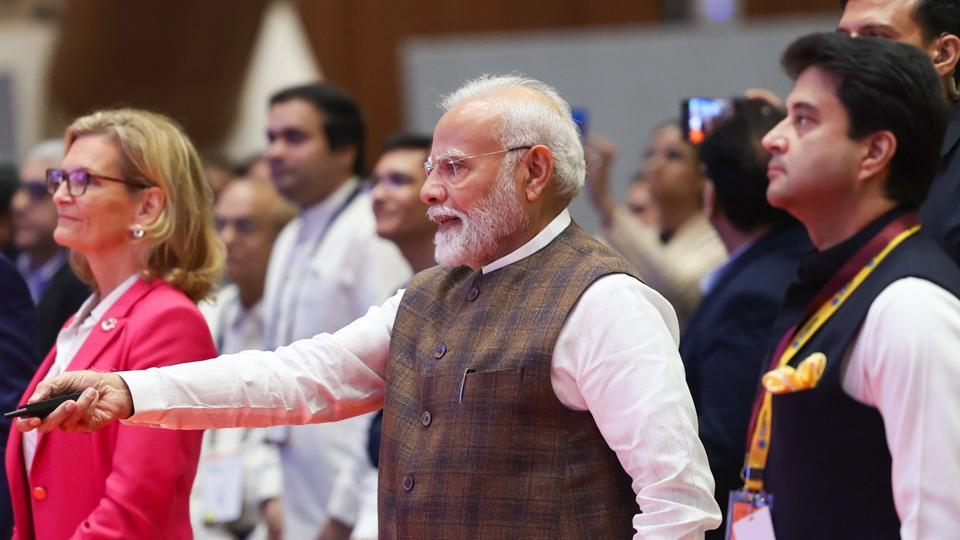
Inaugurating the International Telecommunication Union’s World Telecommunication Standardization Assembly (WTSA) 2024 and India Mobile Congress in New Delhi, Modi underscored the need for concerted efforts to tackle matters that include privacy, media disinformation, Big Tech accountability, and global data flows.
“The time has come for global institutions to accept the importance of global governance,” Modi said, addressing over 3,000 industry leaders, policymakers, and tech experts from more than 190 countries at Bharat Mandapam. “We must create ‘Do’s and Don’ts’ for technology on the global level.”
“Today, all digital tools and applications are beyond boundaries, beyond the borders of any country. Therefore, no country alone can protect its citizens from cyber threats. For this, we will have to work together, and global institutions will have to step forward and take responsibility,” Modi said.
Modi’s call for a balanced approach to technological advancement comes as India positions itself as a major player in the global digital landscape, having offered other countries access to Digital Public Infrastructure tools like payments platforms and health care management services.
He cited India’s technological journey, claiming that the country used digital technology as a tool for citizen empowerment through four pillars of his administration’s Digital India initiative -- affordable devices, widespread digital connectivity, accessible data, and a digital first’ approach. Modi noted that India has made significant strides in each of these areas, leading to transformative changes in various sectors.
The country has seen rapid growth in its tech sector, with over 1.2 billion mobile phone users and 950 million internet users, the PM pointed out during a speech where he laid out a vision for the future of technology that he said should be “both technically strong and ethically sound”.
“Our future should have innovation as well as inclusion.”
Communications minister Jyotiraditya Scindia, who also addressed the gathering, said India’s telecom sector was “aggressive” and “ambitious”. “It is our belief and our commitment -- India followed the world in 4G, we marched with the world in 5G, but we shall lead the world in 6G,” the minister asserted.
Modi drew parallels with the aviation sector. which already has well-established framework, and urged the assembly to consider the diverse needs of different nations. “I would tell the members of this assembly to create standards that are inclusive, secure and adaptable to every future challenge. Create global standards for ethical AI and data privacy that also respect the diversity of different countries.
WTSA is organised by the International Telecommunication Union (ITU), which is the United Nations agency for digital technologies. The assembly is the governing conference for the standardisation work of the ITU and is typically held every four years. In these sessions, industry leaders, policymakers, and tech experts from ITU member countries typically discuss and decide on global telecom standards. It is the first time that the WTSA is being held in Asia.
“This is a historic moment for India, indeed for all of Asia,” Scindia said. He stressed on India’s role in putting forth the needs of the Global South at an international standard-setting forum and recounted how India’s standard on 5G, called 5Gi, had been accepted as one of the candidate technologies of 5G by the ITU.
Among the issues on agenda are next-generation critical technologies such as 6G, AI, internet of things (IoT), and cybersecurity.
Modi highlighted the importance of a human-centric approach to the ongoing technological revolution. “It is crucial that we continuously strive to give technology human-centric dimensions in today’s technological revolution,” the PM stated. “It is our responsibility to ensure this revolution is responsible and sustainable.”
Modi also stressed that the principles of security, dignity, and equity should be at the centre of discussions on technological advancement. “Our aim should be that no country, no region, and no community is left behind in this digital age,” he said.
Citing India’s own initiatives, Modi pointed to the country’s Data Protection Act and National Cyber Security Strategy as examples of commitment to building a safe digital environment.
Modi emphasised India’s commitment to indigenous manufacturing, noting that the country has grown from having only two mobile manufacturing units in 2014 to over 200 today, and highlighted efforts in promoting women’s participation in the tech sector. “Today, more than 40% of students in India’s STEM education are our daughters,” he said.
Modi concluded by reiterating India’s willingness to share its experiences and knowledge related to Digital Public Infrastructure (DPI) with other countries. “India has such a digital bouquet that can take welfare schemes to new heights in the world,” he said.
ITU secretary general Dorren Bogdan-Martin said, “Standards should help to level the playing field for innovation.” She also called on the need to strengthen “the role of international standards as the bedrock of global digital governance”.
The event was also addressed by several industry leaders. “The world is in awe of a nation that, crawling at 2G speed only eight years ago, is now galloping down the 5G highway,” said Akash Ambani, chairman of Reliance Jio Infocomm.
Bharti Enterprises chairman Sunil Bharti Mittal said: “We are now working with the industry to ensure, and with the department of telecom, that our people, when they’re using these networks and enjoying all those services, are safe and secure. Prime Minister, Airtel will play its role in your vision of building a very powerful India”.
Kumar Mangalam Birla, chairman of the Aditya Birla Group, praised the government for its commitment to digital connectivity. “Our government has consistently recognised the importance of digital connectivity and has introduced several reforms over the years to drive us towards an even more connected, empowered, and inclusive digital nation.”


