NEW DELHI: The Canadian government is providing “political space” to extremist forces, external affairs minister S Jaishankar said on Tuesday while reiterating India’s concerns about an attack by pro-Khalistan radicals on a Hindu temple near Toronto.
Jaishankar also reiterated that the Canadian side has not shared any evidence to back its allegations that Indian officials were linked to the murder of Khalistani separatist Hardeep Singh Nijjar and criminal activities targeting pro-Khalistan elements in Canada.
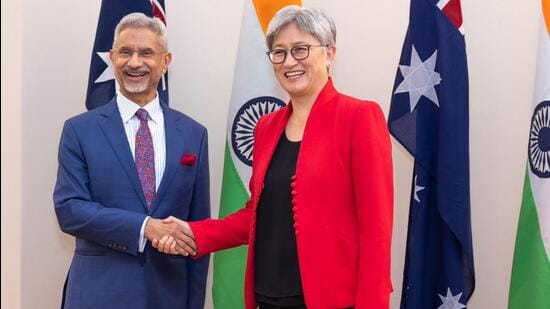
“Let me make three comments. One, Canada has developed a pattern of making allegations without providing specifics. Secondly, when we look at Canada for us, the fact that they’re putting our diplomats under surveillance is something which is unacceptable,” Jaishankar said at a joint media conference in Canberra with his Australian counterpart Penny Wong.
“Third, the incidents [on Sunday], do look at the video, I think they would tell you in a way the political space today which is being given to extremist voices [in Canada]. So, we believe in freedoms, we also believe freedom should not be abused, and have we had a talk about it, exactly on the lines,” he said, referring to the attack on a Hindu temple in Brampton by pro-Khalistan radicals on Sunday.
Prime Minister Narendra condemned the attack, which occurred while Indian officials were conducting a consular camp at the temple, and urged the Canadian government to ensure justice and uphold the rule of law.
{{/usCountry}}Prime Minister Narendra condemned the attack, which occurred while Indian officials were conducting a consular camp at the temple, and urged the Canadian government to ensure justice and uphold the rule of law.
{{/usCountry}}Jaishankar, who described the attack on the Hindu temple as “deeply concerning”, and said the expression of concern by Modi conveys “how deeply we feel about it”.
Responding to a question about Canada’s allegations regarding the Indian government’s involvement in acts targeting Khalistani elements, Wong said: “We have made clear our concerns about the allegations under investigations. We’ve said that we respect Canada’s judicial process.”
She added that Australia conveys its views on such matters to India and has a principled position on matters such as the rule of law, independence of the judiciary and the sovereignty of all countries.
Wong was also asked about the recent vandalisation of two Hindu temples in Canberra and the safety of Australia’s Hindu minority, and she said all Australians, regardless of faith and culture, are entitled to be safe and respected. “In relation to the vandalism that you describe, I know that our local members have expressed a very strong view about that, particularly in the week of Diwali, it’s a very upsetting thing for peoples of the faith community and the Indian community more broadly.”
People have a right to peaceful protest and to peacefully express their views, Wong said. “We draw a line between that and violence, incitement of hatred, or vandalism and they should be dealt with by the appropriate law enforcement authorities,” she added.
India-Canada relations have been at an all-time low since Prime Minister Justin Trudeau alleged in September last year that there was a link between Indian government agents and the killing of Nijjar, who was gunned down outside a gurdwara in Surrey. Nijjar had already been declared a terrorist by India, which dismissed the accusation as absurd.
The relationship took another hit when Canada recently sought to question the Indian envoy and five more diplomats as “persons of interest” in connection with Nijjar’s murder. India withdrew the diplomats and expelled six Canadian diplomats from New Delhi.