NEW DELHI: External affairs minister S Jaishankar on Monday accused the Canadian government of double standards in handling the activities of pro-Khalistan elements operating from Canadian soil and the row over the killing of Hardeep Singh Nijjar.
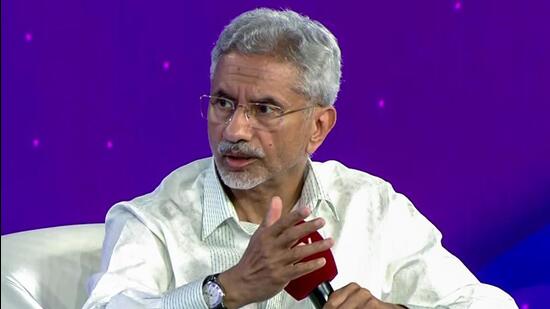
Jaishankar, who was speaking at the NDTV World Summit, said Canadian authorities had responded to India’s concerns about threats by the pro-Khalistan elements towards Indian leaders and diplomats by saying such matters fell within the realm of “freedom of expression”.
India-Canada relations are currently at their lowest point, a year after Prime Minister Justin Trudeau triggered a row by alleging that Indian government agents were linked to the murder of Nijjar, gunned down outside a gurdwara in Surrey in June 2023. India, which had already declared Nijjar a terrorist, dismissed the accusation as “absurd”.
The row took a serious turn last week after Canadian law enforcement sought to question the Indian envoy to Ottawa and five other diplomats as “persons of interest” in the Nijjar killing. India withdrew the six diplomats – Canada said they had been expelled – and expelled an equal number of Canadian diplomats from New Delhi.
“Canada asked us to subject our high commissioner to a police inquiry… and we chose to withdraw the high commissioner and [other] diplomats,” Jaishankar said, adding that Canada “has problems” when Indian diplomats collect information on matters affecting India’s security.
{{/usCountry}}“Canada asked us to subject our high commissioner to a police inquiry… and we chose to withdraw the high commissioner and [other] diplomats,” Jaishankar said, adding that Canada “has problems” when Indian diplomats collect information on matters affecting India’s security.
{{/usCountry}}“Canadian diplomats have no problem going around and collecting information on our military, on our police, profiling people, targeting people to be stopped in Canada,” he added.
When the Indian side alerts Canada about pro-Khalistan elements threatening Indian diplomats, leaders, diplomatic premises, Parliament and airlines, “their answer is freedom of speech”, he said, pointing to the double standards.
“We are having a problem with a segment of politics in Canada...People-to-people relations, we would like to maintain it. I think we need to narrow this down and define this problem for what it is,” he said.
Jaishankar highlighted long-standing differences between India and Canada in handling the issue of Khalistani elements operating from Canadian soil, including the bombing of Air India flight 182 in 1985, which killed 329 people.
He also spoke extensively on India’s relations with key world powers such as China, Russia and the US, and said the Bill Clinton administration had first broken out of the mindset of “India-Pakistan hyphenation”. India-US relations have grown steadily since then because of very strong convergences in the strategic, political and technology spheres, he said.
Jaishankar acknowledged that India-China relations were more complicated as it is “not easy” if two large neighbours “rise next to each other in the same timeframe”. Besides the two countries having a population of more than one billion, they have the challenge of dealing with an unresolved boundary issue.
“Managing this double rise and that too in proximity...will require a lot of skill, deftness and diplomacy,” he said. As the capabilities, influence and ambitions of India and China change, both “will naturally want to be bigger and...more effective in the world” and ensuring equilibrium will be a “big issue”, he added.
India will also have to contend with the US-China rivalry and make calculations in its interests. “We would make those calculations and take those decisions and create the right partnerships which will serve our interests,” Jaishankar said.
Turning to Russia, Jaishankar noted that it is a country that has done nothing to negatively impact India’s interests since 1947. At the same time, Russia’s relationship with the West has broken down and it is turning more towards Asia. Since Russia is a major source of energy, fertilisers and metals, there is a “strategic logic and an economic fit” to the bilateral relationship, he said.