External affairs minister S Jaishankar met his Chinese counterpart Wang Yi in Beijing on Monday at the Shanghai Cooperation Organisation’s (SCO) foreign ministers' meeting and said that the relationship between the two countries requires them to take a “far-seeing approach”.
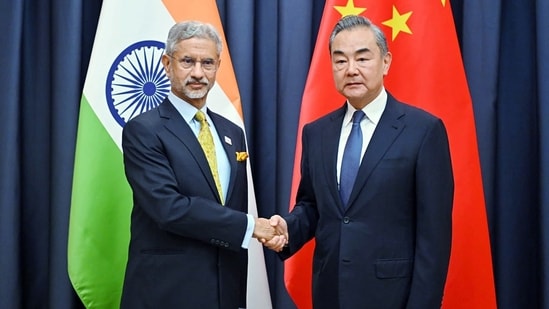
He said that ever since Prime Minister Narendra Modi and Chinese President Xi Jinping met in Russia’s Kazan October 2024, the ties between the countries have improved and that it is their responsibility to maintain that momentum.
In a pursuit to enhance ties and communication with China, Jaishankar said that the representatives of the two countries have met each other at international events and he expects that such meetings can take place in India and China itself. Both the countries have completed 75 years of diplomacy with each other.
Also read: ‘As neighbouring nations…’: In Beijing, Jaishankar's push for dialogue between India, China
“In recent times, the two of us have had several opportunities to meet at international events and carry out strategic communication. It is our expectation that this will now be regular and take place in each other's countries” he said.
Jaishankar brings up India-China border issue
{{/usCountry}}“In recent times, the two of us have had several opportunities to meet at international events and carry out strategic communication. It is our expectation that this will now be regular and take place in each other's countries” he said.
Jaishankar brings up India-China border issue
{{/usCountry}}Jaishankar also brought up the border issue, a long-standing point of contention between the two countries, during his opening remarks at the meet.
He said that the ties between India and China have improved in the last nine months as a result of the “resolution of friction along the border”.
He added, “This is the fundamental basis for mutual strategic trust and for smooth development of bilateral relations. It is now incumbent on us to address other aspects related to the border, including de-escalation.”
He also expressed gratitude that the Kailash Manasarovar Yatra has resumed after a gap of five years. The pilgrimage to Mount Kailash and Mansarovar Lake in the Tibet Autonomous Region had been suspended since 2020, initially because of the Covid-19 pandemic and then due to the protracted military standoff in Ladakh sector of the Line of Actual Control (LAC).
‘Need stable and constructive ties’
Jaishankar said that “stable and constructive ties” between India and China will benefit the whole world, not just the two countries and added that such ties should be built and handled “on the basis of mutual respect, mutual interest and mutual sensitivity”.
“We have also earlier agreed that differences should not become disputes, nor should competition ever become conflict,” he said.
Emphasizing the multifaceted nature of India-China ties, Jaishankar stressed upon the importance of restoring people-to-people exchanges and the need to avoid trade-related barriers and restrictive measures.
“As neighbouring nations and major economies in the world today, there are various facets and dimensions of our ties. Measures towards normalizing our people-to-people exchanges can certainly foster mutually beneficial cooperation. It is also essential in this context that restrictive trade measures and roadblocks are avoided. I hope to discuss these issues in further detail,” he said.
Jaishankar said he looked forward to a “constructive and forward-looking exchange of views” with his Chinese counterpart.