Rivers burst their banks in the Jammu region, sweeping away everything in their path as boulders, trees, and debris thundered down slopes, killing 32 people in a landslide on the Vaishno Devi route.
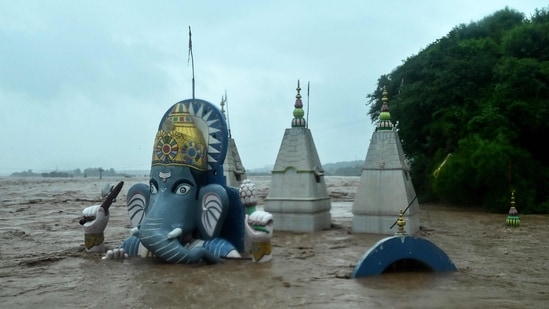
The downpour unleashed flash floods and landslides across Jammu and Kashmir, damaging infrastructure on a massive scale. Bridges collapsed, electricity poles and mobile towers snapped, and communication services broke down, leaving millions cut off.
Traffic on the Jammu-Srinagar and Kishtwar-Doda highways was halted, dozens of hill roads were blocked, and several trains to and from Jammu were cancelled.
The path to the Mata Vaishno Devi shrine on Trikuta Hill was among the worst hit. Around 3 pm, a landslide struck near the Inderprastha Bhojnalaya at Adhkwari, midway along the 12-km trek from Katra. killing 32 people.
Administration said the Himkoti trek route had already been closed since Tuesday morning. The old route remained functional until 1.30 pm, when it too was suspended as a precaution.
Army mobilises three relief columns
Three relief columns of the Army were swiftly mobilised. “One column is assisting in saving lives in Ardhkuwari, Katra. One relief column reached the location of the landslide on the road from Katra to Thakra Kot, and one column is providing assistance south of Jaurian,” said PRO Defence Jammu.
{{/usCountry}}Three relief columns of the Army were swiftly mobilised. “One column is assisting in saving lives in Ardhkuwari, Katra. One relief column reached the location of the landslide on the road from Katra to Thakra Kot, and one column is providing assistance south of Jaurian,” said PRO Defence Jammu.
{{/usCountry}}“Efforts are on to save lives, provide assistance to the needy and take the civilians to safe areas. Close coordination with civil agencies is being carried out,” the PRO Defence added. This comes days after flash floods triggered by a cloudburst in Kishtwar district on August 14 killed 65 people, mostly pilgrims, and left more than 100 injured.
Rain-related casualties
At least four people were reported killed in Doda district, three drowned after slipping into a river, while one died in a house collapse. Hundreds were evacuated from low-lying areas. Officials reported infrastructure damage across Kishtwar, Reasi, Rajouri, Ramban, and Poonch districts.
Jammu and Kashmir chief minister Omar Abdullah termed the situation serious and presided over an emergency meeting. “Instructions have been issued to place additional funds at the disposal of the DCs (deputy commissioners) to cover emergency restoration work and other exigencies,” he said.
Abdullah ordered the timely provision of essentials such as food, water, and medicine and prioritised relief for vulnerable groups.Nearly all water bodies overflowed above danger marks, inundating low-lying areas. The Modhopur barrage on the Ravi river in Kathua crossed the one lakh cusec mark, while the Taranah, Ujh, Tawi, and Chenab rivers also overflowed.
Meteorological data recorded 155.6 mm of rainfall in Kathua, 99.8 mm in Bhaderwah, 81.5 mm in Jammu, and 68.8 mm in Katra within 24 hours.
Administration has warned citizens to avoid water bodies and landslide-prone areas, while the meteorological department predicted sustained moderate to heavy rain with chances of cloudbursts, flash floods, and landslides up to August 27.
Network outages affected all service providers due to damage to optical fibres, complicating emergency responses.
Omar Abdullah on Wednesday said communication remains severely limited, with only a trickle of Jio data, no WiFi, slow browsing, and WhatsApp barely handling short texts, recalling the isolation of 2014 and 2019.
“Still struggling with almost nonexistent communication. There is a trickle of data flowing on Jio mobile but no fixed line WiFi, no browsing, almost no apps, things like X open frustratingly slowly, WhatsApp struggles with anything more than short text messages. Haven’t felt this disconnected since the terrible days of 2014 & 2019,” Omar wrote on X.
Schools closed, exams suspended
All government and private schools in the Jammu division were closed till August 27, with exams for Classes 10 and 11 suspended. Recruitment campaigns for security organisations, including the BSF, were halted.
Northern Railways cancelled 22 trains halting at or departing from Jammu and Katra and short-terminated 27 others due to heavy rainfall. Train services from Pathankot to Kandrori were also suspended due to flash floods at the Chakki River. Services on the Katra-Srinagar stretch continued.
Evacuations and relief operations
In a multi-agency operation led by the Jammu district administration, more than 3,500 residents were evacuated from flood-affected areas. Teams from the district administration, police, NDRF, SDRF, Indian Army, and local volunteers coordinated relief operations and worked to restore essential services.
Community kitchens at Muthi and Satwari provided food, while medical teams were stationed at major relief sites. Temporary shelters, including the Youth Hostel in Jammu, accommodated displaced residents. Efforts to restore power, water supply, and road connectivity are ongoing, with Tehsildar Nagrota overseeing debris clearance.With PTI inputs