E-Paper



Jet rams into medical college hostel, 5 killed
An AI-171 Boeing 787 crashed into BJ Medical College hostel in Ahmedabad, killing 4 students and injuring 19, with several others missing.


It was lunch time at the BJ Medical College hostel in Ahmedabad’s Meghaninagar area. The MBBS students – many between 18 and 22 – shuffled into the mess-cum-dining hall of the five-storey building around 1.30pm. Living in a building that is just 3km from the Sardar Vallabhbhai Patel International Airport, the students were used to the roar of jets.
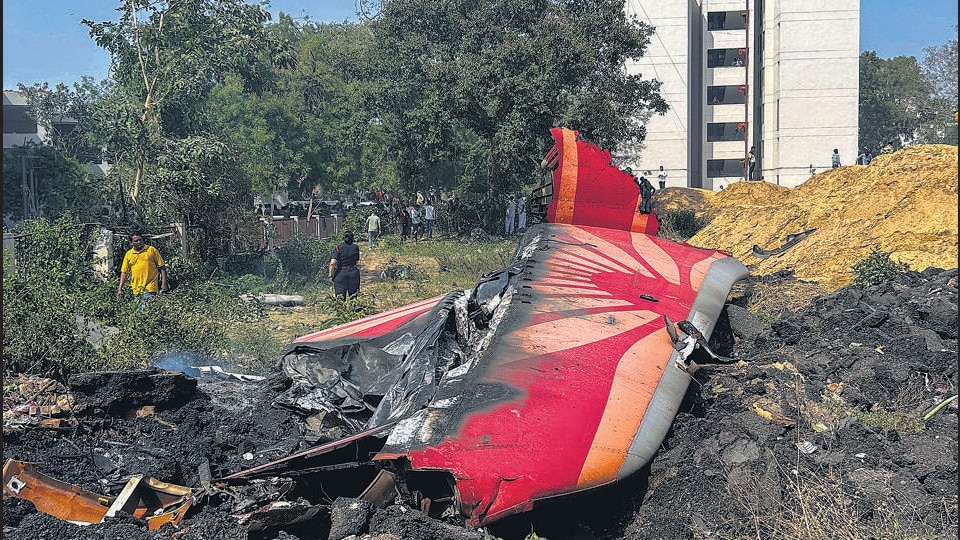
But Thursday was different. At 1.39pm, an AI-171 Boeing 787-8 Dreamliner rammed into the white concrete building, turning the sky orange as it burst into a fireball. Disoriented students struggled to outrun the cloud of black soot and the tall flames, the floor a mess of broken glass, twisted metal, and food buried in ash.
“I was having food with my friends when I heard a loud blast like a crash. Next, I realised that the roof had collapsed and I lay buried underneath. My eyes were closed and I was having difficulty breathing. I thought I would become unconscious but I did not. After about half an hour, I saw that people were moving the debris over me and soon I was rescued,” said a second year MBBS student.
The tail cone of the aircraft with damaged stabilizer fins still attached to it was lodged near the top of the BJ Medical College building.
“While four MBBS students living in the hostel died, 19 were injured. Five of them are serious. Two third-year students are untraceable,” college dean Minakshi Parikh told reporters. “A doctor’s wife was also killed while two relatives of other doctors were injured. Three members of a doctor’s family went missing after the incident. All other doctors and relatives are safe,” said Parikh.
Dhaval Gameti, president of the resident doctors’ association, BJ Medical College, said around 50-60 people were injured in all, and 4-5 relatives of super specialty resident doctors were also unaccounted for.
The entire compound, on which the six buildings of the medical college stood, were hit by the Dreamliner. Four of these buildings were hostels. As night fell, the incident site resembled a war zone. Closer to the hostel buildings, the whiff of burnt aviation turbine fuel was more than evident.
The trees within the compound turned black from the fire. At one spot next to the building, one of the trees fell and smoke continued to billow out of its core. On the terrace of one of the smaller buildings, the overhead water tank was precariously perched on one of the two engines of the ill-fated aircraft.
At the compound’s main gate, what resembles the plane’s emergency door, was partially buried among the boundary wall’s rubble. Surrounding the emergency door were numerous rings which might have been part of the fuselage. Amid all these remnants of the devastation were hundreds of people — first responders, rescuers, police personnel and ordinary people.
Ramila, the mother of a student at the medical college, told ANI her son had gone to the hostel for his lunch break when the plane crashed. “My son is safe, and I have spoken to him. He jumped from the second floor, so he suffered some injuries,” she said.
An official at the Asarwa Civil Hospital said that there were 50-60 students whose condition was stable while there were three others who were being treated in the ICU. “About 4-5 students are missing and they could have not survived the crash,” he added.
Amisha Patel, a 25-year-old worker employee in the pharmacy department of the Civil Hospital, said she visited the hostel along with her friend to have lunch.
“Suddenly there was a crash. The area was fully covered with smoke. I panicked and jumped from the third floor. I have sustained multiple fractures including one in my left leg,” said Patel. She said that while her friend managed to escape unhurt using the staircase, many other students who were eating at the mess were injured.
“The plane was flying very low before it crashed,” eyewitness Haresh Shah told PTI. “As it crashed into the building, the sound was like a blast, and the plane and the building caught fire,” he said. Local residents were the first to reach the site and try to save the passengers as well as those in the building. Initial footage shot by residents on mobile phones showed charred bodies among the debris.
“The plane crashed in the dining hall of the hostel where people were present. Many of them were injured and taken to hospital,” said another eye-witness, requesting anonymity.
Red and blue emergency lights flashed as Indian Army and NDRF teams, in yellow vests, searched the rubble. Asarwa Civil Hospital, meters away, had its 1,200-bed Women and Children Hospital spared. Sparks from rescue tools glowed against the gray, charred ruins of collapsed roofs.